Gold slips from recent highs as risk sentiment improves, US Dollar firms
- Gold pulls back from recent highs as US-Japan trade deal boosts sentiment.
- US Dollar strength and rising yields limit gains for bullion but Fed policy uncertainty and trade tensions limit losses.
- XAU/USD hovers above $3,400 while the precious metal remains vulnerable to shifts in risk sentiment and the broader outlook for the US Dollar.

Gold is undergoing a modest pullback on Wednesday, as markets assess the implications of a United States (US)–Japan trade agreement and remain cautious ahead of further developments in the European Union (EU)–US negotiations.
Despite the correction, XAU/USD is holding above the $3,400 mark, supported by lingering tariff risks and broader policy uncertainty.
US President Donald Trump announced on Wednesday that a “massive deal” had been reached with Japan, outlining key terms in a Truth Social post.
The agreement includes a reduced 15% reciprocal tariff on Japanese goods, down from a proposed 25%. The deal is also expected to entail plans for $550 billion in Japanese investment and expanded US access to Japan’s agricultural and automotive markets.
The deal has helped calm some trade-related fears, reducing short-term safe-haven flows into Gold.
However, underlying support for gold remains intact. Markets remain wary of unresolved trade tensions, ahead of the August 1 tariff deadline and ongoing questions around Fed independence.
Daily digest market movers: Gold retains its appeal amid ongoing Fed uncertainty and unresolved tariff risks
- Existing Home Sales data released on Wednesday reflected a decline in the estimated value of the housing market. The recent data showed that US existing home sales fell to an annualized rate of 3.93 million in June. These figures were below the 4.01 million forecast, representing a 2.7% monthly decline, which may be a potential sign that high mortgage rates and affordability issues are filtering through to the housing market.
- At the same time, EU-US trade talks remain unresolved, with less than two weeks until the August 1 tariff deadline. If no agreement is reached, the US may impose broad-based tariffs of up to 30% on EU imports. This has prompted the European Union to prepare retaliatory measures targeting key US exports, including digital services and aerospace products.
- Apart from trade talks, policy uncertainty and mounting pressure on the Federal Reserve (Fed) to cut rates have put pressure on Yields, limiting gains in the US Dollar. US President Trump has consistently and very publicly called for the Fed to dramatically lower interest rates, often stating they should be at 1% or even lower.
- In a meeting with Philippine President Ferdinand Marcos on Tuesday, Trump stated that Powell has "done a bad job, but he's going to be out pretty soon." Comments from Treasury Secretary Scott Bessent also suggested that it might be time to "examine the entire institution and whether they've been successful.” He proposed a framework for the Fed's non-monetary functions due to concerns over "mission creep" and building renovation overruns.
- Some critics also point to the Fed's practice of paying interest on bank reserves as a "perverse" structure that subsidizes banks and has led to the Fed operating at a loss.
- With the Fed currently in a blackout period ahead of the July 30 rate decision, criticism from Trump and concerns surrounding Fed Independence have enhanced the appeal of Gold.
Gold technical analysis: XAU/USD consolidates near five-week highs, holds above $3,400
Gold (XAU/USD) is currently trading near $3,412 at the time of writing, retreating modestly from its five-week intraday high of $3,439. Despite the pullback, the metal remains well supported above the psychological $3,400 level, following a breakout from a multi-week ascending triangle formation.
The Relative Strength Index (RSI) is currently hovering around 63 on the daily chart, indicating that momentum remains positive but is not yet overbought.
If bulls maintain control, a retest of the June swing high of $3,452 appears likely, with potential for further upside toward the all-time high and psychological $3,500 level.
On the downside, immediate support is seen at the $3,400 round level, followed by the 23.6% Fibonacci retracement of the April low-high move at $3,371 and the 50-day SMA at $3,336. A break below the triangle apex and the 38.2% Fibonacci level at $3,292 would invalidate the near-term bullish structure.
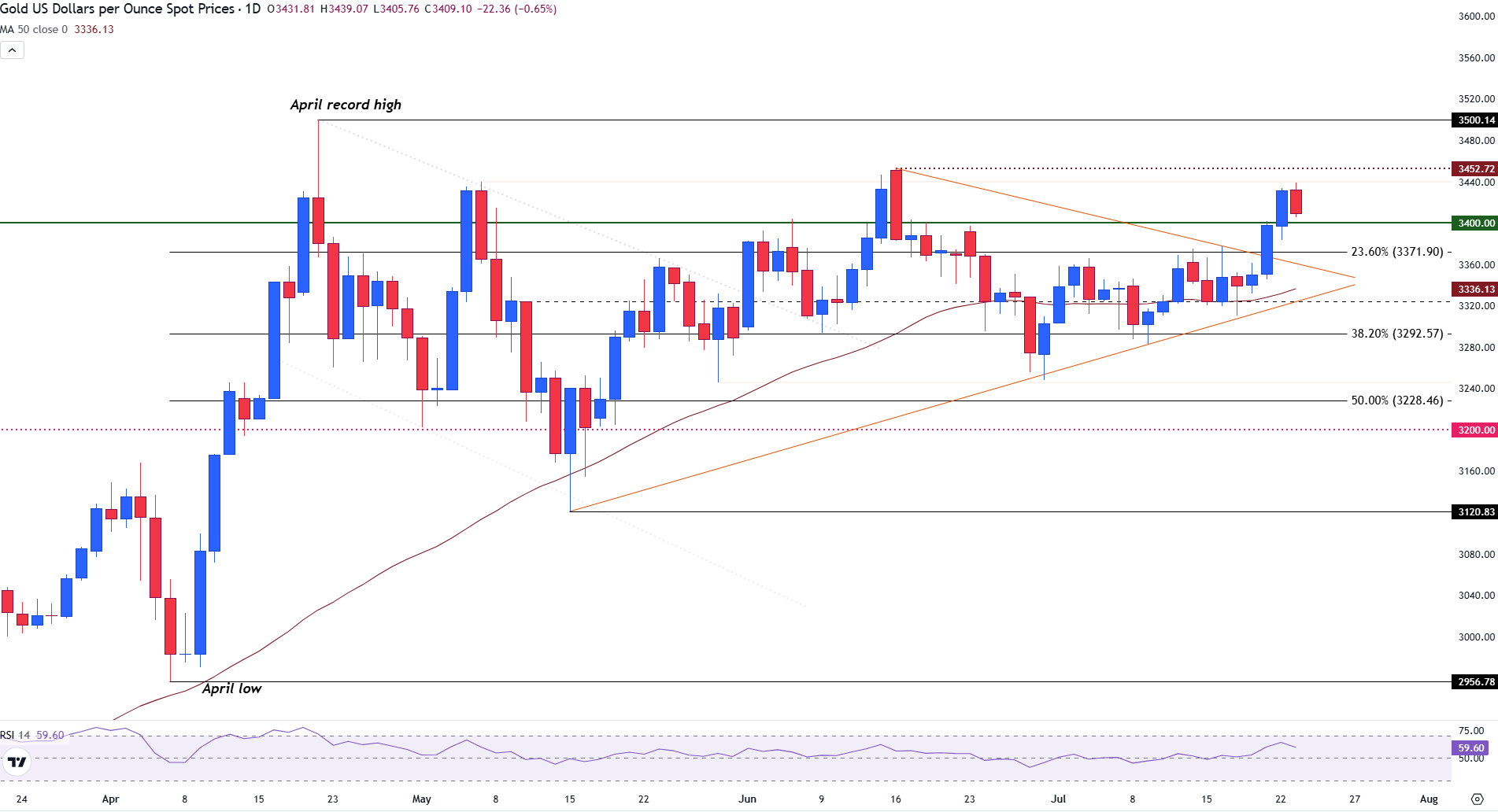
Gold daily chart
US Dollar FAQs
The US Dollar (USD) is the official currency of the United States of America, and the ‘de facto’ currency of a significant number of other countries where it is found in circulation alongside local notes. It is the most heavily traded currency in the world, accounting for over 88% of all global foreign exchange turnover, or an average of $6.6 trillion in transactions per day, according to data from 2022. Following the second world war, the USD took over from the British Pound as the world’s reserve currency. For most of its history, the US Dollar was backed by Gold, until the Bretton Woods Agreement in 1971 when the Gold Standard went away.
The most important single factor impacting on the value of the US Dollar is monetary policy, which is shaped by the Federal Reserve (Fed). The Fed has two mandates: to achieve price stability (control inflation) and foster full employment. Its primary tool to achieve these two goals is by adjusting interest rates. When prices are rising too quickly and inflation is above the Fed’s 2% target, the Fed will raise rates, which helps the USD value. When inflation falls below 2% or the Unemployment Rate is too high, the Fed may lower interest rates, which weighs on the Greenback.
In extreme situations, the Federal Reserve can also print more Dollars and enact quantitative easing (QE). QE is the process by which the Fed substantially increases the flow of credit in a stuck financial system. It is a non-standard policy measure used when credit has dried up because banks will not lend to each other (out of the fear of counterparty default). It is a last resort when simply lowering interest rates is unlikely to achieve the necessary result. It was the Fed’s weapon of choice to combat the credit crunch that occurred during the Great Financial Crisis in 2008. It involves the Fed printing more Dollars and using them to buy US government bonds predominantly from financial institutions. QE usually leads to a weaker US Dollar.
Quantitative tightening (QT) is the reverse process whereby the Federal Reserve stops buying bonds from financial institutions and does not reinvest the principal from the bonds it holds maturing in new purchases. It is usually positive for the US Dollar.
which may be a potential sign that high mortgage rates and affordability issues are
Author

Tammy Da Costa, CFTe®
FXStreet
Tammy is an economist and market analyst with a deep passion for financial markets, particularly commodities and geopolitics.
















