Gold bulls retain control near record high amid flight to safety, dovish Fed
- Gold extends its record-setting run on Thursday amid a supportive fundamental backdrop.
- Fresh US-China trade tensions and geopolitical risks underpin the safe-haven precious metal.
- Fed rate cut bets and US government closure weigh on the USD, offering additional support.

Gold (XAU/USD) sticks to its bullish bias through the first half of the European session and currently trades near the all-time peak touched earlier this Thursday amid a supportive fundamental backdrop. Worries about economic risks stemming from a prolonged US government shutdown, renewed US-China trade conflict, and rising geopolitical tensions continue to act as a tailwind for the safe-haven precious metal.
Furthermore, the growing acceptance that the US Federal Reserve (Fed) will lower borrowing costs two more times this year keeps the US Dollar (USD) depressed for the third straight day and lends additional support to the non-yielding Gold. The XAU/USD bulls, meanwhile, seem rather unaffected by extremely overbought conditions and a positive risk tone, which backs the case for a further appreciating move.
Daily Digest Market Movers: Gold continues to draw support from a combination of factors
- The partial federal government shutdown has extended into a third week, with no resolution in sight. The vote on the Republican-backed stopgap funding bill to reopen the government fell short of the votes needed for passage in the Senate for the ninth time on Wednesday.
- Investors seem worried that a prolonged US government closure would affect the economic performance. A Treasury official said that the shutdown may cost the US economy $15 billion a week in lost output, correcting an earlier statement from Treasury Secretary Scott Bessent.
- U.S.-China trade tensions escalated further after both sides imposed tit-for-tat port fees this week. Adding to this, US President Donald Trump said that he was considering terminating the cooking oil trade with China in retaliation to the latter's refusal to purchase American soybeans.
- Trump said that he saw the US as locked in an all-out trade war with China. However, US Treasury Secretary Scott Bessent proposed a pause of import duties on Chinese goods for longer than three months if China halts its plan for strict export controls on rare-earth elements.
- On the geopolitical front, US Defense Secretary Pete Hegseth warned Russia of possible costs for its continued aggression if the war in Ukraine does not come to an end. Moreover, Trump had said that he is considering providing Ukraine with longer-range Tomahawk cruise missiles.
- US Federal Reserve Chair Jerome Powell struck a dovish tone on Tuesday, saying that the labor market remained mired in its low-hiring, low-firing doldrums through September. This reaffirms market bets for a 25-basis-point Fed rate cut at each of the October and December meetings.
- The US Dollar prolongs its downtrend for the third straight day and drops to an over one-week low during the Asian session on Thursday. This contributes to an extension of the recent record-setting run in the Gold price and backs the case for a further near-term appreciating move.
- In the absence of any major market-moving economic releases, speeches from a slew of influential FOMC members will be scrutinized for rate-cut cues. This will play a key role in driving the USD demand and providing some meaningful impetus to the non-yielding yellow metal.
Gold bulls not ready to give up yet despite extremely overbought conditions
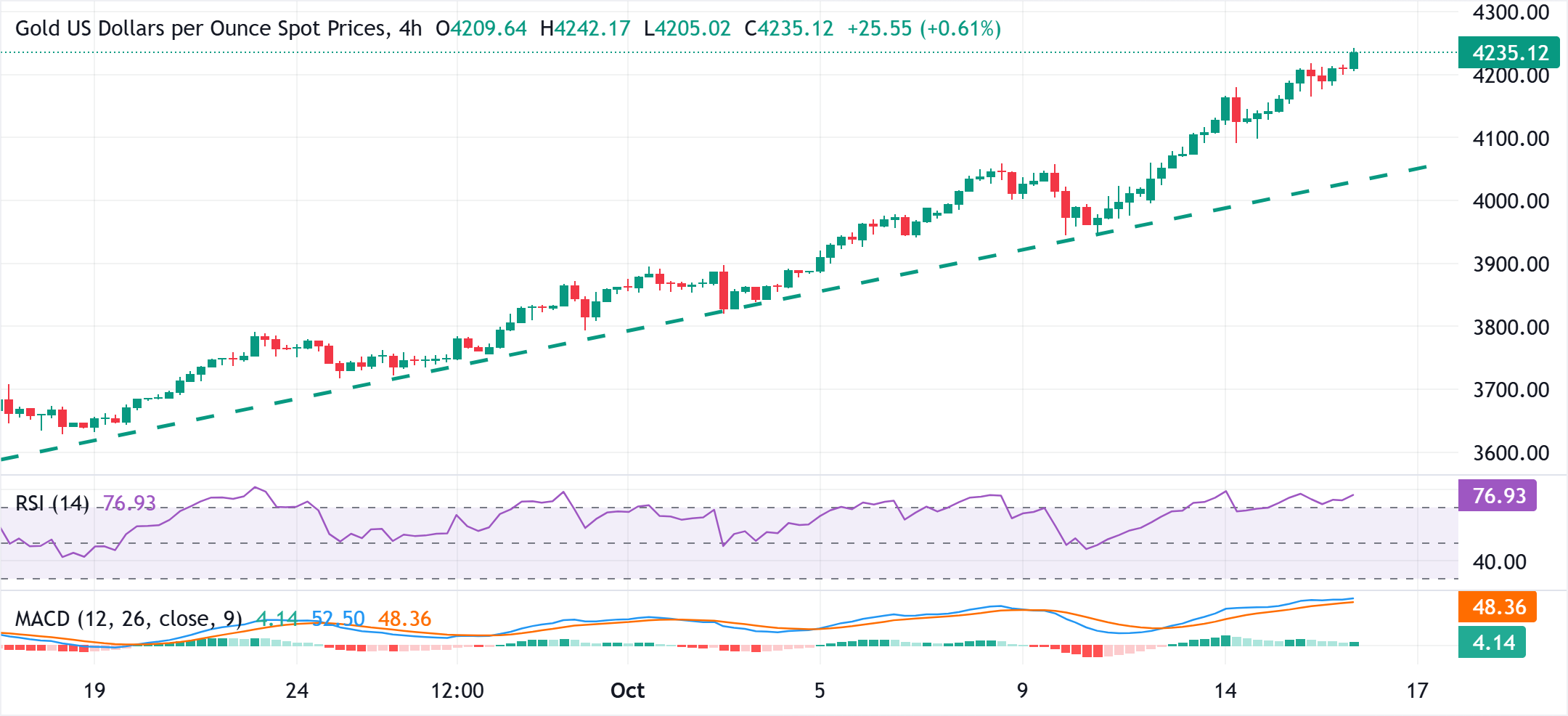
The XAU/USD pair has been trending higher along an upward-sloping trend line over the past month or so. Furthermore, the overnight sustained break and acceptance above the $4,200 round figure could be seen as a fresh trigger for bulls. However, an extremely overbought daily Relative Strength Index (RSI) warrants caution before positioning for a further appreciating move.
Meanwhile, any corrective pullback could attract some buyers near the $4,200 mark, which, in turn, should limit the downside for the Gold near the $4,180-4,175 region. A convincing break below the latter, however, might prompt some technical selling and drag the commodity to the $4,135-4,135 intermediate support en route to the $4,100 mark. The next relevant support is pegged near the $4,060-4,055 region, which, if broken decisively, could be seen as the first sign that the XAU/USD pair has topped out in the near term.
Risk sentiment FAQs
In the world of financial jargon the two widely used terms “risk-on” and “risk off'' refer to the level of risk that investors are willing to stomach during the period referenced. In a “risk-on” market, investors are optimistic about the future and more willing to buy risky assets. In a “risk-off” market investors start to ‘play it safe’ because they are worried about the future, and therefore buy less risky assets that are more certain of bringing a return, even if it is relatively modest.
Typically, during periods of “risk-on”, stock markets will rise, most commodities – except Gold – will also gain in value, since they benefit from a positive growth outlook. The currencies of nations that are heavy commodity exporters strengthen because of increased demand, and Cryptocurrencies rise. In a “risk-off” market, Bonds go up – especially major government Bonds – Gold shines, and safe-haven currencies such as the Japanese Yen, Swiss Franc and US Dollar all benefit.
The Australian Dollar (AUD), the Canadian Dollar (CAD), the New Zealand Dollar (NZD) and minor FX like the Ruble (RUB) and the South African Rand (ZAR), all tend to rise in markets that are “risk-on”. This is because the economies of these currencies are heavily reliant on commodity exports for growth, and commodities tend to rise in price during risk-on periods. This is because investors foresee greater demand for raw materials in the future due to heightened economic activity.
The major currencies that tend to rise during periods of “risk-off” are the US Dollar (USD), the Japanese Yen (JPY) and the Swiss Franc (CHF). The US Dollar, because it is the world’s reserve currency, and because in times of crisis investors buy US government debt, which is seen as safe because the largest economy in the world is unlikely to default. The Yen, from increased demand for Japanese government bonds, because a high proportion are held by domestic investors who are unlikely to dump them – even in a crisis. The Swiss Franc, because strict Swiss banking laws offer investors enhanced capital protection.
Author

Haresh Menghani
FXStreet
Haresh Menghani is a detail-oriented professional with 10+ years of extensive experience in analysing the global financial markets.