Gold surges on risk-off mood, poor US data boosts Fed easing odds
- XAU/USD trades at $3,386, extending rally on Fed rate cut speculation.
- US jobless claims top 240K for second week; inflation cools.
- Israel reportedly weighing military strike on Iran adds to geopolitical risk.

Gold price rallies for the second straight day, shy of testing the $3,400 figure following the release of softer inflation and jobs data in the United States (US) as geopolitical tensions grow in the Middle East. The XAU/USD trades at $3,386 at the time of writing.
Market mood remains upbeat, following back-to-back positive inflation reports in the US, which are pressuring the Federal Reserve (Fed) to reduce interest rates as the economy has yet to show the full impact of tariffs on prices. The labor market continues to exhibit some weakness, as the number of Americans filing for unemployment claims surpassed 240,000 for the second consecutive week.
Aside from this, ABC reported that Israel is considering taking military action against Iran in the coming days. In the meantime, US Senior Advisor Steve Witkoff will meet Iranian officials this weekend in Oman.
Regarding trade policy, the US and China agreed to a framework on Wednesday, revealed the US Commerce Secretary Howard Lutnick. The agreement is pending approval from President Donald Trump and Chinese President Xi Jinping.
Ahead of this week, the US economic docket will feature the University of Michigan (UoM) Consumer Sentiment for June. Next week, traders' focus shifts to the Federal Reserve’s (Fed) monetary policy meeting on June 17-18.
Daily digest market movers: Gold price surges as the Greenback and US yields tumble
- The Greenback plunges to three-year lows, according to the US Dollar Index (DXY). The DXY, which tracks the value of the Dollar against a basket of peers, fell 0.60% to 97.99 after hitting a multi-year low of 97.60.
- US Treasury yields are falling as the US 10-year Treasury yield has dropped five basis points (bps) to 4.367%. US real yields followed suit, losing five basis points to 2.097%, boosting Bullion’s advance.
- US Producer Price Index (PPI) in May rose 2.6% YoY, a tenth above April’s reading of 2.5%. Core PPI – which excludes volatile items like food and energy – dipped from 3.1% to 3% YoY.
- Every month, the PPI was mainly muted, rising 0.1% MoM below the 0.2% expected by the consensus. Excluding food and energy, PPI rose 0.1%, down from 0.3%.
- Geopolitical tensions remain high as acknowledged by US President Trump, who said that Israel could strike Iran in the coming days. Sources cited by The Washington Post noted that US intelligence officials are increasingly concerned about Israel striking Iran without Washington's approval.
- Money markets suggest that traders are pricing in 51 basis points of easing toward the end of the year, according to Prime Market Terminal data.
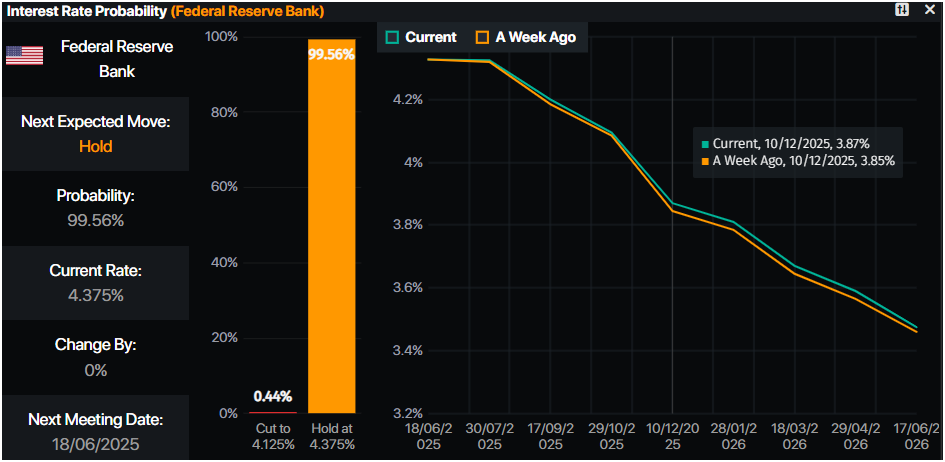
Source: Prime Market Terminal
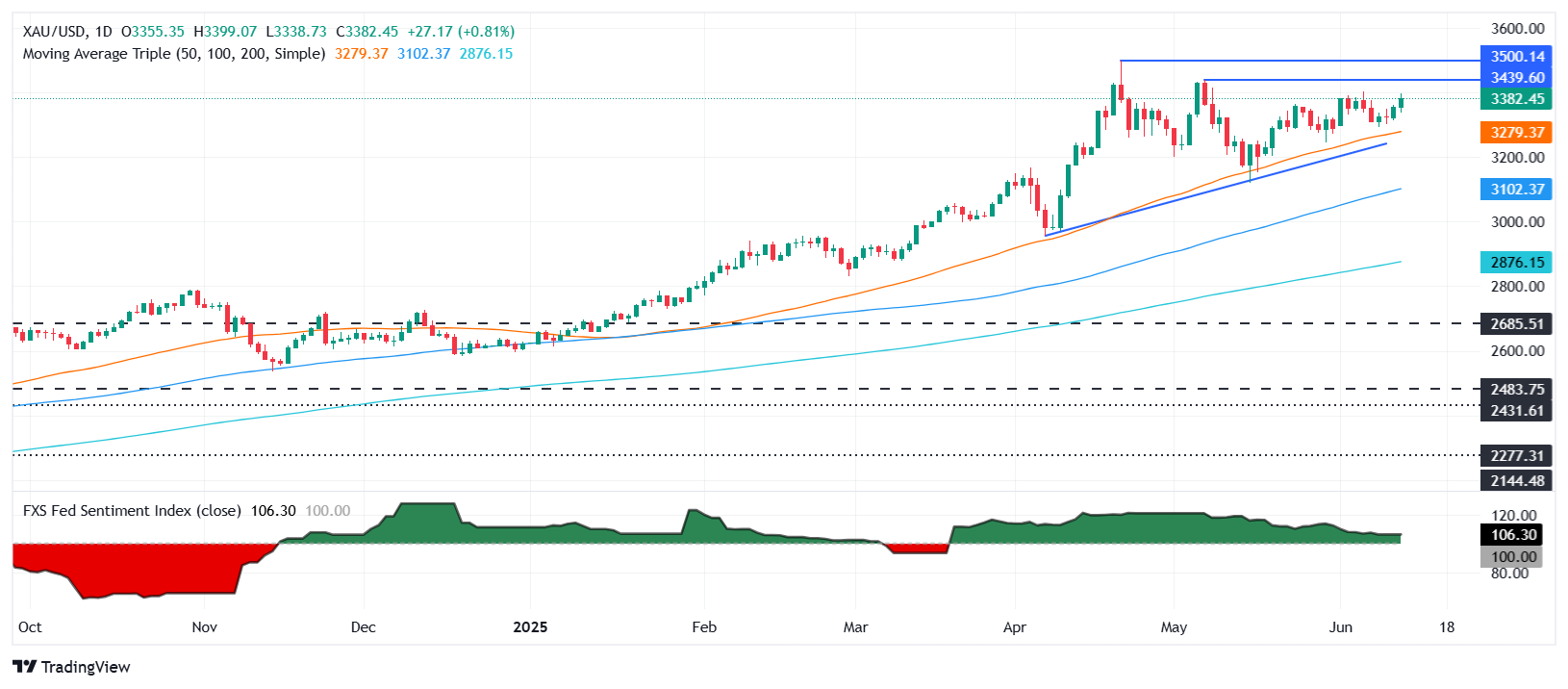
XAU/USD technical outlook: Gold price consolidates near $3,400
Gold price appears poised to test higher levels in the near term as price action remains constructive. The yellow metal has printed a successive series of higher highs and higher lows, trading near the $3,400 figure, which, once cleared, could open the door for further gains.
The Relative Strength Index (RSI) is bullish and has cleared the latest peak, indicating that buyers are gathering momentum. Therefore, if XAU/USD extends its gains past $3,400, it could test key resistance levels. Up next lies the $3,450 mark, followed by the record high of $3,500.
Conversely, if Gold falls below $3,300, look for downward pressure pushing XAU/USD towards the 50-day Simple Moving Average (SMA) at $3,275, ahead of the April 3 high-turned-support at $3,167.
US-China Trade War FAQs
Generally speaking, a trade war is an economic conflict between two or more countries due to extreme protectionism on one end. It implies the creation of trade barriers, such as tariffs, which result in counter-barriers, escalating import costs, and hence the cost of living.
An economic conflict between the United States (US) and China began early in 2018, when President Donald Trump set trade barriers on China, claiming unfair commercial practices and intellectual property theft from the Asian giant. China took retaliatory action, imposing tariffs on multiple US goods, such as automobiles and soybeans. Tensions escalated until the two countries signed the US-China Phase One trade deal in January 2020. The agreement required structural reforms and other changes to China’s economic and trade regime and pretended to restore stability and trust between the two nations. However, the Coronavirus pandemic took the focus out of the conflict. Yet, it is worth mentioning that President Joe Biden, who took office after Trump, kept tariffs in place and even added some additional levies.
The return of Donald Trump to the White House as the 47th US President has sparked a fresh wave of tensions between the two countries. During the 2024 election campaign, Trump pledged to impose 60% tariffs on China once he returned to office, which he did on January 20, 2025. With Trump back, the US-China trade war is meant to resume where it was left, with tit-for-tat policies affecting the global economic landscape amid disruptions in global supply chains, resulting in a reduction in spending, particularly investment, and directly feeding into the Consumer Price Index inflation.
Author

Christian Borjon Valencia
FXStreet
Markets analyst, news editor, and trading instructor with over 14 years of experience across FX, commodities, US equity indices, and global macro markets.

















