Gold rallies past $4,200 on safe-haven rush amid US political, trade chaos
- Gold hits $4,218 as Trump hints at cutting trade ties with China, further escalating tensions.
- Powell’s dovish stance and Beige Book reveal stagflation fears, boosting demand for safe assets.
- Gold's year-to-date gains exceed 60% as central bank buying and ETF inflows underpin the rally.

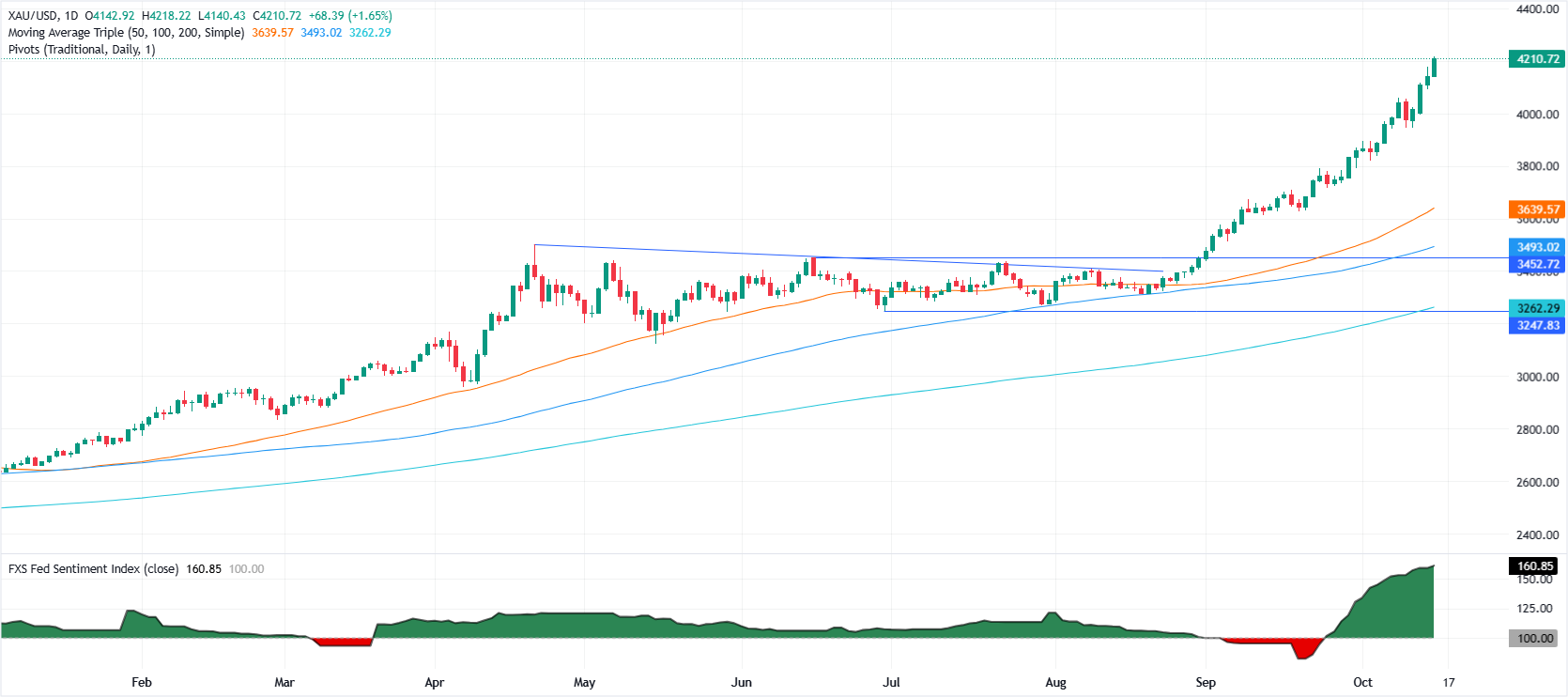
Gold (XAU/USD) price rallies for the fourth consecutive trading day on Wednesday, up by more than 1.40% and hitting a record high of $4,218 as the trade-war escalates and geopolitical uncertainty pushes investors to the safe-haven metal.
Bullion soars to fresh record amid geopolitical turmoil, dovish Fed tone and mounting global uncertainty
Uncertainty over the trade agreement between Washington and Beijing keeps the Bullion bullish trade in play. US President Donald Trump said that he was considering cutting some trade ties with China after both countries imposed port fees this week.
Year to date, the Gold price has risen over 60%, due to geopolitical uncertainty, rate cut expectations by the Federal Reserve (Fed), central bank buying and strong ETF inflows.
Earlier, the US Treasury Secretary Scott Bessent proposed a truce on tariffs on Chinese products, aimed to resolve rare-earth issues, but Gold traders shrugged off his comments and drove the yellow metal past the $4,200 milestone for the first time.
On Tuesday, Fed Chair Jerome Powell was dovish, acknowledged the weakness of the labor market, and added that the central bank should move to more “neutral” interest rates.
Data-wise, the Fed revealed the Beige Book, ahead of the October 28-29 meeting. Regarding the labor market, employment levels remained stable, while hiring was muted across districts and sectors. Additionally, the book had shown signs of stagflation, as the economy stagnates amid a high inflation scenario.
In the meantime, Gold prices are set to continue rallying, amid a scarce US economic docket. Adding to the safe-haven bid, the ongoing US government shutdown reached its fifteenth day and shows no signs of an agreement between the White House and Democrats.
Daily market movers: Gold rallies amid US Dollar weakness
- Bullion prices are underpinned by US Dollar weakness. The US Dollar Index (DXY), which tracks the performance of the buck’s value against a basket of six currencies, is down 0.28% to 98.75.
- Conversely, the US 10-year Treasury note yield is flat at around 4.04%. US real yields — which correlate inversely to Gold prices — are also steady at 1.74%.
- US Treasury Secretary Scott Bessent proposed a longer pause on high tariffs on Chinese products, in exchange for the recently tightened limits imposed by Beijing on critical rare earths. “Is it possible that we could go to a longer roll in return? Perhaps. But all that’s going to be negotiated in the coming weeks,” he said in a press conference in Washington.
- On Tuesday, Fed Chair Powell said that, based on the data available, “the outlook for employment and inflation does not appear to have changed much since our September meeting four weeks ago.” Furthermore, added that data shows that economic activity might be firmer than expected. He added that risks to the labor market had increased, along with inflationary pressures.
- Powell said that elevated inflation is due to rising goods prices, which reflect “tariffs rather than broader inflationary pressures.
- The Fed will receive an update on consumer price inflation on October 24. The US Bureau of Labor Statistics announced that it will release its latest Consumer Price Index (CPI) report amid the ongoing shutdown.
- Traders are assigning a 98% probability to a 25-basis-point rate cut at the Federal Reserve’s October meeting, followed by another fully priced-in 25-bps reduction in December.
Technical outlook: Gold’s price remains buoyant, poised to test $4,300
Gold maintains a bullish bias even as it consolidates below record highs near $4,218. Momentum continues to favor buyers, with the Relative Strength Index (RSI) staying firmly in bullish territory — a sign that upward pressure remains strong.
A break above the previous high would expose resistance at $4,250, followed by $4,300 and $4,350. Conversely, a daily close below $4,200 could trigger a pullback, with initial support seen at $4,150 and $4,100. A drop below this level would target the former all-time high of $4,059, followed by $4,000.
Gold FAQs
Gold has played a key role in human’s history as it has been widely used as a store of value and medium of exchange. Currently, apart from its shine and usage for jewelry, the precious metal is widely seen as a safe-haven asset, meaning that it is considered a good investment during turbulent times. Gold is also widely seen as a hedge against inflation and against depreciating currencies as it doesn’t rely on any specific issuer or government.
Central banks are the biggest Gold holders. In their aim to support their currencies in turbulent times, central banks tend to diversify their reserves and buy Gold to improve the perceived strength of the economy and the currency. High Gold reserves can be a source of trust for a country’s solvency. Central banks added 1,136 tonnes of Gold worth around $70 billion to their reserves in 2022, according to data from the World Gold Council. This is the highest yearly purchase since records began. Central banks from emerging economies such as China, India and Turkey are quickly increasing their Gold reserves.
Gold has an inverse correlation with the US Dollar and US Treasuries, which are both major reserve and safe-haven assets. When the Dollar depreciates, Gold tends to rise, enabling investors and central banks to diversify their assets in turbulent times. Gold is also inversely correlated with risk assets. A rally in the stock market tends to weaken Gold price, while sell-offs in riskier markets tend to favor the precious metal.
The price can move due to a wide range of factors. Geopolitical instability or fears of a deep recession can quickly make Gold price escalate due to its safe-haven status. As a yield-less asset, Gold tends to rise with lower interest rates, while higher cost of money usually weighs down on the yellow metal. Still, most moves depend on how the US Dollar (USD) behaves as the asset is priced in dollars (XAU/USD). A strong Dollar tends to keep the price of Gold controlled, whereas a weaker Dollar is likely to push Gold prices up.
Author

Christian Borjon Valencia
FXStreet
Markets analyst, news editor, and trading instructor with over 14 years of experience across FX, commodities, US equity indices, and global macro markets.
















