Gold rallies past $4,100 as dovish Fed sparks December cut frenzy
- Gold surges towards $4,100 after Fed officials signal openness to a December rate cut, boosting dovish bets.
- Market pricing for a December 25 bps cut jumps to 71% as Miran and Williams hint easing may be warranted.
- US data shows resilient activity but weak consumer sentiment, reinforcing uncertainty over the Fed’s next policy move.

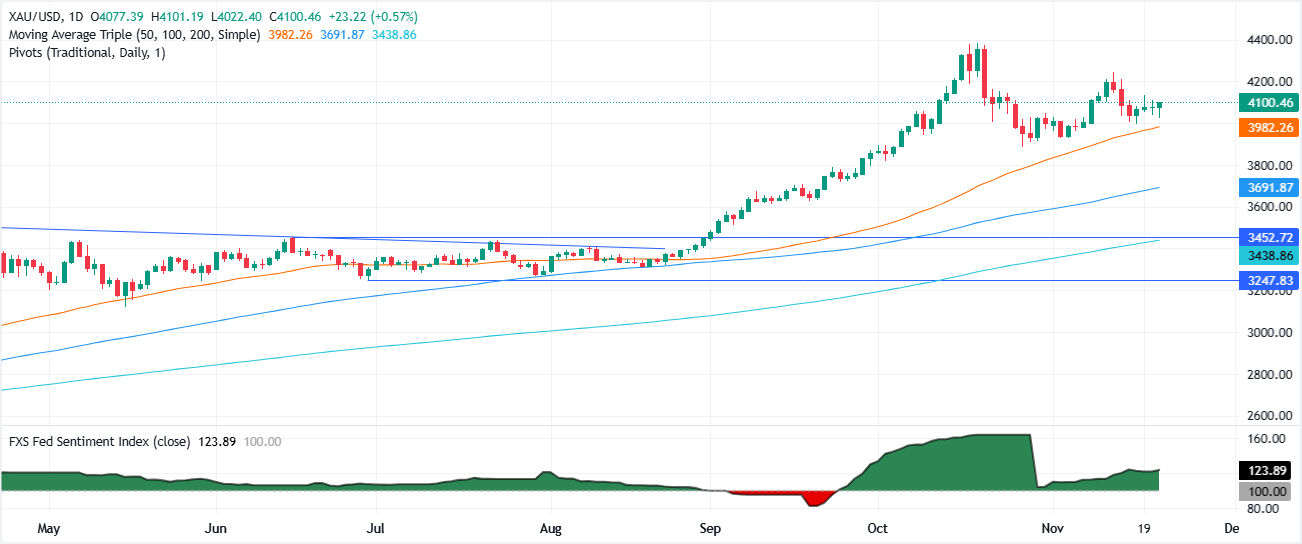
Gold (XAU/USD) remains steady during the North American session on Friday as a Federal Reserve (Fed) officials opened the door for a cut at the December meeting. At the time of writing, XAU/USD trades at $4,096, up by 0.53%, after hitting a daily high of $4,101.
XAU/USD edges higher despite mixed US data, sharply shifting rate cut expectations
Bullion has remained fluctuating during the last three days, as traders seem undecided on XAU’s next move. Speeches by Fed officials and the resumption of US economic data hint that the economy is solid, with a resilient labor market but elevated prices.
Comments from New York Fed John Williams and Governor Stephen Miran were dovish, prompting investors to increase the odds of a 25-bps rate cut at the December meeting. Conversely, Boston Fed Susan Collins and Dallas Lorie Logan opted to maintain a restrictive policy, holding rates unchanged.
Consequently, market participants see a 71% chance of a December rate cut, a sharp jump from around 31% earlier in the day.
The US economic docket showed that business activity remains firm, while Consumer Sentiment for November fell close to its record low, according to the University of Michigan. At the same time, inflation expectations were downwardly revised for one and a five-year period.
Daily market movers: Mixed US economic data, ignored by Gold bulls
- New York Fed John Williams said they can still cut rates in the “near-term”, which boosted odds for a December move. Echoing some of his words was Governor Stephen Miran, who said that Thursday’s Nonfarm Payrolls data favors a December rate cut, and that if his vote was the marginal one, he “would vote for a 25-bps cut.”
- Dallas Fed Lorie Logan said that rates need to be on hold “for a time” while they assess the impact of current policy on inflation. She said she finds it “difficult” to cut in December. Boston Fed Susan Collins coincided with Logan adding that “restrictive policy is very appropriate right now.”
- The US S&P Global Manufacturing PMI dipped from 52.5 to 51.9 in November, slightly below the 52 estimates. Conversely, the Services PMI improved from 54.8 to 55, above forecasts of 54.8. Survey comments showed that business confidence has improved, and that hopes for additional rate cuts and the government reopening “improved economic optimism.”
- The University of Michigan Consumer Sentiment Index for November improved slightly to 51 from a preliminary 50.3, but declined compared to the 53.6 of the previous month and remains close to the record low of June 2022. Inflation expectations edged lower, for one year, from a preliminary 4.7% to 4.5%, and for five years, from 3.6% to 3.4%.
- The US Bureau of Labor Statistics (BLS) revealed on Thursday that Nonfarm Payrolls for September rose by 119K, doubling estimates of 50,000. Despite registering a solid number, the Unemployment Rate jumped from 4.3% to 4.4% but it remained within the Federal Reserve’s projections.
- The US Dollar Index (DXY), which tracks the buck’s performance versus six currencies, registers modest gains of 0.07% at 100.28. At the same time, US Treasury yields remain steady, with the 10-year US Treasury note yield standing at 4.08%. US real yields, which correlate inversely to Gold prices, are falling two basis points to 1.84%.
Technical analysis: Gold bulls stepped in, pushing prices toward $4,100
Gold’s uptrend is resuming, but traders must achieve a daily close above $4,100. Once reached, the next stop would be $4,150 before testing the last cycle high of $4,245, November’s 13 peak.
Failure at $4,100 would expose $4,050 before diving to the November 18 swing low of $3,998, ahead of testing the 50-day Simple Moving Average (SMA) at $3,981.
Gold FAQs
Gold has played a key role in human’s history as it has been widely used as a store of value and medium of exchange. Currently, apart from its shine and usage for jewelry, the precious metal is widely seen as a safe-haven asset, meaning that it is considered a good investment during turbulent times. Gold is also widely seen as a hedge against inflation and against depreciating currencies as it doesn’t rely on any specific issuer or government.
Central banks are the biggest Gold holders. In their aim to support their currencies in turbulent times, central banks tend to diversify their reserves and buy Gold to improve the perceived strength of the economy and the currency. High Gold reserves can be a source of trust for a country’s solvency. Central banks added 1,136 tonnes of Gold worth around $70 billion to their reserves in 2022, according to data from the World Gold Council. This is the highest yearly purchase since records began. Central banks from emerging economies such as China, India and Turkey are quickly increasing their Gold reserves.
Gold has an inverse correlation with the US Dollar and US Treasuries, which are both major reserve and safe-haven assets. When the Dollar depreciates, Gold tends to rise, enabling investors and central banks to diversify their assets in turbulent times. Gold is also inversely correlated with risk assets. A rally in the stock market tends to weaken Gold price, while sell-offs in riskier markets tend to favor the precious metal.
The price can move due to a wide range of factors. Geopolitical instability or fears of a deep recession can quickly make Gold price escalate due to its safe-haven status. As a yield-less asset, Gold tends to rise with lower interest rates, while higher cost of money usually weighs down on the yellow metal. Still, most moves depend on how the US Dollar (USD) behaves as the asset is priced in dollars (XAU/USD). A strong Dollar tends to keep the price of Gold controlled, whereas a weaker Dollar is likely to push Gold prices up.
Author

Christian Borjon Valencia
FXStreet
Markets analyst, news editor, and trading instructor with over 14 years of experience across FX, commodities, US equity indices, and global macro markets.