Gold holds steady above $2,900 as Trump reinstates tariffs on metals
- Gold reaches new high as US 25% tariffs on steel and aluminum stoke fears of global economic slowdown and inflation.
- Market sentiment remains unexpectedly positive, with Wall Street up and the US Dollar strengthening alongside Gold.
- Upcoming testimony from Fed Chair Jerome Powell and key US economic reports to influence gold's next moves.

Gold price rallied sharply and set a record high above $2,900 on Monday after the President of the United States (US), Donald Trump, enacted tariffs of 25% on base metals. Traders seeking safety pushed the non-yielding metal higher amid fears that Trump trade policies could derail the global economy and drive inflation higher.
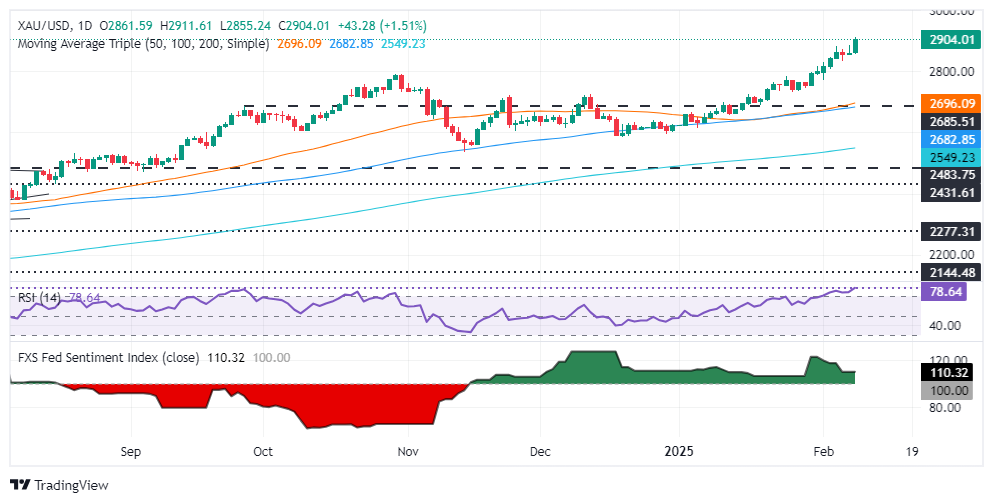
The XAU/USD pair trades at $2,905 after hitting an all-time high of $2,911. On Sunday, Trump said that steel and aluminum imports into the US are set to be hit by 25% duties, including proceeds from Canada, the United Arab Emirates (UAE) and Mexico. This pushed Gold prices higher, with bulls finally clearing the $2,900 barrier and setting their sights on $3,000 a troy ounce.
Despite this, the market mood remains positive as Wall Street remains in positive territory. The Greenback also climbs alongside Gold, while US Treasury bond yields remain steady, which is usually a headwind for the prices of precious metals.
Bullion has also benefited from central bank demand. The World Gold Council (WGC) revealed that banks bought more than 1,000 tons for the third year in a row in 2024. After Trump’s victory, purchases by central banks grew over 54% YoY to 333 tons, the WGC calculated.
Despite this, Federal Reserve (Fed) officials are turning slightly cautious, which has kept Gold prices from appreciating sharply. Fed Chairman Jerome Powell's testimony in the US Congress will be scrutinized by traders. Any hawkish hints could weigh on the yellow metal.
The US economic docket will feature Fed speakers, inflation figures, employment data and Retail Sales.
Daily digest market movers: Gold price poised to hit $3,000
- The US 10-year Treasury bond yield stays firm at 4.489%.
- US real yields, which correlate inversely to Bullion prices, drop one basis point to 2.055%, a tailwind for XAU/USD.
- The New York Fed Survey of Consumer Expectations indicated that US consumers anticipate inflation to stay at 3% in the near term. Additionally, long-term expectations for five years from now have risen, with consumers now expecting prices to increase to 3% in December, up from a previous expectation of 2.7%.
- Last week, US employment data was mixed, though the dip in the Unemployment Rate hints at the strength of the labor market. This might prevent the Fed from cutting rates soon.
- Money market fed funds rate futures are pricing in 39 basis points of easing by the Federal Reserve in 2025.
XAU/USD technical outlook: Gold prices set to challenge $2,900
Gold’s uptrend is set to extend unless a daily close below $2,900 happens, which could pave the way for a pullback. Momentum remains bullish as the Relative Strength Index (RSI) is overbought, though as long as it remains below the most extreme reading of 80, bulls could still push prices higher.
The next resistance would be the psychological figure of $2,950, followed by $3,000. Conversely, if XAU/USD tumbles below $2,900, the first support would be $2,850, ahead of the October 31 swing high of $2,790. Further weakness is seen at the January 27 swing low of $2,730.
Gold FAQs
Gold has played a key role in human’s history as it has been widely used as a store of value and medium of exchange. Currently, apart from its shine and usage for jewelry, the precious metal is widely seen as a safe-haven asset, meaning that it is considered a good investment during turbulent times. Gold is also widely seen as a hedge against inflation and against depreciating currencies as it doesn’t rely on any specific issuer or government.
Central banks are the biggest Gold holders. In their aim to support their currencies in turbulent times, central banks tend to diversify their reserves and buy Gold to improve the perceived strength of the economy and the currency. High Gold reserves can be a source of trust for a country’s solvency. Central banks added 1,136 tonnes of Gold worth around $70 billion to their reserves in 2022, according to data from the World Gold Council. This is the highest yearly purchase since records began. Central banks from emerging economies such as China, India and Turkey are quickly increasing their Gold reserves.
Gold has an inverse correlation with the US Dollar and US Treasuries, which are both major reserve and safe-haven assets. When the Dollar depreciates, Gold tends to rise, enabling investors and central banks to diversify their assets in turbulent times. Gold is also inversely correlated with risk assets. A rally in the stock market tends to weaken Gold price, while sell-offs in riskier markets tend to favor the precious metal.
The price can move due to a wide range of factors. Geopolitical instability or fears of a deep recession can quickly make Gold price escalate due to its safe-haven status. As a yield-less asset, Gold tends to rise with lower interest rates, while higher cost of money usually weighs down on the yellow metal. Still, most moves depend on how the US Dollar (USD) behaves as the asset is priced in dollars (XAU/USD). A strong Dollar tends to keep the price of Gold controlled, whereas a weaker Dollar is likely to push Gold prices up.
Author

Christian Borjon Valencia
FXStreet
Markets analyst, news editor, and trading instructor with over 14 years of experience across FX, commodities, US equity indices, and global macro markets.

















