Gold price uptrend remains uninterrupted; fresh all-time peak and counting
- Gold price retains its bullish bias amid worries about Trump’s tariffs and a global trade war.
- Sliding US bond yields weigh on the USD and lend additional support to the precious metal.
- The Fed’s hawkish outlook could cap the XAU/USD pair amid slightly overbought conditions.

Gold price (XAU/USD) builds on its steady intraday ascent and climbs to a fresh record high, further beyond the $2,950 level during the first half of the European session on Thursday. The move up is sponsored by worries that US President Donald Trump's trade tariffs could trigger a global trade war, which, in turn, is seen benefiting the safe-haven bullion. Apart from this, a fresh leg down in the US Treasury bond yields keeps the US Dollar (USD) bulls on the defensive and lends additional support to the commodity.
Meanwhile, hawkish FOMC meeting minutes released on Wednesday reaffirmed market expectations for an extended pause on rates by the Federal Reserve (Fed). This might hold back traders from placing fresh bets and act as a headwind for the non-yielding Gold price amid slightly overbought conditions on the daily chart. Nevertheless, the fundamental backdrop suggests that the path of least resistance for the XAU/USD remains to the upside and supports prospects for an extension of a two-month-old upward trajectory.
Gold price continues to attract safe-haven flows amid worries about Trump's tariff plans
- US President Donald Trump said on Wednesday that he will announce heavy tariffs on a number of products next month or even sooner, raising the risk of a further escalation of trade tensions and underpinning the safe-haven Gold price.
- US Commerce Secretary Howard Lutnick said in a Fox News interview that Trump's goal is to abolish the Internal Revenue Service and let all the outsiders pay. Meanwhile, Trump said that a new trade deal with China is possible.
- The US Dollar struggles to capitalize on its modest recovery gains registered over the past two days amid a fresh leg down in the US Treasury bond yields and turns out to be another factor lending additional support to the precious metal.
- Minutes from the last FOMC policy meeting held in January released on Wednesday revealed officials noted a high degree of uncertainty that requires the central bank to take a careful approach in considering any further interest rate cuts.
- Fed Vice Chairman Philip Jefferson said that the US economic performance has been quite strong, the US labor market is solid, inflation has eased but is still elevated, and the path back to the 2% inflation target could be bumpy.
- Chicago Fed President Austan Goolsbee said that inflation has decreased but it is still excessive and once inflation falls, rates can fall more. This, however, fails to impress the USD bulls or influence the non-yielding yellow metal.
- Thursday's US economic docket features the usual Weekly Initial Jobless Claims and the Philly Fed Manufacturing Index. This, along with speeches by influential FOMC members, could drive the USD and the XAU/USD pair.
- The market focus will then shift to the release of flash global PMIs on Friday, which should provide a fresh insight into the global economic health and provide some meaningful impetus to the safe-haven commodity.
Gold price confirms breakout above trading range barrier, could appreciate further
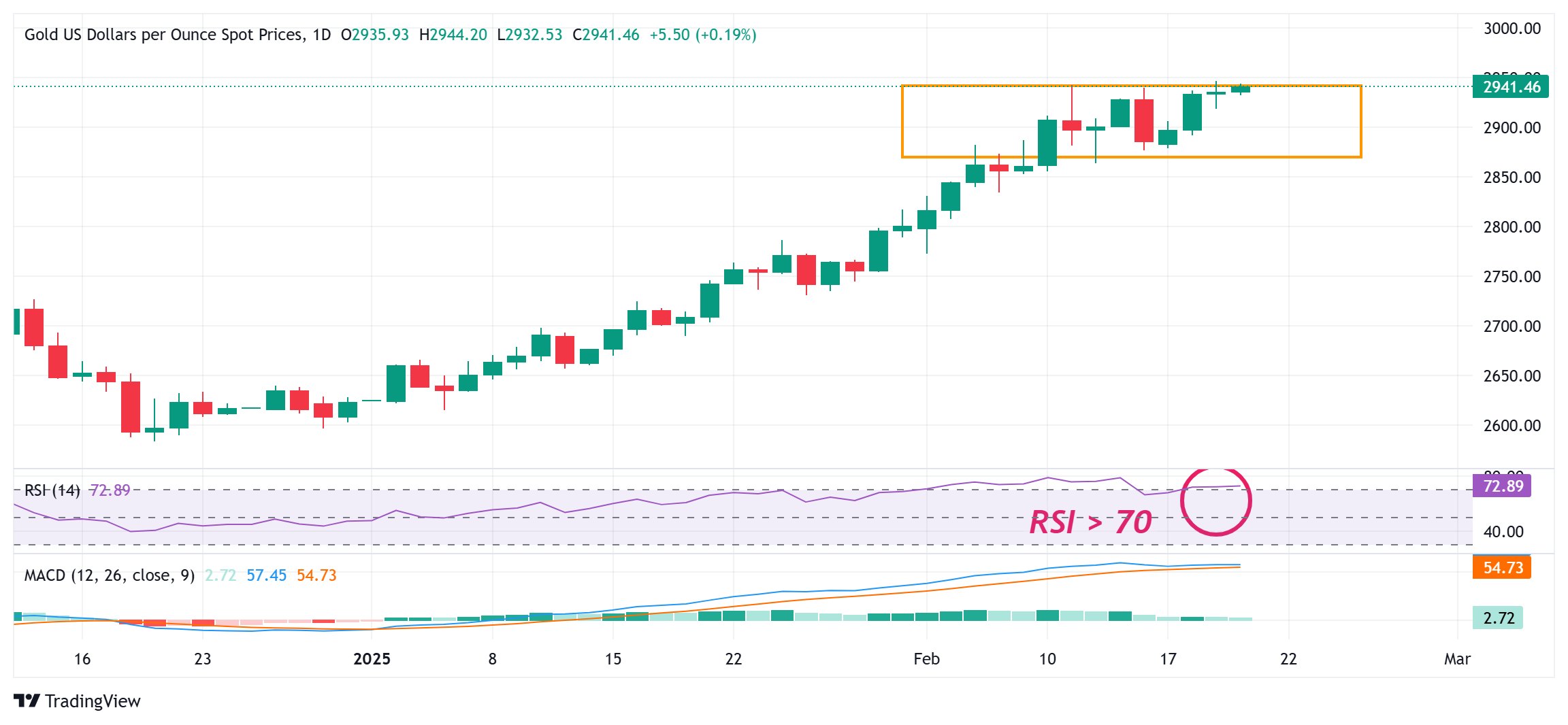
From a technical perspective, the daily Relative Strength Index (RSI) is holding above the 70 mark and warrants some caution for bullish traders. This, in turn, suggests that the Gold price is more likely to extend over a one-week-old range-bound price action. Nevertheless, the near-term bias remains tilted firmly in favor of bullish traders and suggests that the path of least resistance for the XAU/USD pair remains to the upside. A sustained strength beyond the $2,945-2,950 area will mark a fresh breakout through a short-term range and a consolidation phase. This would set the stage for an extension of a well-established uptrend witnessed over the past two months or so.
Meanwhile, any corrective pullback below the $2,928 immediate support could be seen as a buying opportunity near the $2,918 region, or the overnight swing low, and remain limited near the $2,900 mark. This is followed by the $2,880 horizontal support, which if broken decisively could drag the Gold price to the $2,860-2,855 area en route to the $2,834 zone. Some follow-through selling should pave the way for a fall toward the $2,815 region before the XAU/USD pair eventually drops to the $2,800 mark and the next relevant support near the $2,785-2,784 area.
Interest rates FAQs
Interest rates are charged by financial institutions on loans to borrowers and are paid as interest to savers and depositors. They are influenced by base lending rates, which are set by central banks in response to changes in the economy. Central banks normally have a mandate to ensure price stability, which in most cases means targeting a core inflation rate of around 2%. If inflation falls below target the central bank may cut base lending rates, with a view to stimulating lending and boosting the economy. If inflation rises substantially above 2% it normally results in the central bank raising base lending rates in an attempt to lower inflation.
Higher interest rates generally help strengthen a country’s currency as they make it a more attractive place for global investors to park their money.
Higher interest rates overall weigh on the price of Gold because they increase the opportunity cost of holding Gold instead of investing in an interest-bearing asset or placing cash in the bank. If interest rates are high that usually pushes up the price of the US Dollar (USD), and since Gold is priced in Dollars, this has the effect of lowering the price of Gold.
The Fed funds rate is the overnight rate at which US banks lend to each other. It is the oft-quoted headline rate set by the Federal Reserve at its FOMC meetings. It is set as a range, for example 4.75%-5.00%, though the upper limit (in that case 5.00%) is the quoted figure. Market expectations for future Fed funds rate are tracked by the CME FedWatch tool, which shapes how many financial markets behave in anticipation of future Federal Reserve monetary policy decisions.
Author

Haresh Menghani
FXStreet
Haresh Menghani is a detail-oriented professional with 10+ years of extensive experience in analysing the global financial markets.