Gold price stands firm near daily top as geopolitical risks benefit safe-haven assets amid weaker USD
- Gold price regains positive traction on Monday as geopolitical risks revive safe-haven demand.
- The USD remains depressed below a multi-week high and further benefits the precious metal.
- The market focus now shifts to the crucial two-day FOMC policy meeting starting on Tuesday.


Gold price (XAU/USD) stands firm near the daily high through the first half of the European session and looks to build on its bounce from the $3,200 neighborhood, or over a two-week low touched last Thursday. Against the backdrop of the protracted Russia-Ukraine war, an escalation of the Middle East conflict keeps the geopolitical risk in play. Furthermore, the uncertainty over US President Donald Trump's tariff plans weighs on investors' sentiment and benefits the traditional safe-haven precious metal.
Meanwhile, the initial market reaction to the better-than-expected release of the US monthly jobs report on Friday fades rather quickly amid heightened economic uncertainty on the back of Trump's tariffs. Apart from this, bets for an imminent start of the Federal Reserve's (Fed) rate-cutting cycle keep the US Dollar (USD) depressed below a multi-week high and further underpins the non-yielding Gold price. The XAU/USD bulls, however, seem reluctant ahead of a two-day FOMC meeting starting on Tuesday.
Daily Digest Market Movers: Gold price is underpinned by reviving safe-haven demand and weaker USD
- In an interview broadcast on Sunday, Russian President Vladimir Putin stated that Russia has the means and strength to bring the Ukraine conflict to a logical conclusion. This comes ahead of Putin's unilaterally declared three-day ceasefire over May 8-10. Russia, however, had dismissed proposals from Ukraine and the US for an unconditional 30-day ceasefire.
- Israeli Prime Minister Benjamin Netanyahu promised to respond to Yemen’s Houthi rebels ballistic missile attack that hit Ben Gurion International Airport on Sunday and added that Iran would also face consequences from the strike. Responding to this, Iran’s Defence Minister Aziz Nasirzadeh said that Tehran would strike back if the US or Israel attacked.
- US President Donald Trump on Sunday announced a 100% tariff on all movies produced in foreign countries. His unpredictable trade stance unsettles investors, driving safe-haven flows that help gold extend its rebound from last week's low near the $3,200 round figure.
- Traders trimmed bets that the Federal Reserve will cut rates as soon as in June following the better-than-expected release of the US jobs data on Friday, which showed that the economy added 177K jobs in April against 130K expected. Additional details revealed that the Unemployment Rate held steady at 4.2%, pointing to a still resilient US labor market.
- The US Dollar, however, struggles to attract any meaningful buyers and remains depressed below a multi-week high touched last Thursday amid heightened economic uncertainty on the back of Trump's tariffs. This lends additional support to the XAU/USD pair ahead of the highly-anticipated two-day FOMC policy meeting starting on Tuesday.
- Furthermore, speeches from influential Fed officials later this week will be scrutinized for insights into the future monetary policy trajectory and drive the USD demand. In the meantime, the US ISM Services PMI on Monday, which, along with trade-related developments and geopolitical headlines, could produce some impetus to the XAU/USD pair on Monday.
Gold price mixed technical setup warrants some caution for bulls and before positioning for further gains
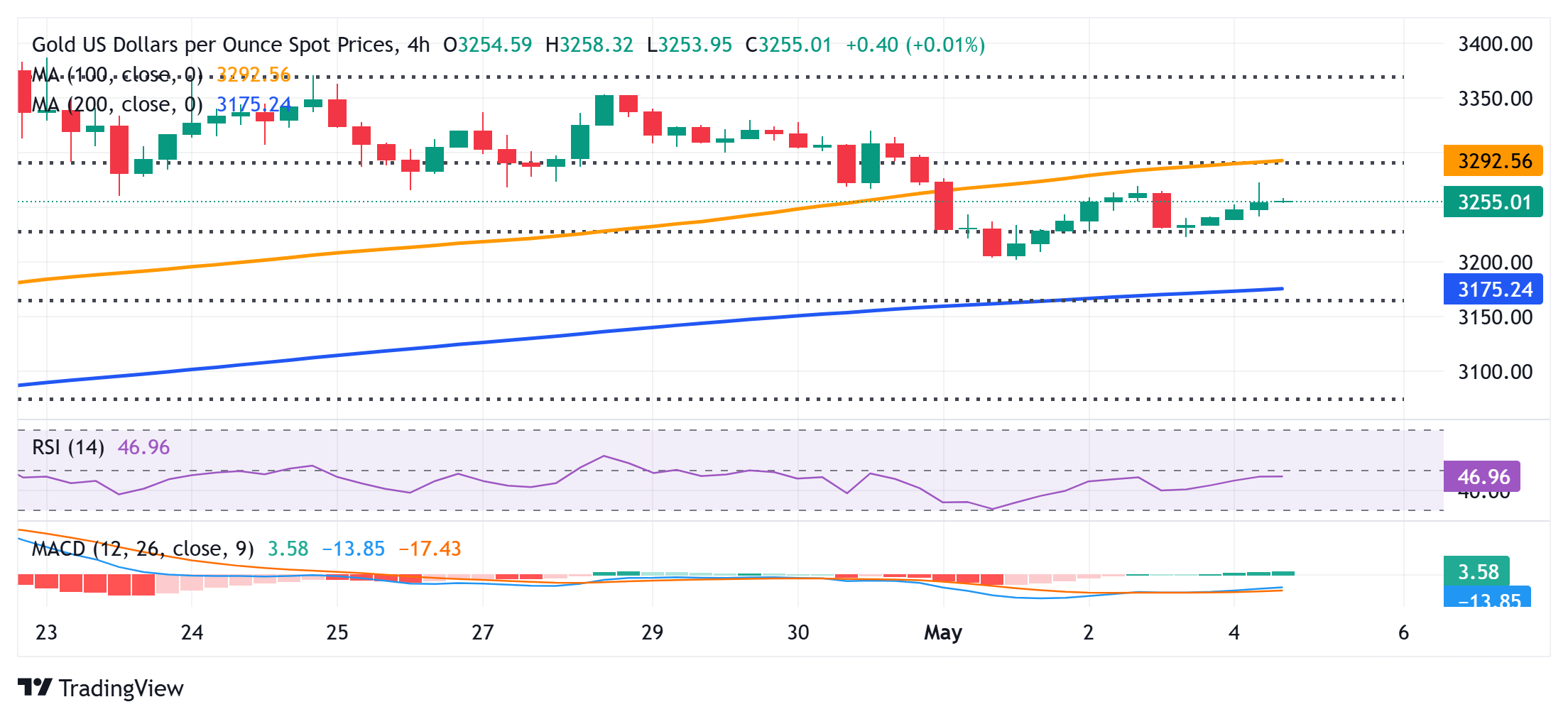
From a technical perspective, the precious metal last week showed some resilience below the 50% Fibonacci retracement level of the move higher from the vicinity of mid-$2,900s. The subsequent bounce from the $3,200 neighborhood warrants some caution before positioning for an extension of the recent pullback from the $3,500 mark, or the all-time peak touched in April. Any further move up could lift the Gold price beyond the $3,300 mark, towards the $3,348-$3,350 supply zone en route to the $3,367-$3,368 intermediate hurdle and the $3,400 round figure.
On the flip side, weakness below the $3,225 region (50% Fibo. level) might continue to find some support ahead of the $3,200 mark. A convincing break below the said handle would make the Gold price vulnerable to accelerate the downfall towards the $3,170-3,165 confluence, comprising the 61.8% Fibo. level and the 200-period Simple Moving Average (SMA) on the 4-hour chart. Some follow-through selling will be seen as a fresh trigger for bearish traders and pave the way for a further near-term depreciating move.
Economic Indicator
Fed Interest Rate Decision
The Federal Reserve (Fed) deliberates on monetary policy and makes a decision on interest rates at eight pre-scheduled meetings per year. It has two mandates: to keep inflation at 2%, and to maintain full employment. Its main tool for achieving this is by setting interest rates – both at which it lends to banks and banks lend to each other. If it decides to hike rates, the US Dollar (USD) tends to strengthen as it attracts more foreign capital inflows. If it cuts rates, it tends to weaken the USD as capital drains out to countries offering higher returns. If rates are left unchanged, attention turns to the tone of the Federal Open Market Committee (FOMC) statement, and whether it is hawkish (expectant of higher future interest rates), or dovish (expectant of lower future rates).
Read more.Next release: Wed May 07, 2025 18:00
Frequency: Irregular
Consensus: 4.5%
Previous: 4.5%
Source: Federal Reserve
Author
Haresh Menghani
FXStreet
Haresh Menghani is a detail-oriented professional with 10+ years of extensive experience in analysing the global financial markets.