Gold price divest to two-week low, around $2,880 area amid modest USD strength
- Gold price drifts lower as an uptick in US bond yields allows the USD to move away from a multi-month low.
- The uncertainty over Trump’s tariff plans and trade war fears should act as tailwinds for the XAU/USD pair.
- Bets that the Fed will cut interest rates further this year might contribute to limiting losses for the yellow metal.

Gold price (XAU/USD) continues losing ground through the first half of the European session and drops to a two-week low, around the $2,881-$2,880 region in the last hour. A modest pickup in the US Treasury bond yields assists the US Dollar (USD) to build on the overnight modest bounce from its lowest level since December 10. This, along with a generally positive tone around the equity markets, turns out to be a key factors undermining the precious metal.
However, the uncertainty over US President Donald Trump's tariff plans and trade war fears warrants some caution for bearish traders and before confirming that the safe-haven Gold price has topped out in the near term. Furthermore, expectations that the Federal Reserve (Fed) will cut interest rates further, amid signs of a cooling US economy and growth concerns, could limit losses for the non-yielding bullion. Traders now look forward to Thursday's US economic docket for a fresh impetus.
Gold price remains heavily offered amid rising US bond yields, stronger USD
- The US Dollar builds on the overnight bounce from the 11-week low amid a modest bounce in the US Treasury bond yields and exerts some downward pressure on the Gold price during the Asian session on Thursday.
- US President Donald Trump fueled hopes for another pause on steep new tariffs on imports from Mexico and Canada and said on Wednesday that they could take effect on April 2, vs. the previous deadline on March 4.
- A White House official, however, said that the deadline for tariffs on Mexican and Canadian goods remained in effect "as of this moment," pending Trump's review of actions to halt the flow of migrants into the US.
- Furthermore, Trump said that his administration will soon announce a 25% tariff on imports from the European Union, which continues to fuel uncertainty and should act as a tailwind for the safe-haven precious metal.
- Bets for more interest rate cuts by the Federal Reserve this year are on the rise in the wake of the recent downbeat US macro data, which pointed to signs of a cooling economy and fueled concerns about the growth outlook.
- Atlanta Fed President Raphael Bostic noted on Wednesday that the US central bank should hold rates where they are, at a level that continues to put downward pressure on inflation, which has shown a lot of progress but is still high.
- Hence, the focus will remain glued to the release of the US Personal Consumption Expenditures (PCE) Price Index – the Fed's preferred inflation measure – due on Friday for further cues about the central bank's rate-cut path.
- In the meantime, Thursday's US economic docket – featuring the release of the Prelim Q4 GDP print, Durable Goods Orders, Pending Home Sales, and Weekly Initial Jobless Claims – might provide short-term impetuses.
- Apart from this, speeches by influential FOMC members could offer more insights on policy easing this year, which will drive the USD demand and contribute to producing trading opportunities around the XAU/USD pair.
Gold price is likely to attract some dip-buying near the $2,860 pivotal support
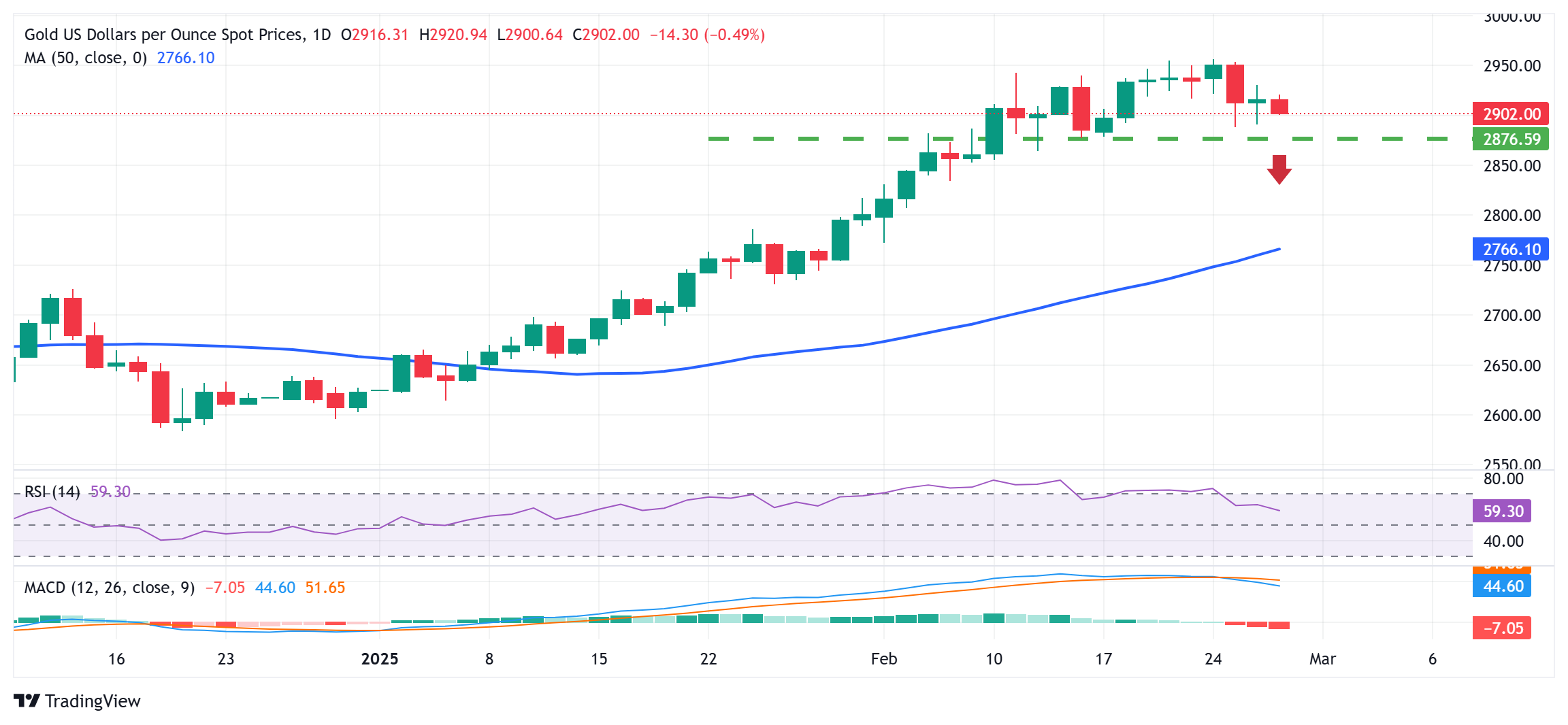
From a technical perspective, the $2,888 area, or over a one-week low touched on Tuesday is likely to act as immediate support ahead of the $2,878 zone and the $2,860-2,855 region. Failure to defend the said support levels could make the Gold price vulnerable to accelerate the corrective decline further towards the $2,834 region en route to the $2,800 round-figure mark.
On the flip side, any positive move beyond the $2,920 immediate hurdle could attract some sellers near the overnight swing high, around the $2,930 region. A sustained strength beyond the latter has the potential to lift the Gold price further toward the $2,950-2,955 horizontal resistance, or the record high touched on the first day of the current week.
Economic Indicator
Gross Domestic Product Annualized
The real Gross Domestic Product (GDP) Annualized, released quarterly by the US Bureau of Economic Analysis, measures the value of the final goods and services produced in the United States in a given period of time. Changes in GDP are the most popular indicator of the nation’s overall economic health. The data is expressed at an annualized rate, which means that the rate has been adjusted to reflect the amount GDP would have changed over a year’s time, had it continued to grow at that specific rate. Generally speaking, a high reading is seen as bullish for the US Dollar (USD), while a low reading is seen as bearish.
Read more.Next release: Thu Feb 27, 2025 13:30 (Prel)
Frequency: Quarterly
Consensus: 2.3%
Previous: 2.3%
Source: US Bureau of Economic Analysis
The US Bureau of Economic Analysis (BEA) releases the Gross Domestic Product (GDP) growth on an annualized basis for each quarter. After publishing the first estimate, the BEA revises the data two more times, with the third release representing the final reading. Usually, the first estimate is the main market mover and a positive surprise is seen as a USD-positive development while a disappointing print is likely to weigh on the greenback. Market participants usually dismiss the second and third releases as they are generally not significant enough to meaningfully alter the growth picture.
Author

Haresh Menghani
FXStreet
Haresh Menghani is a detail-oriented professional with 10+ years of extensive experience in analysing the global financial markets.