Gold price surges past $3,350 as Trump tariff threats jolt markets
- Gold rebounds sharply from $3,322 as risk sentiment boosts safe-haven demand.
- Trump hits Canada with 35% tariffs, mulls 15–20% duties on others.
- Traders brace for US CPI and key Fedspeak ahead of July 19 blackout.

Gold price rallies nearly 1% on Friday as the market mood shifts sour on controversial trade policies imposed by US President Donald Trump on Canada and threatening to broaden duties to other countries and Copper. At the time of writing, the XAU/USD trades at $3,354 after bouncing off daily lows of $3,322.
On Thursday, Trump unveiled 35% tariffs on Canadian goods, though he maintains exemptions for products that adhere to the USMCA trade deal signed in 2020. Moreover, he stated that he is planning to impose blanket tariffs of 15% to 20% on most trading partners.
The economic calendar in the US is scarce. Chicago’s Fed President Austan Goolsbee said that he does not understand arguments that the Fed should cut rates to make government debt cheaper and reiterated the Fed’s mandate is on jobs and price stability.
Next week, the US economic docket will feature the Consumer Price Index (CPI) for June, Retail Sales, Initial Jobless Claims data, along with a flurry of Federal Reserve (Fed) speakers ahead of the blackout period, set to begin on July 19.
Daily digest market movers: Gold and US Dollar climb in tandem on risk-off mood
- Gold price benefited from the escalation of the trade war, even though the Dollar remains solid in the week, set to print gains of over 0.87%, according to the US Dollar Index (DXY), its best week since February 2025.
- On trade, US President Donald Trump announced 50% duties on Copper imports and Brazilian products.
- Chicago Fed President Austan Goolsbee commented that before April 2 Liberation Day tariffs, the hard data on the economy was looking solid. Still, since then, there has been potential disruption and ambiguity that the Fed needs to resolve.
- The US CPI for June will be revealed next week, with figures expected to rise 2.6%, up from 2.4% in May, on a yearly basis. Monthly, the print is awaited at 0.3% up from 0.1% in the previous month.
- Core CPI is expected to increase by 2.8% YoY in June, unchanged from May figures. Every month, core inflation is awaited at 0.3% MoM, up from 0.1%.
- Further US data is expected. Retail Sales in June are foreseen to remain unchanged at 0%, following May’s -0.9% plunge. Initial Jobless Claims for the week ending July 12 are projected to drop from 227K to 225K.
- On Wednesday, the US President Donald Trump emphasized that he would apply 10% additional tariffs to countries aligning themselves with anti-American policies of the BRICS.
- Data from the Chicago Board of Trade revealed that market players are eyeing 49 basis points (bps) of easing in 2025.
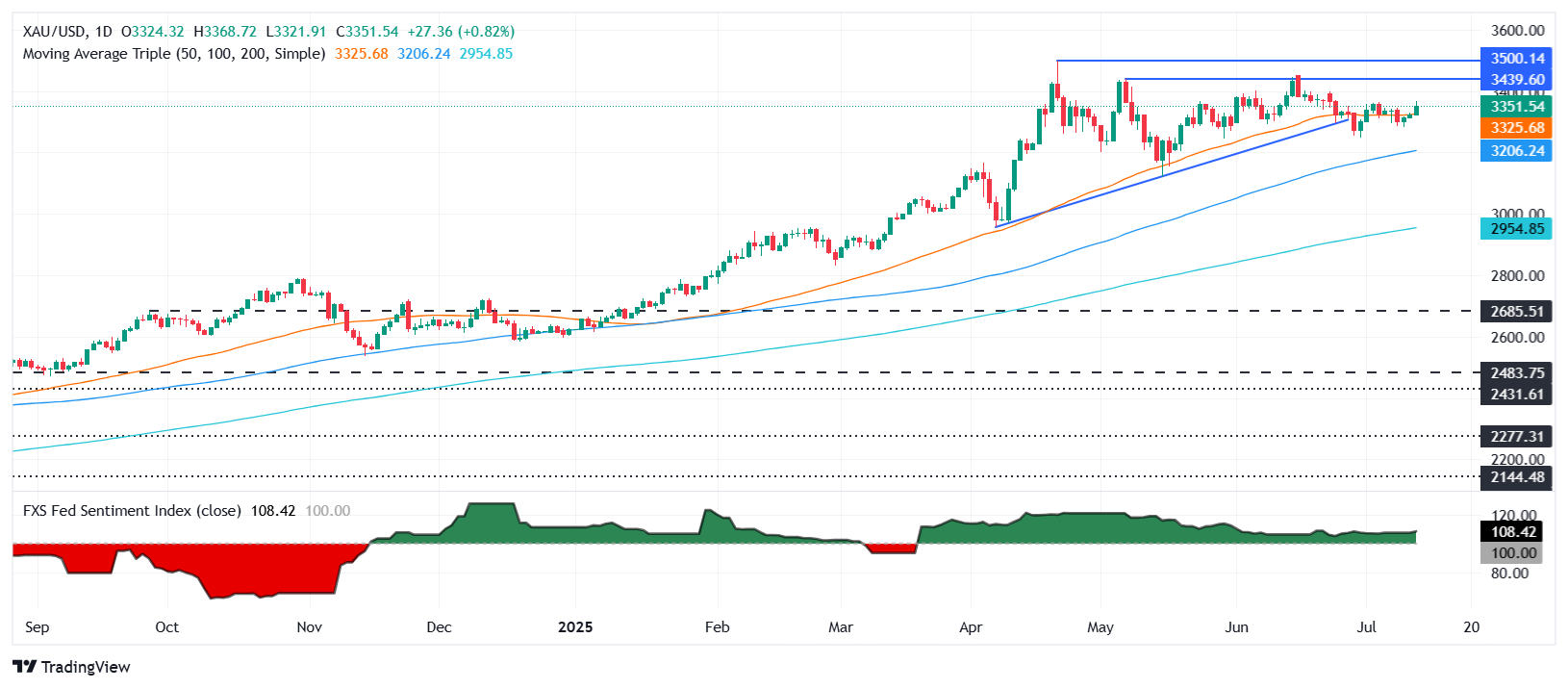
XAU/USD technical outlook: Gold price rallies toward $3,350
Gold price uptrend resumed as the yellow metal rose above $3,350, which opened the door for further upside. The Relative Strength Index (RSI) turned bullish of late, hinting that buyers are gathering traction.
An XAU/USD daily close above $3,350 sets the stage to challenge the $3,400 figure. A breach of the latter will expose the $3,450 mark, ahead of the record high of $3,500. On the downside, if Bullion prices tumble toward $3,300, expect a test of lower prices. The next support levels would be the confluence of the 100-day Simple Moving Average (SMA) and June 30's $3,246, followed by $3,200.
Gold FAQs
Gold has played a key role in human’s history as it has been widely used as a store of value and medium of exchange. Currently, apart from its shine and usage for jewelry, the precious metal is widely seen as a safe-haven asset, meaning that it is considered a good investment during turbulent times. Gold is also widely seen as a hedge against inflation and against depreciating currencies as it doesn’t rely on any specific issuer or government.
Central banks are the biggest Gold holders. In their aim to support their currencies in turbulent times, central banks tend to diversify their reserves and buy Gold to improve the perceived strength of the economy and the currency. High Gold reserves can be a source of trust for a country’s solvency. Central banks added 1,136 tonnes of Gold worth around $70 billion to their reserves in 2022, according to data from the World Gold Council. This is the highest yearly purchase since records began. Central banks from emerging economies such as China, India and Turkey are quickly increasing their Gold reserves.
Gold has an inverse correlation with the US Dollar and US Treasuries, which are both major reserve and safe-haven assets. When the Dollar depreciates, Gold tends to rise, enabling investors and central banks to diversify their assets in turbulent times. Gold is also inversely correlated with risk assets. A rally in the stock market tends to weaken Gold price, while sell-offs in riskier markets tend to favor the precious metal.
The price can move due to a wide range of factors. Geopolitical instability or fears of a deep recession can quickly make Gold price escalate due to its safe-haven status. As a yield-less asset, Gold tends to rise with lower interest rates, while higher cost of money usually weighs down on the yellow metal. Still, most moves depend on how the US Dollar (USD) behaves as the asset is priced in dollars (XAU/USD). A strong Dollar tends to keep the price of Gold controlled, whereas a weaker Dollar is likely to push Gold prices up.
Author

Christian Borjon Valencia
FXStreet
Markets analyst, news editor, and trading instructor with over 14 years of experience across FX, commodities, US equity indices, and global macro markets.