Gold price advances as US CPI heats up
- Gold halts losses despite US CPI jumping above 3% in January.
- Traders slash Fed rate-cut bets to just 30 bps for 2025.
- US Dollar erases gains after Powell and Fed officials stay hawkish.

Gold price recovered some ground late during Wednesday’s North American session. Federal Reserve (Fed) Chair Jerome Powell said that policy needs to remain restrictive as inflationary pressures mount and United States (US) President Donald Trump's tariff threats intensify. XAU/USD trades at $2,897, virtually unchanged.
The non-yielding metal halted its downtrend after the US Bureau of Labor Statistics (BLS) revealed that inflation jumped above 3% in the United States, suggesting that the Fed’s pause on its easing cycle could be longer than expected.
Last week, the December fed funds rate futures contract showed that traders expected 40 basis points (bps) of easing. After the CPI, those expectations were adjusted to just 30 bps of rate cuts by the end of the year.
US Treasury bond yields and the Greenback reacted to the upside. Nevertheless, the US Dollar (USD) lost some steam and erased post-CPI gains, sitting at 107.98, virtually unchanged as portrayed by the US Dollar Index (DXY).
Earlier, Fed Chair Jerome Powell finished his testimony at the US House of Representatives. He said that the job on inflation is not completed, and he added, “So we want to keep policy restrictive for now.”
Atlanta’s Fed President Raphael Bostic echoed some of his words, saying that if the economy evolves as expected, inflation could get to 2% in 2026. Chicago’s Fed President Austan Goolsbee added that multiple inflation readings like January’s would ratify that the “job is clearly not done.”
Daily digest market movers: Gold price holds rally capped by high US yields
- The US 10-year Treasury bond yield edges up nine and a half basis points (bps) at 4.635%.
- US real yields, which correlate inversely to Bullion prices, surge almost nine bps up to 2.157%, a headwind for XAU/USD.
- The US Consumer Price Index (CPI) climbed above 3% YoY for the first time in six months, exceeding forecasts and December’s 2.9% increase. This rise underscores the ongoing challenge the Federal Reserve faces in controlling inflation. Core CPI, which excludes volatile items, rose by 3.3% YoY up from 3.2%, above forecasts of 3.1%.
- Bullion has seen increased demand from central banks, with the World Gold Council (WGC) reporting that central banks purchased over 1,000 tons of gold for the third consecutive year in 2024. Following Trump's electoral victory, purchases by central banks surged by more than 54% year-over-year to 333 tons, according to WGC data.
- Money market fed funds rate futures are pricing in 30 basis points of easing by the Federal Reserve in 2025.
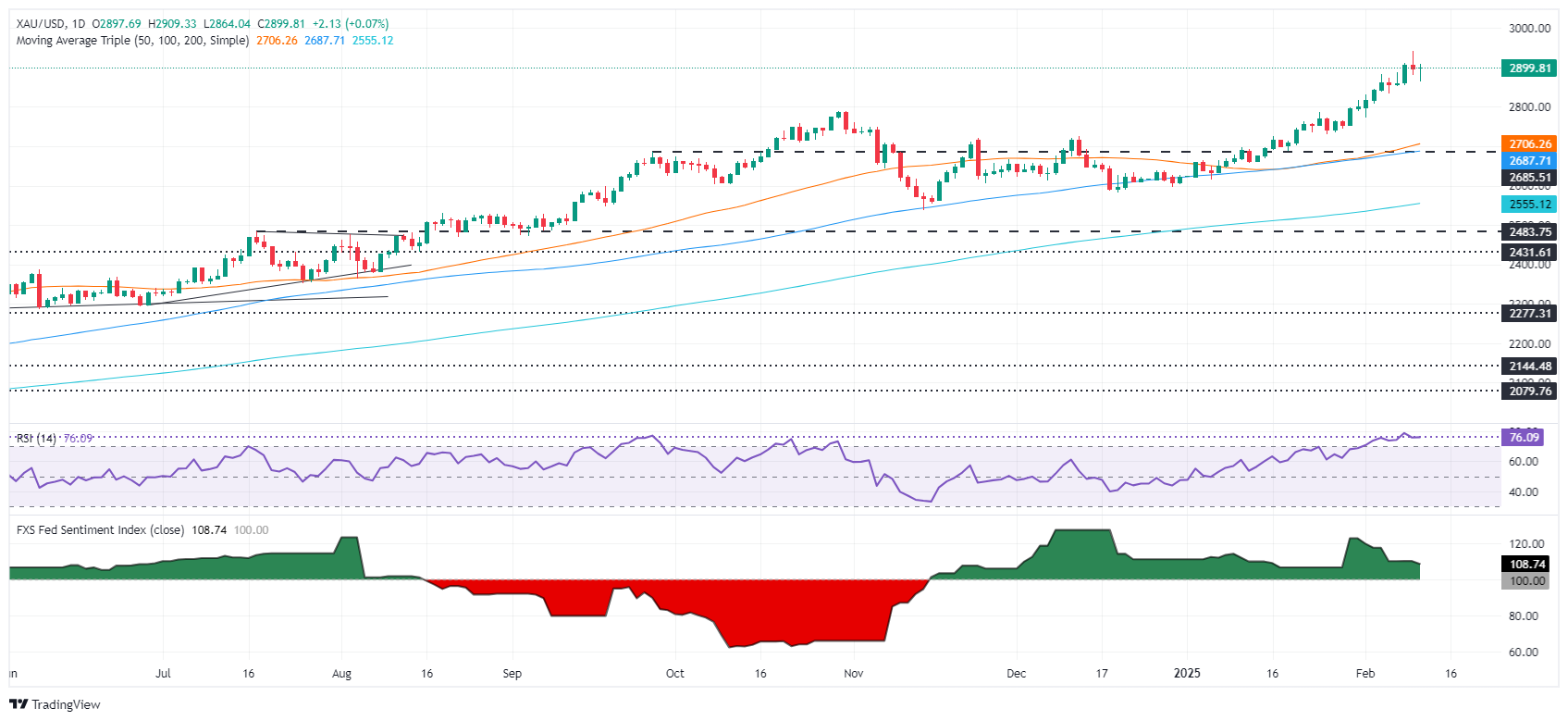
XAU/USD technical outlook: Gold price hovers around $2,900
Price action hints that Gold’s is poised for further gains after printing ‘back-to-back’ pin bars, an indication of some indecision. Although US CPI data was hot, XAU/USD was not set for a volatile reaction following Tuesday’s trading day, in which Gold hit a record-high of $2,942 before plunging below $2,900.
The Relative Strength Index (RSI) shifted flat despite being in overbought territory, opening the door for some consolidation.
If XAU/USD clears the $2,900 mark, key resistance is at a record high, followed by the psychological price levels of $2,950 and $3,000. Conversely, if Gold tumbles, the first support would be the $2,850, followed by the October 31 cycle high turned support at $2 and January’s 27 swing low of $2,730.
Economic Indicator
Consumer Price Index (MoM)
Inflationary or deflationary tendencies are measured by periodically summing the prices of a basket of representative goods and services and presenting the data as The Consumer Price Index (CPI). CPI data is compiled on a monthly basis and released by the US Department of Labor Statistics. The MoM figure compares the prices of goods in the reference month to the previous month.The CPI is a key indicator to measure inflation and changes in purchasing trends. Generally, a high reading is seen as bullish for the US Dollar (USD), while a low reading is seen as bearish.
Read more.Last release: Wed Feb 12, 2025 13:30
Frequency: Monthly
Actual: 0.5%
Consensus: 0.3%
Previous: 0.4%
Source: US Bureau of Labor Statistics
The US Federal Reserve has a dual mandate of maintaining price stability and maximum employment. According to such mandate, inflation should be at around 2% YoY and has become the weakest pillar of the central bank’s directive ever since the world suffered a pandemic, which extends to these days. Price pressures keep rising amid supply-chain issues and bottlenecks, with the Consumer Price Index (CPI) hanging at multi-decade highs. The Fed has already taken measures to tame inflation and is expected to maintain an aggressive stance in the foreseeable future.
Author

Christian Borjon Valencia
FXStreet
Markets analyst, news editor, and trading instructor with over 14 years of experience across FX, commodities, US equity indices, and global macro markets.