Gold price stalls at $3,331 despite weak Dollar, strong US data caps gains
- Gold fails to capitalize on Greenback’s slide to February 2022 levels and falling Treasury yields.
- Strong US Durable Goods and Jobless Claims data offset recessionary Q1 GDP revision.
- Trump may announce Powell’s successor by October, adding policy uncertainty to Fed outlook.

Gold price retreats on Thursday during the North American session, failing to gain traction amid a session characterized by a weak US Dollar, which is testing levels last seen in February 2022. The XAU/USD trades at $3,331 and prints modest losses of 0.05%.
The yellow metal is struggling to rally despite the Greenback being near three-and-a-half-year lows and US Treasury yields plunging. Solid economic data in the United States (US) kept bullion from advancing, even though market participants got slightly ahead of themselves, pricing in two rate cuts toward the end of 2025.
US jobs data revealed that the number of Americans filing for unemployment claims came below forecasts, while Durable Goods Orders for May crushed estimates. The final printing of the Gross Domestic Product (GDP) for Q1 2025 confirmed that the economy lost traction, contracting more than expected and by a larger margin than the previous figure.
In addition to this, a Wall Street Journal article revealed that US President Donald Trump is considering nominating the next Federal Reserve Chair by September or October, which would replace Jerome Powell in eleven months. This would create confusion among investors, who would also have to review the comments of the Trump nominee.
Aside from this, Fed officials have echoed some of Powell’s remarks, including Boston Fed President Susan Collins, Richmond Fed President Thomas Barkin, and Governor Michael Barr.
Daily digest market movers: Gold price steadies amid weak US Dollar, falling US yields
- Gold price uptrend stalls as the yellow metal trades near $3,330 due to the de-escalation of the Israel–Iran conflict.
- The US 10-year Treasury note is yielding 4.259%, down three basis points (bps). The US Dollar Index (DXY), which tracks the performance of the buck’s value against a basket of six peers, is also down 0.59% at 97.13.
- Initial Jobless Claims dropped to 236,000 for the week ending June 21, below both the prior reading of 245,000 and market expectations, according to the US Department of Labor. Despite this, the Unemployment Rate is expected to increase as two of the past three weekly prints came in higher than forecast.
- US Durable Goods Orders surged in May, rising 16.4% MoM — nearly double the forecast of 8.5% — driven by a sharp increase in commercial aircraft orders. This marked a strong rebound from April’s 6.6% decline.
- Separately, the Bureau of Economic Analysis reported that the US economy contracted more than initially estimated in the first quarter of 2025. GDP shrank by 0.5% QoQ, compared to the previous estimate of a 0.2% drop, in line with expectations.
- Boston Fed Susan Collins said that there is not enough data to reduce rates at the July meeting. Richmond Fed Thomas Barkin revealed that tariffs are more likely than not to drive inflation higher in upcoming months. He added, “I don’t expect the impact on inflation to be anywhere near as significant as what we just experienced.”
- Money markets suggest that traders are pricing in 63.5 basis points of easing toward the end of the year, according to Prime Market Terminal data.

Source: Prime Market Terminal
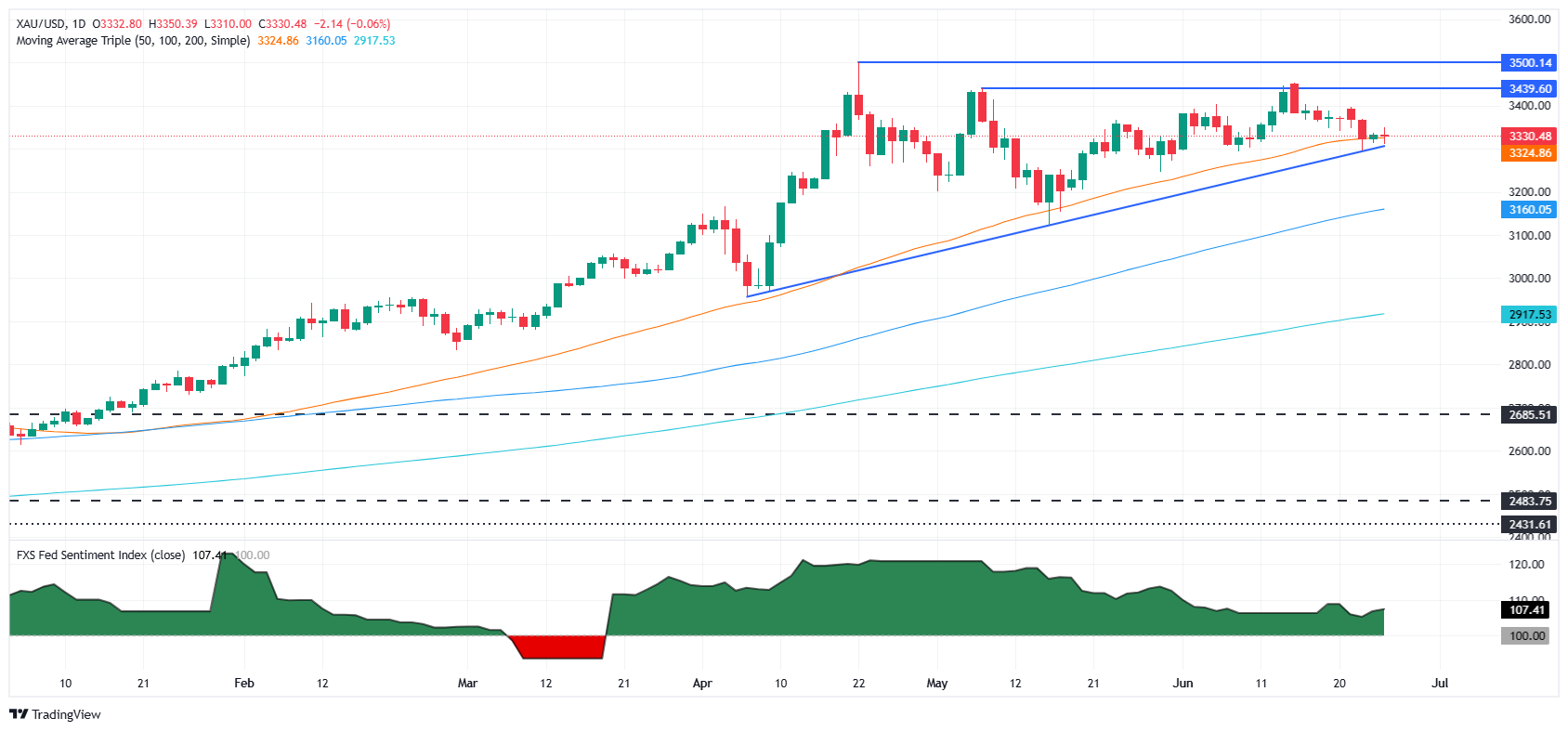
XAU/USD technical outlook: Gold price hovers near $3,330
Gold price remains upwardly biased, although it hovers near the 50-day Simple Moving Average (SMA) at $3,322. The Relative Strength Index (RSI) indicates that momentum has turned slightly bearish, and price action is achieving higher highs and higher lows, which could pave the way for some sideways movement.
For a bullish continuation, XAU/USD must climb past $3,400. The following key resistance levels lie ahead, at $3,450, followed by the record high of $3,500. Conversely, if XAU/USD tumbles below $3,300, the first support would be the May 29 low of $3,245 and $3,200.
Gold FAQs
Gold has played a key role in human’s history as it has been widely used as a store of value and medium of exchange. Currently, apart from its shine and usage for jewelry, the precious metal is widely seen as a safe-haven asset, meaning that it is considered a good investment during turbulent times. Gold is also widely seen as a hedge against inflation and against depreciating currencies as it doesn’t rely on any specific issuer or government.
Central banks are the biggest Gold holders. In their aim to support their currencies in turbulent times, central banks tend to diversify their reserves and buy Gold to improve the perceived strength of the economy and the currency. High Gold reserves can be a source of trust for a country’s solvency. Central banks added 1,136 tonnes of Gold worth around $70 billion to their reserves in 2022, according to data from the World Gold Council. This is the highest yearly purchase since records began. Central banks from emerging economies such as China, India and Turkey are quickly increasing their Gold reserves.
Gold has an inverse correlation with the US Dollar and US Treasuries, which are both major reserve and safe-haven assets. When the Dollar depreciates, Gold tends to rise, enabling investors and central banks to diversify their assets in turbulent times. Gold is also inversely correlated with risk assets. A rally in the stock market tends to weaken Gold price, while sell-offs in riskier markets tend to favor the precious metal.
The price can move due to a wide range of factors. Geopolitical instability or fears of a deep recession can quickly make Gold price escalate due to its safe-haven status. As a yield-less asset, Gold tends to rise with lower interest rates, while higher cost of money usually weighs down on the yellow metal. Still, most moves depend on how the US Dollar (USD) behaves as the asset is priced in dollars (XAU/USD). A strong Dollar tends to keep the price of Gold controlled, whereas a weaker Dollar is likely to push Gold prices up.
Author

Christian Borjon Valencia
FXStreet
Markets analyst, news editor, and trading instructor with over 14 years of experience across FX, commodities, US equity indices, and global macro markets.