Gold price soars past $3,240 as trade war fears deepen, yields slide
- Gold rallies sharply as safe-haven demand surges on US-China tensions and collapsing Treasury yields.
- Trump’s tariff threat on pharmaceuticals and China’s Boeing ban add fuel to market volatility.
- Mixed US data adds to uncertainty; traders now focus on Retail Sales and Powell’s Wednesday speech.

Gold price ended Tuesday’s session on a higher note due to traders buying the precious metals amid uncertainty over US President Donald Trump's tariff plans, which has kept market participants on edge. The XAU/USD trades at $3,240 a troy ounce, gaining over 6.50%.
The precious metal rose sharply towards the end of Tuesday’s New York session as US Treasury bond yields continued to drop for the second straight day. Fears that US President Trump would begin to impose tariffs on pharmaceuticals deteriorated the market mood.
Remaining in the trade-war space, China ordered its domestic airlines to halt deliveries of Boeing jets, adding to the sour mood of market participants.
US data was mixed, with import prices remaining muted. The New York Fed Manufacturing headline fared better than forecasted, as did some of the internals. Nevertheless, prices paid rose into expansionary territory, and the six-month outlook deteriorated.
This week, Gold traders will watch Retail Sales for March alongside Fed speakers crossing the wires, mainly Fed Chair Jerome Powell, on Wednesday. Investors await housing data and Initial Jobless Claims for the rest of the week.
Daily digest market movers: Gold price rallies, as US real yields drop
The US 10-year Treasury yield tumbled four and a half basis points to 4.339%. US real yields fall three and a half bps to 2.149%, as shown by the US 10-year Treasury Inflation-Protected Securities yields failing to cap Gold prices.
The NY Empire State Manufacturing Index improved to -8.1 in April 2025 from -20 in March, the lowest price since May 2023, compared to forecasts of -14.5. Despite this, the reading hinted that business activity declined while input prices increased.
March Retail Sales are expected to rise from 0.6% to 1.3% MoM on Wednesday. However, the so-called control group used for calculations of the Gross Domestic Product (GDP) is expected to drop from 1% to 0.6%, implying that households are beginning to cut expenses amid an economic downturn.
Later, Industrial Production for the same period is forecast to shrink by 0.2% MoM, below February’s 0.7% expansion. This could halt a series of positive readings after three straight months of contractions witnessed from September to November 2024.
Money market players had priced in 85 bps of easing toward the end of 2025. The first cut is expected in July.
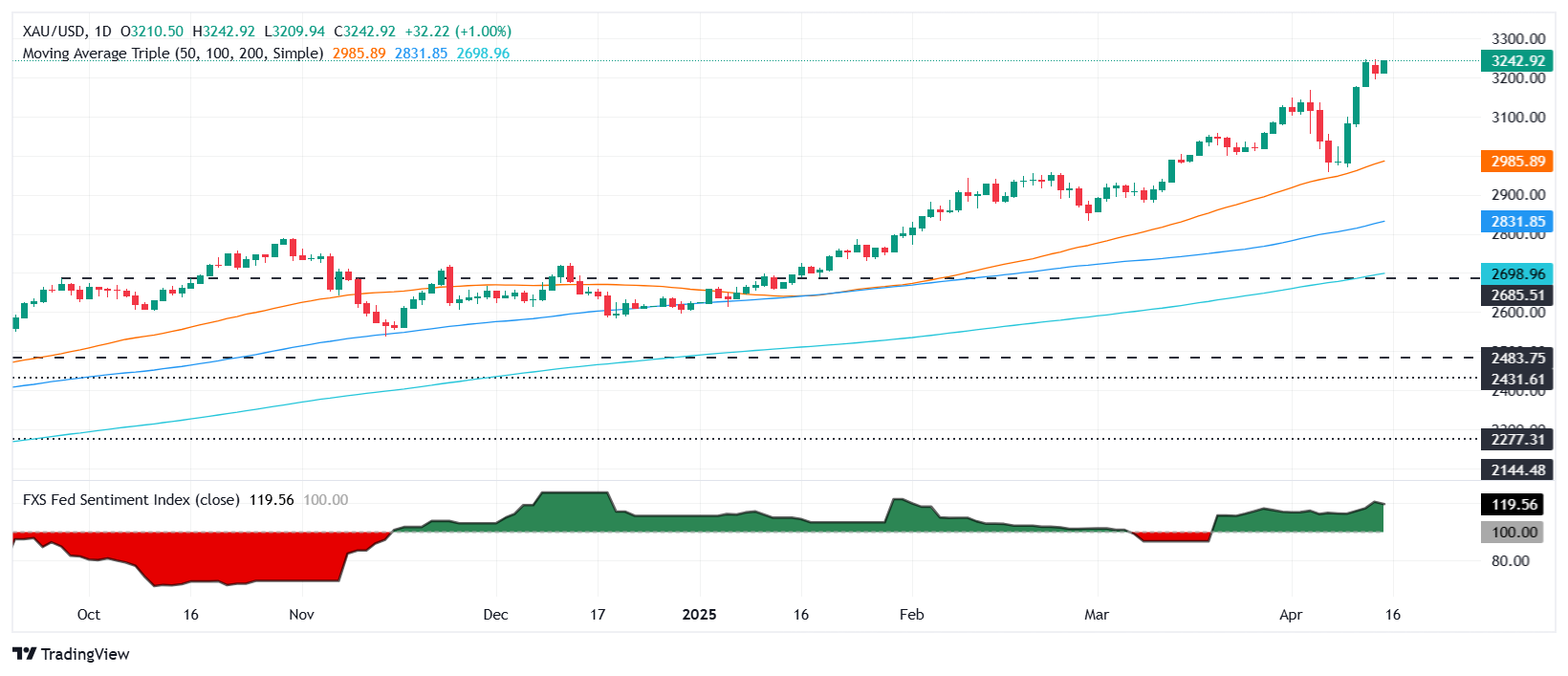
XAU/USD technical outlook: Gold price remains bullis near $3,240 posied to reach new record high
Gold price uptrend remains intact with buyers eyeing the $3,250 mark. A breach of the current all-time high (ATH) of $3,245 could pave the way toward the latter. If those two ceiling levels are cleared, the next stop would be $3,300.
Conversely, if XAU/USD drops below $3,200, the first support would be the April 10 high of $3,176. Once cleared, the next stop would be the $3,100 mark.
Gold FAQs
Gold has played a key role in human’s history as it has been widely used as a store of value and medium of exchange. Currently, apart from its shine and usage for jewelry, the precious metal is widely seen as a safe-haven asset, meaning that it is considered a good investment during turbulent times. Gold is also widely seen as a hedge against inflation and against depreciating currencies as it doesn’t rely on any specific issuer or government.
Central banks are the biggest Gold holders. In their aim to support their currencies in turbulent times, central banks tend to diversify their reserves and buy Gold to improve the perceived strength of the economy and the currency. High Gold reserves can be a source of trust for a country’s solvency. Central banks added 1,136 tonnes of Gold worth around $70 billion to their reserves in 2022, according to data from the World Gold Council. This is the highest yearly purchase since records began. Central banks from emerging economies such as China, India and Turkey are quickly increasing their Gold reserves.
Gold has an inverse correlation with the US Dollar and US Treasuries, which are both major reserve and safe-haven assets. When the Dollar depreciates, Gold tends to rise, enabling investors and central banks to diversify their assets in turbulent times. Gold is also inversely correlated with risk assets. A rally in the stock market tends to weaken Gold price, while sell-offs in riskier markets tend to favor the precious metal.
The price can move due to a wide range of factors. Geopolitical instability or fears of a deep recession can quickly make Gold price escalate due to its safe-haven status. As a yield-less asset, Gold tends to rise with lower interest rates, while higher cost of money usually weighs down on the yellow metal. Still, most moves depend on how the US Dollar (USD) behaves as the asset is priced in dollars (XAU/USD). A strong Dollar tends to keep the price of Gold controlled, whereas a weaker Dollar is likely to push Gold prices up.
Author

Christian Borjon Valencia
FXStreet
Markets analyst, news editor, and trading instructor with over 14 years of experience across FX, commodities, US equity indices, and global macro markets.















