Gold price climbs fueled by Trump tariff threats
- XAU/USD nears record highs, Goldman Sachs sees $3,100 target.
- The investment bank projects a 9% upside as central bank demand surges.
- Trump’s tariff policies fuel market jitters, boosting Gold’s appeal.
- Fed officials remain cautious on inflation, FOMC Minutes in focus this week.

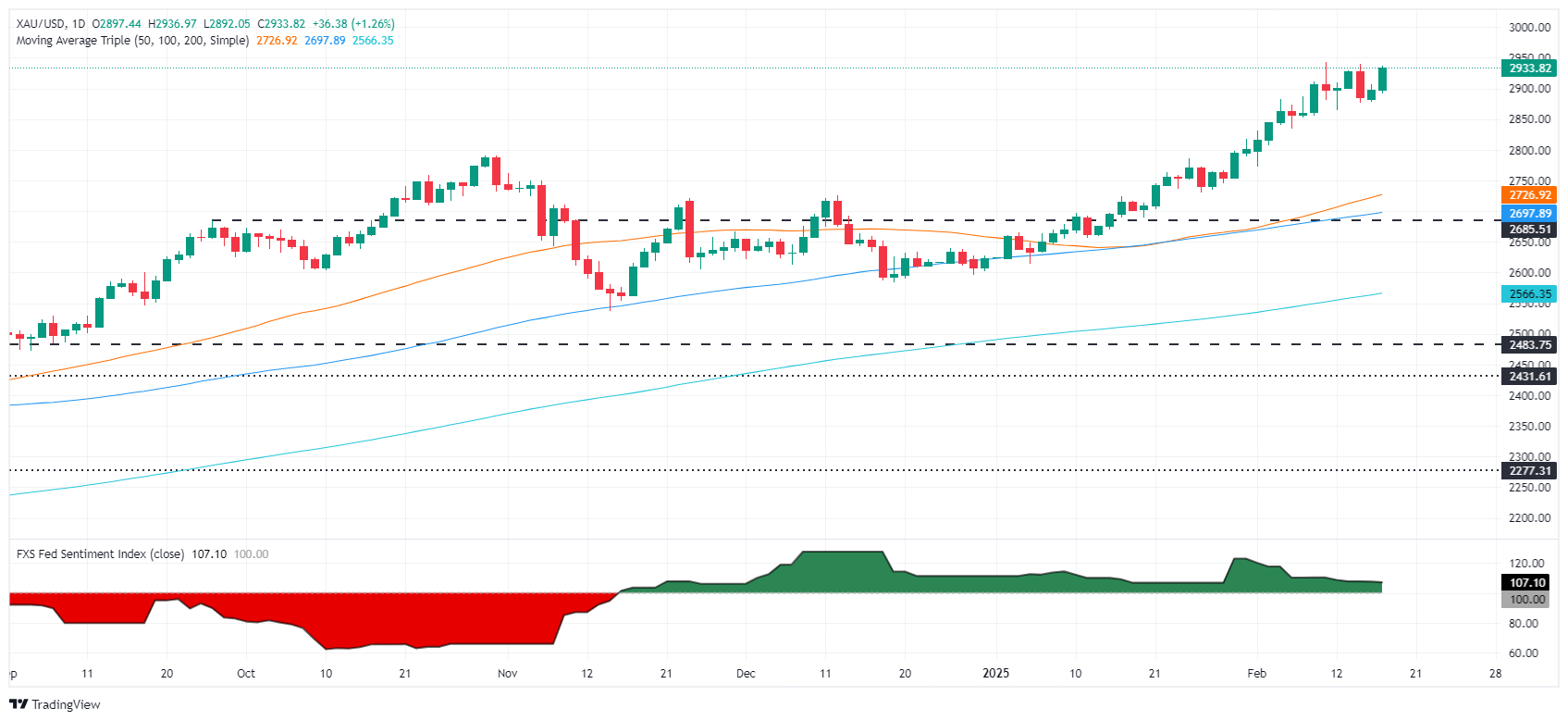
Gold price surged more than 1% on Tuesday due to safe-haven demand amid uncertainty over controversial trade policies proposed by US President Donald Trump. The XAU/USD trades at $2,933 after bouncing off daily lows of $2,892.
The financial markets remain rattled following last week’s US Trump imposition of tariffs on steel and aluminum imports and plans for applying reciprocal duties. Therefore, Bullion prices remain poised to challenge record highs after hitting $2,942 on February 11.
Goldman Sachs upward revised XAU/USD price to $3,100 by year’s end as the investment bank said “structurally higher" central bank demand will add 9% to the price of the non-yielding metal.
After Trump’s victory on November 6, Gold dipped to $2,534 before rallying over 15.90% due to haven and global central bank buying. The World Gold Council (WGC) revealed that central banks purchased more than 54% YoY to 333 tonnes following Trump’s victory, according to its data.
Gold traders should be warned that Federal Reserve (Fed) officials turned slightly skeptical about getting the job done on inflation after the Consumer Price Index (CPI) had risen for five straight months. San Francisco Fed President Mary Daly said, “Policy needs to remain restrictive until…I see that we are really continuing to make progress on inflation.”
Market participants will watch the release of January’s Federal Open Market Committee (FOMC) monetary policy decision, along with housing data, Initial Jobless Claims for the last week, and S&P Global Flash PMIs.
Daily digest market movers: Gold price benefits from safe-haven demand
- The US 10-year Treasury bond yield climbs seven basis points (bps), yields 4.55%.
- US real yields, which correlate inversely to Bullion prices, rise four-and-a-half basis points to 2.086%, a headwind for Bullion prices.
- Fed Governor Christopher Waller stated that his "baseline" expectation is that President Donald Trump's new trade restrictions will have only a limited impact on prices.
- Meanwhile, Philadelphia Fed President Patrick Harker reaffirmed support for maintaining a steady interest rate policy, acknowledging that inflation has remained elevated and persistent in recent months.
- US Housing Starts for January is expected to decrease from 1.499 million to 1.4 million. At the same time, Building Permits for the same period are expected to drop from 1.482 million to 1.46 million.
- Money market fed funds rate futures are pricing in 39 basis points of easing by the Fed in 2025.
XAU/USD technical outlook: Gold price skyrockets past $2,900
Gold price trend remains up with buyers setting their sights on clearing the all-time high of $2,942. Further key resistance levels lie at $2,950 and the $3,000 mark. It should be said that if those levels are cleared, Goldman Sachs estimated XAU/USD to hit $3,100 by year’s end.
For a bearish continuation, sellers must push the Gold spot price below $2,900. In that outcome, key support levels will be exposed, like the February 14 swing low of $2,877, followed by the February 12 low of $2,864. On further weakness, Gold could fall to test the October 31 swing high at $2,790.
Tariffs FAQs
Tariffs are customs duties levied on certain merchandise imports or a category of products. Tariffs are designed to help local producers and manufacturers be more competitive in the market by providing a price advantage over similar goods that can be imported. Tariffs are widely used as tools of protectionism, along with trade barriers and import quotas.
Although tariffs and taxes both generate government revenue to fund public goods and services, they have several distinctions. Tariffs are prepaid at the port of entry, while taxes are paid at the time of purchase. Taxes are imposed on individual taxpayers and businesses, while tariffs are paid by importers.
There are two schools of thought among economists regarding the usage of tariffs. While some argue that tariffs are necessary to protect domestic industries and address trade imbalances, others see them as a harmful tool that could potentially drive prices higher over the long term and lead to a damaging trade war by encouraging tit-for-tat tariffs.
During the run-up to the presidential election in November 2024, Donald Trump made it clear that he intends to use tariffs to support the US economy and American producers. In 2024, Mexico, China and Canada accounted for 42% of total US imports. In this period, Mexico stood out as the top exporter with $466.6 billion, according to the US Census Bureau. Hence, Trump wants to focus on these three nations when imposing tariffs. He also plans to use the revenue generated through tariffs to lower personal income taxes.
Author

Christian Borjon Valencia
FXStreet
Markets analyst, news editor, and trading instructor with over 14 years of experience across FX, commodities, US equity indices, and global macro markets.