Gold price rises past $3,350 on Waller’s dovish comments, soft US Dollar
- Gold boosted as Fed’s Waller supports July rate cut, boosting Gold as yields decline.
- US Dollar Index slips to 98.48, enhancing appeal of Dollar-denominated Bullion.
- UoM survey shows improved sentiment and easing long-term inflation expectations.

Gold price advances during the North American session on Friday as the US Dollar weakens, with traders booking profits ahead of the weekend. Additionally, a Fed Governor's comments turned more dovish than expected, supporting a rate cut in July. At the time of writing, the XAU/USD trades at $3,353, up 0.43%.
The market mood is upbeat after the University of Michigan (UoM) revealed that Americans have become optimistic about the economy and expect inflation to edge lower. Recently, Fed Governor Christopher Waller suggested that the central bank should cut interest rates at the upcoming monetary policy meeting, triggering a decline in US Treasury yields, a tailwind for the Gold market.
The US Dollar Index (DXY), which tracks the buck’s value against a basket of six currencies, tumbles 0.13% to 98.48. A weaker US Dollar favors the precious metal denominated in that currency, making Gold prices cheaper for foreign buyers.
Following Waller’s comments, traders priced in 45 basis points (bps) of easing toward the end of the year, up from 42 bps a day ago, according to the December 2025 fed funds rate futures contract.
Bullion failed to reach the weekly high hit on Wednesday, following rumors that US President Donald Trump was considering the removal of Fed Chair Jerome Powell. Later, he denied those comments, though he continued to exert pressure on the central bank.
Next week, the US economic docket will feature housing data, S&P Global Flash PMIs, jobless claims and Durable Goods Orders.
Gold daily market movers: Climbs as US yields drop on Fed dovish comments
- The Consumer Sentiment Index revealed by the University of Michigan showed an improvement in July’s preliminary reading, up from 60.7 to 61.8, exceeding estimates of 61.5. Joanne Hsu, the director of the survey, said, "Consumers are unlikely to regain their confidence in the economy unless they feel assured that inflation is unlikely to worsen, for example, if trade policy stabilizes for the foreseeable future."
- The survey also revealed that inflation expectations were downwardly revised, with inflation for the next five years seen at 3.6%, down from 4%, and for the next year at 4.4%, below the prior month’s 5%.
- Fed Governor Christopher Waller said the labor market is doing fine overall but less so in the private sector. Although he favors a rate cut at the July meeting, Waller said he would never commit prior to the meeting.”
- US economic data revealed mixed readings of inflation, with the Consumer Price Index (CPI) edging toward the 3% threshold, while the Producer Price Index (PPI), moved downwards. However, the release of stronger-than-expected Retail Sales indicated that most of the increase was due to higher prices resulting from tariffs.
- US Treasury yields are down on the day, with the US 10-year Treasury yield, which typically correlates negatively with Gold, losing three basis points (bps) at 4.421%.
- Interest rate probability indicates that the Fed will maintain its current rates, with odds standing at 94% for a hold and 6% for a 25-basis-point rate cut at the July 30 meeting.
XAU/USD technical outlook: Gold price hovers around $3,350
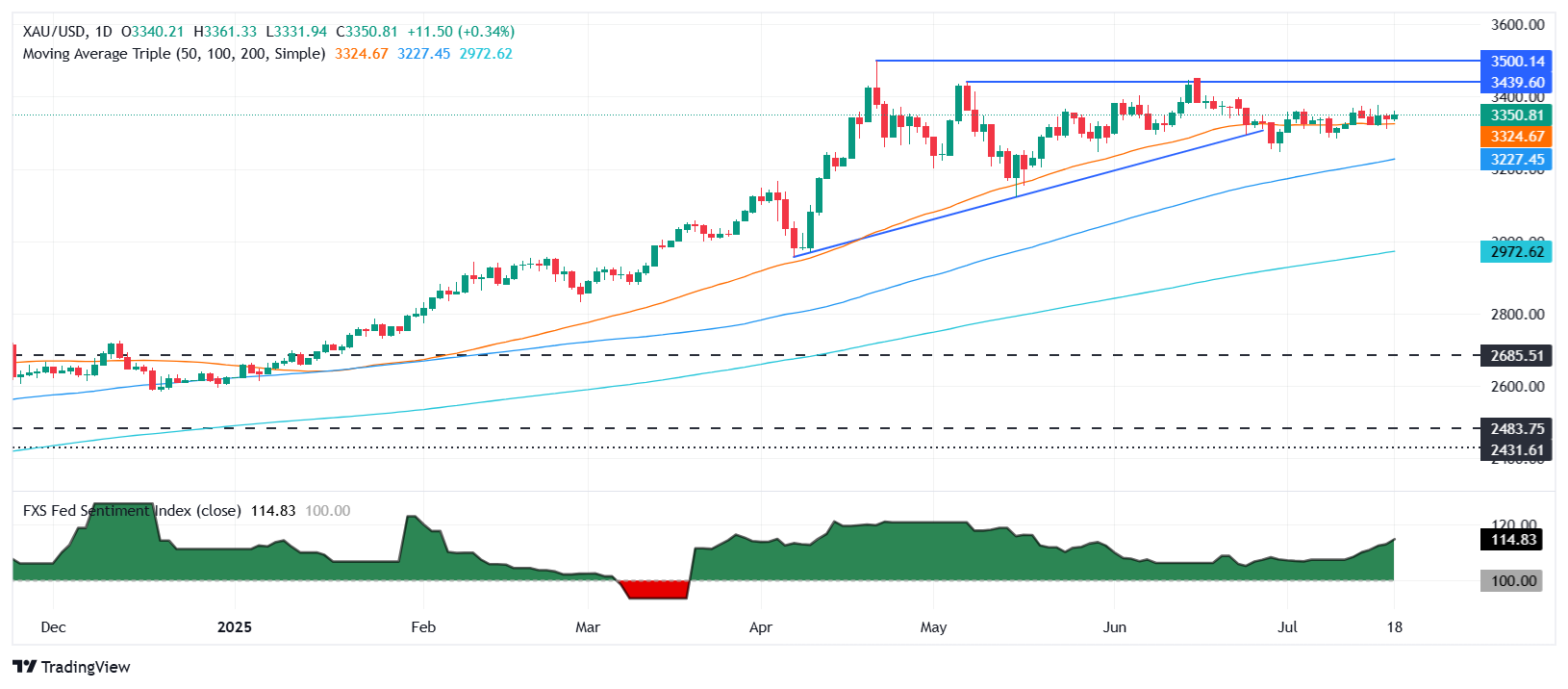
Gold is set to consolidate at around the $3,350 level for the remainder of the day, with traders awaiting the weekend. If XAU/USD rises past the current week’s high of $3,377, the next resistance would be $3,400. A breach of the latter clears the way to challenge the June 16 high of $3,452, ahead of the record high of $3,500.
On the other hand, if XAU/USD drops below $3,300, look for a decline to the June 30 low of $3,246, followed by the 100-day Simple Moving Average (SMA) at $3,209.
Gold FAQs
Gold has played a key role in human’s history as it has been widely used as a store of value and medium of exchange. Currently, apart from its shine and usage for jewelry, the precious metal is widely seen as a safe-haven asset, meaning that it is considered a good investment during turbulent times. Gold is also widely seen as a hedge against inflation and against depreciating currencies as it doesn’t rely on any specific issuer or government.
Central banks are the biggest Gold holders. In their aim to support their currencies in turbulent times, central banks tend to diversify their reserves and buy Gold to improve the perceived strength of the economy and the currency. High Gold reserves can be a source of trust for a country’s solvency. Central banks added 1,136 tonnes of Gold worth around $70 billion to their reserves in 2022, according to data from the World Gold Council. This is the highest yearly purchase since records began. Central banks from emerging economies such as China, India and Turkey are quickly increasing their Gold reserves.
Gold has an inverse correlation with the US Dollar and US Treasuries, which are both major reserve and safe-haven assets. When the Dollar depreciates, Gold tends to rise, enabling investors and central banks to diversify their assets in turbulent times. Gold is also inversely correlated with risk assets. A rally in the stock market tends to weaken Gold price, while sell-offs in riskier markets tend to favor the precious metal.
The price can move due to a wide range of factors. Geopolitical instability or fears of a deep recession can quickly make Gold price escalate due to its safe-haven status. As a yield-less asset, Gold tends to rise with lower interest rates, while higher cost of money usually weighs down on the yellow metal. Still, most moves depend on how the US Dollar (USD) behaves as the asset is priced in dollars (XAU/USD). A strong Dollar tends to keep the price of Gold controlled, whereas a weaker Dollar is likely to push Gold prices up.
Author

Christian Borjon Valencia
FXStreet
Markets analyst, news editor, and trading instructor with over 14 years of experience across FX, commodities, US equity indices, and global macro markets.