Gold price bulls remain on the sidelines amid reduced Fed rate cut bets
- Gold price attracts some sellers at the start of a new week, though it lacks follow-through.
- Hawkish Fed expectations, elevated US bond yields and bullish USD weighs on the commodity.
- Geopolitical tensions and the risk-off mood limit losses for the safe-haven precious metal.

Gold price (XAU/USD) trades with a mild negative bias during the first half of the European session and for now, seems to have snapped a four-day winning streak to a one-month high touched on Friday. The upbeat US Nonfarm Payrolls (NFP) report reinforced market expectations that the Federal Reserve (Fed) will pause its rate-cutting cycle later this month. This keeps the US Treasury bond yields elevated near their highest level in over a year and the US Dollar (USD) near a two-year peak, which, in turn, exerts some pressure on the non-yielding yellow metal.
Meanwhile, hawkish Fed expectations, along with persistent geopolitical tensions, temper investors' appetite for riskier assets. This is evident from a weaker tone around the equity markets and continues to offer support to the safe-haven Gold price. Hence, it will be prudent to wait for strong follow-through selling before confirming that the XAU/USD's move-up witnessed over the past three weeks or so has run its course and positioning for any meaningful corrective decline. Investors now look forward to this week's release of the US inflation figures for some meaningful impetus.
Gold price is pressured by hawkish Fed-inspired elevated US bond yields and sustained USD buying
- The US Bureau of Labor Statistics (BLS) reported on Friday that Nonfarm Payrolls rose by 256,000 in December, well above the 212,000 in the previous month and market expectations for a reading of 160,000.
- Other details of the report showed that the Unemployment Rate unexpectedly ticked lower to 4.1% from 4.2% and annual wage inflation, as measured by the change in the Average Hourly Earnings, declined to 3.9%.
- This comes on top of the Federal Reserve's (Fed) hawkish shift in December and dampens hopes for further interest rate cuts by the US central bank, pushing the US Treasury bond yields and the US Dollar higher.
- The yield on the benchmark 10-year US government bond has spiked to its highest level since late 2023, while the USD Index, which tracks the Greenback against a basket of currencies, shot to over a two-year peak.
- Elevated US bond yields and a bullish USD act as a headwind for the Gold price on Monday, though the risk-off mood lends some support to the safe-haven bullion and helps limit any meaningful corrective slide.
- The Office of Foreign Assets Control (OFAC) said on Friday that the US and the UK administration imposed tougher sanctions against Russia's oil industry, targeting nearly 200 vessels of the so-called shadow fleet.
- The Russian Defence Ministry said on Sunday that Russian forces have carried out strikes on Ukrainian military airfields, personnel and vehicles in 139 locations using its air force, drones, missiles and artillery.
- In an apparent violation of the ceasefire agreement between Israel and Hezbollah, more Israeli strikes have been reported in Lebanon. Moreover, Israeli strikes continued across Gaza amid renewed ceasefire talks.
Gold price setup favors bulls and supports prospects for the emergence of dip-buying at lower levels
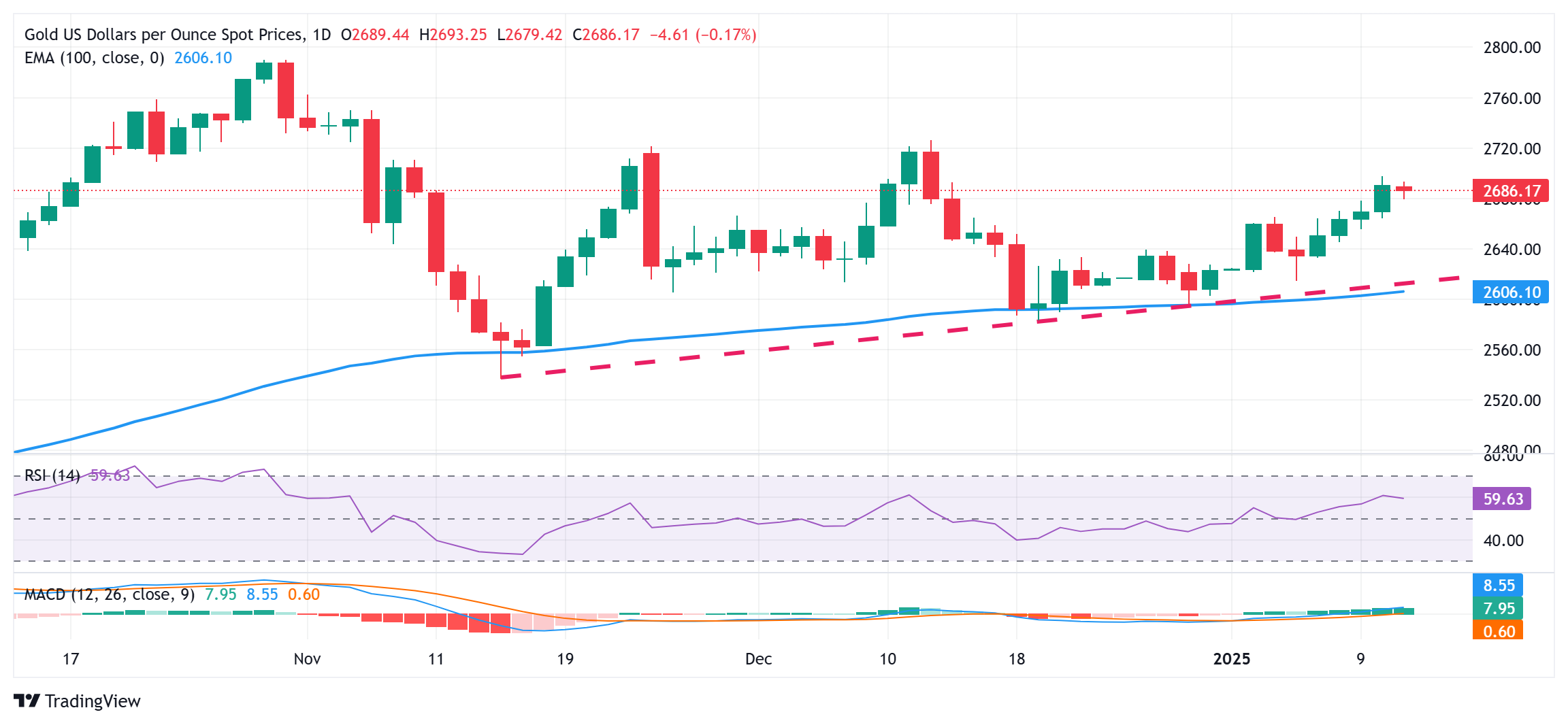
From a technical perspective, any further slide is likely to attract fresh buyers and find decent support near the $2,665-2,664 area. A convincing break below, however, could make the Gold price vulnerable to accelerate the downfall towards the $2,635 region. The downward trajectory could extend further towards the $2,605 confluence, comprising the 100-day Exponential Moving Average (SMA) and a multi-week-old ascending trend-line support.
On the flip side, bulls might now wait for a sustained strength beyond the $2,700 mark before placing fresh bets. Given that oscillators on the daily chart have been gaining positive traction and are still far from being in the overbought territory, the Gold price might then climb to the $2,715 region en route to the $2,730-2,732 area and the $2,746-2,748 supply zone.
Interest rates FAQs
Interest rates are charged by financial institutions on loans to borrowers and are paid as interest to savers and depositors. They are influenced by base lending rates, which are set by central banks in response to changes in the economy. Central banks normally have a mandate to ensure price stability, which in most cases means targeting a core inflation rate of around 2%. If inflation falls below target the central bank may cut base lending rates, with a view to stimulating lending and boosting the economy. If inflation rises substantially above 2% it normally results in the central bank raising base lending rates in an attempt to lower inflation.
Higher interest rates generally help strengthen a country’s currency as they make it a more attractive place for global investors to park their money.
Higher interest rates overall weigh on the price of Gold because they increase the opportunity cost of holding Gold instead of investing in an interest-bearing asset or placing cash in the bank. If interest rates are high that usually pushes up the price of the US Dollar (USD), and since Gold is priced in Dollars, this has the effect of lowering the price of Gold.
The Fed funds rate is the overnight rate at which US banks lend to each other. It is the oft-quoted headline rate set by the Federal Reserve at its FOMC meetings. It is set as a range, for example 4.75%-5.00%, though the upper limit (in that case 5.00%) is the quoted figure. Market expectations for future Fed funds rate are tracked by the CME FedWatch tool, which shapes how many financial markets behave in anticipation of future Federal Reserve monetary policy decisions.
Author

Haresh Menghani
FXStreet
Haresh Menghani is a detail-oriented professional with 10+ years of extensive experience in analysing the global financial markets.