Gold tumbles as US yields jump as traders await US Nonfarm Payrolls
- Gold price drops as rising US Treasury yields diminish its appeal amidst uncertain Fed actions.
- Mixed US jobless claims data contribute to market volatility ahead of crucial Nonfarm Payrolls release.
- Fed Chair Powell's optimistic economic assessment tempers expectations for imminent rate cuts.

Gold price retreats on Thursday as investors digested the latest US jobless claims data, ahead of the release of November’s Nonfarm Payrolls figures. A jump in US Treasury bond yields weighed on the yellow metal, which dropped 0.85%, trading at $2,626.
XAU/USD dips as US Treasury bond yields rise while traders trim bets that the US Federal Reserve (Fed) will lower borrowing costs by 25 basis points (bps) at the upcoming December meeting. Nevertheless, the mixed US jobs data revealed during the week kept investors uncertain about the outcome of the Fed’s decision.
Earlier, the US Department of Labor revealed that jobless claims for the last week exceeded the consensus, and the week ending on November 23 figures. At the same time, the US Bureau of Economic Analysis announced that the US trade deficit narrowed in October.
Bullion prices were capped by Fed Chair Jerome Powell’s comments on Wednesday. He said the economy remains robust, adding that he feels “very good about where the economy is and where monetary policy is.” Powell commented that the central bank “can afford to be a little more cautious as we try to find neutral.”
According to CME FedWatch Tool data, expectations that the Fed would cut rates at the December 17-18 meeting remain at 70%. However, Fed policymakers remained muted in their support for further easing, as next week’s inflation data would provide additional hints on the status of the distillation process.
Traders eye the release of November’s Nonfarm Payroll figures alongside the University of Michigan Consumer Sentiment.
Daily digest market movers: Gold price drops despite soft Initial Jobless Claims data
- Gold prices advanced as US real yields rose one basis point to 1.91%.
- The US 10-year Treasury bond yield is up one basis point to 4.18%.
- The US Dollar Index, which tracks the buck's performance against six currencies, stumbles 0.51% to 105.80 on the day.
- Initial Jobless Claims in the US increased by 9K to 224K for the week ending November 30, surpassing expectations of 215K, with the 4-week moving average climbing to 218.3K.
- The US trade deficit narrowed sharply in October to $73.8 billion, down from $83.8 billion in September, according to the Bureau of Economic Analysis.
- Data from the Chicago Board of Trade, via the December fed funds rate futures contract, shows investors estimate 19 bps of Fed easing by the end of 2024.
- Fed speakers crossed the newswires. St. Louis Fed President Alberto Musalem said that time might be near to slow or pause rate cuts. Richmond Fed’s Thomas Barkin said that risks for inflation and maximum employment remain balanced.
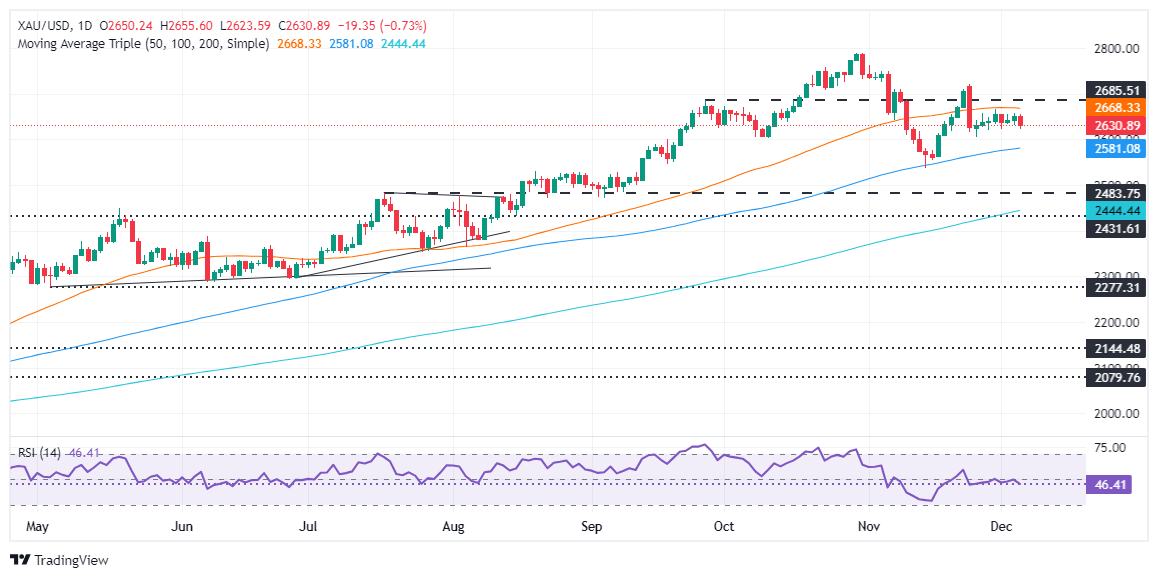
Technical outlook: Gold price consolidates between $2,600 and the 50-day SMA
Gold price remains consolidated after failing to register successive series of higher highs and lower lows, capped by the 50-day Simple Moving Average (SMA) at $2,667 on the upside. On the downside, XAU/USD failed to drop below the $2,620 figure, which could expose the $2,600 figure once cleared.
Momentum suggests that sellers are gathering some steam, as depicted by the recently turned bearish Relative Strength Index (RSI).
With that said, if XAU/USD slumps below $2,600, it will expose the confluence of an upslope support trendline and the 100-day Simple Moving Average (SMA) at $2,580, followed by the November 14 daily low and intermediate support at $2,536.
Conversely, if Gold reclaims $2,650, the next resistance would be the 50-day SMA. Once cleared, the next resistance would be $2,700, followed by the record high of $2,790.
Employment FAQs
Labor market conditions are a key element to assess the health of an economy and thus a key driver for currency valuation. High employment, or low unemployment, has positive implications for consumer spending and thus economic growth, boosting the value of the local currency. Moreover, a very tight labor market – a situation in which there is a shortage of workers to fill open positions – can also have implications on inflation levels and thus monetary policy as low labor supply and high demand leads to higher wages.
The pace at which salaries are growing in an economy is key for policymakers. High wage growth means that households have more money to spend, usually leading to price increases in consumer goods. In contrast to more volatile sources of inflation such as energy prices, wage growth is seen as a key component of underlying and persisting inflation as salary increases are unlikely to be undone. Central banks around the world pay close attention to wage growth data when deciding on monetary policy.
The weight that each central bank assigns to labor market conditions depends on its objectives. Some central banks explicitly have mandates related to the labor market beyond controlling inflation levels. The US Federal Reserve (Fed), for example, has the dual mandate of promoting maximum employment and stable prices. Meanwhile, the European Central Bank’s (ECB) sole mandate is to keep inflation under control. Still, and despite whatever mandates they have, labor market conditions are an important factor for policymakers given its significance as a gauge of the health of the economy and their direct relationship to inflation.
Author

Christian Borjon Valencia
FXStreet
Markets analyst, news editor, and trading instructor with over 14 years of experience across FX, commodities, US equity indices, and global macro markets.

















