Gold price remains depressed below $2,900 as traders keenly await US CPI report
- Gold price attracts some sellers for the second straight day amid a modest USD uptick.
- The overnight hawkish remarks from Fed Chair Powell revived demand for the buck.
- Trade war fears should help limit any corrective slide for the safe-haven XAU/USD pair.

Gold price (XAU/USD) maintains its offered tone through the first half of the European session on Wednesday, though it lacks follow-through selling as traders opt to wait for the release of the US consumer inflation figures. In the meantime, the US Dollar (USD) attracts some buyers in the wake of Federal Reserve (Fed) Chair Jerome Powell's hawkish remarks on Tuesday. This, along with a generally positive risk tone, undermines the commodity for the second straight day.
However, concerns that US President Donald Trump's new levies on commodity imports and promised reciprocal tariffs, along with geopolitical risks, should continue to act as a tailwind for the safe-haven Gold price. This, in turn, warrants some caution before confirming that the XAU/USD has topped out in the near term and positioning for any meaningful corrective decline from the all-time peak, around the $2,942-2,943 area touched on Tuesday amid trade war fears.
Gold price bears seem non committed amid worries about Trump's tariffs
- Federal Reserve Chair Jerome Powell, in remarks before the Senate Banking Committee on Tuesday, called the economy strong overall with a solid labor market and said that inflation is easing but still above the 2% goal.
- This comes on top of Friday's mostly upbeat US employment details and expectations that US President Donald Trump's policies would reignite inflationary pressure, which could allow the Fed to stick to its hawkish stance.
- The US Dollar gains some positive traction in the wake of rising bets that the Fed would hold interest rates steady in the foreseeable future and exert pressure on the Gold price for the second consecutive day on Wednesday.
- US President Donald Trump signed executive orders to impose 25% tariffs on steel and aluminum imports into the US and promised broader reciprocal tariffs to match the levies other governments charge on US products.
- Trump also signaled he would look at imposing additional tariffs on automobiles, pharmaceuticals, and computer chips, which fueled worries about a global trade war and acts as a tailwind for the safe-haven precious metal.
- Investors now look forward to the release of the latest US consumer inflation figures for fresh cues about the Fed's rate-cut path and determining the near-term trajectory for the USD and the non-yielding yellow metal.
- The headline US Consumer Price Index is seen rising 2.9% YoY in January and the core CPI (excluding food and energy prices) coming in at a 3.1% YoY rate, slightly lower than the 3.2% recorded in the previous month.
Gold price technical setup supports prospects for emergence of dip-buying
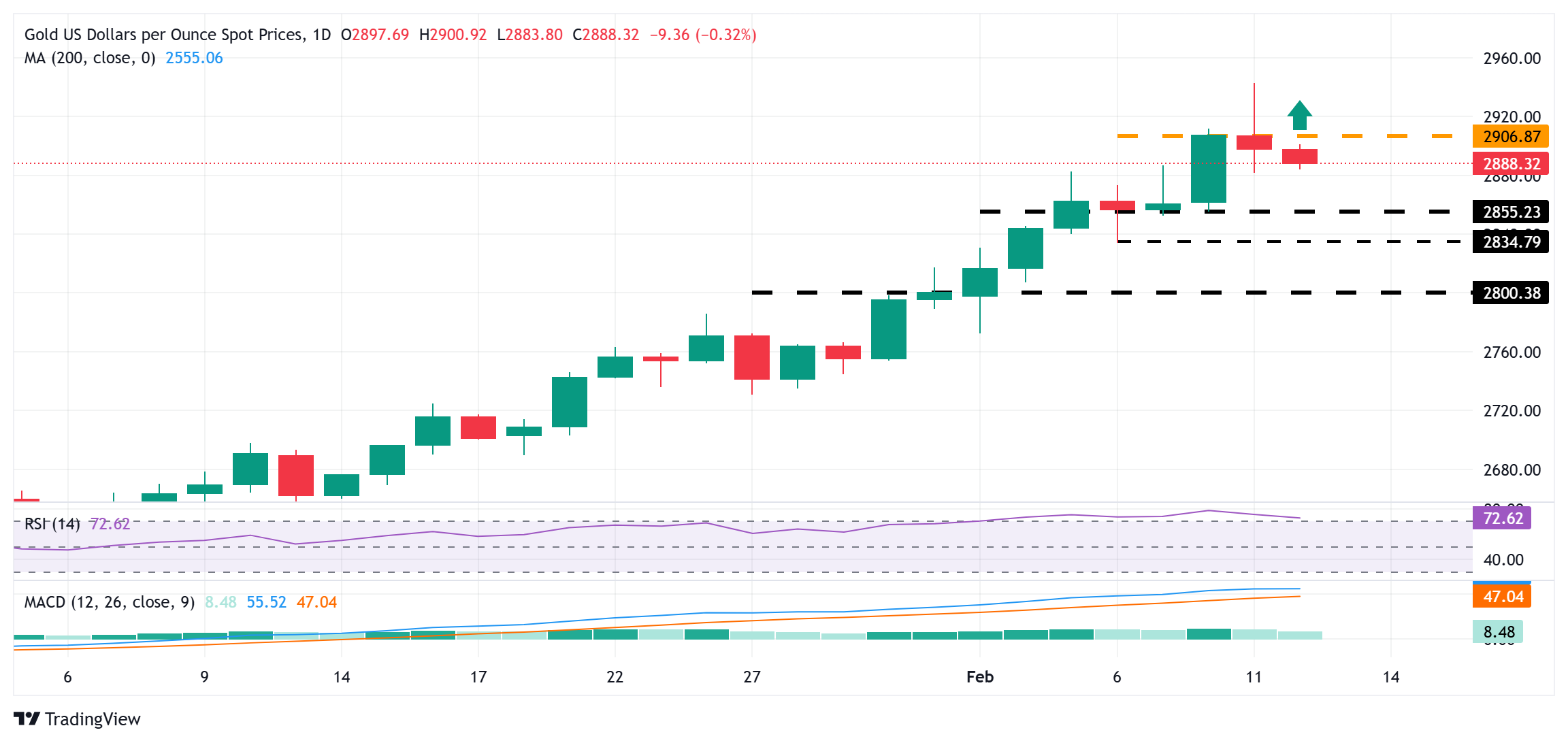
From a technical perspective, the overnight Relative Strength Index (RSI) on the daily chart turns out to be a key factor that prompts some profit-taking around the Gold price. That said, any further slide might still be seen as a buying opportunity and remain limited near the $2,855-2,852 region. This is followed by support near the $2,834 area, which if broken could drag the XAU/USD further towards the $2,800 mark.
On the flip side, bulls might now wait for a move back above the $2,910 immediate hurdle before placing fresh bets. The subsequent move up could lift the Gold price back towards the $2,942-2,943 region, or the all-time peak touched on Tuesday. Some follow-through buying would set the stage for an extension of the recent well-established uptrend witnessed over the past two months or so.
Economic Indicator
Consumer Price Index (YoY)
Inflationary or deflationary tendencies are measured by periodically summing the prices of a basket of representative goods and services and presenting the data as The Consumer Price Index (CPI). CPI data is compiled on a monthly basis and released by the US Department of Labor Statistics. The YoY reading compares the prices of goods in the reference month to the same month a year earlier.The CPI is a key indicator to measure inflation and changes in purchasing trends. Generally speaking, a high reading is seen as bullish for the US Dollar (USD), while a low reading is seen as bearish.
Read more.Next release: Wed Feb 12, 2025 13:30
Frequency: Monthly
Consensus: 2.9%
Previous: 2.9%
Source: US Bureau of Labor Statistics
The US Federal Reserve has a dual mandate of maintaining price stability and maximum employment. According to such mandate, inflation should be at around 2% YoY and has become the weakest pillar of the central bank’s directive ever since the world suffered a pandemic, which extends to these days. Price pressures keep rising amid supply-chain issues and bottlenecks, with the Consumer Price Index (CPI) hanging at multi-decade highs. The Fed has already taken measures to tame inflation and is expected to maintain an aggressive stance in the foreseeable future.
Tariffs FAQs
Tariffs are customs duties levied on certain merchandise imports or a category of products. Tariffs are designed to help local producers and manufacturers be more competitive in the market by providing a price advantage over similar goods that can be imported. Tariffs are widely used as tools of protectionism, along with trade barriers and import quotas.
Although tariffs and taxes both generate government revenue to fund public goods and services, they have several distinctions. Tariffs are prepaid at the port of entry, while taxes are paid at the time of purchase. Taxes are imposed on individual taxpayers and businesses, while tariffs are paid by importers.
There are two schools of thought among economists regarding the usage of tariffs. While some argue that tariffs are necessary to protect domestic industries and address trade imbalances, others see them as a harmful tool that could potentially drive prices higher over the long term and lead to a damaging trade war by encouraging tit-for-tat tariffs.
During the run-up to the presidential election in November 2024, Donald Trump made it clear that he intends to use tariffs to support the US economy and American producers. In 2024, Mexico, China and Canada accounted for 42% of total US imports. In this period, Mexico stood out as the top exporter with $466.6 billion, according to the US Census Bureau. Hence, Trump wants to focus on these three nations when imposing tariffs. He also plans to use the revenue generated through tariffs to lower personal income taxes.
Author

Haresh Menghani
FXStreet
Haresh Menghani is a detail-oriented professional with 10+ years of extensive experience in analysing the global financial markets.