Gold price sticks to gains comfortably above $3,100 ahead of US tariffs announcement
- Gold price attracts some dip-buyers on Wednesday and stalled the overnight pullback from the all-time high.
- Fed rate cut bets, subdued USD demand and rising trade tensions lend support to the safe-haven XAU/USD.
- The uptick lacks bullish conviction as traders now await Trump's impending reciprocal tariffs announcement.

Gold price (XAU/USD) trades with a positive bias through the first half of the European session on Wednesday and remains close to the all-time peak touched the previous day. Investors remain worried about US President Donald Trump's aggressive trade policies and their impact on the global economy. Adding to this, persistent geopolitical tensions turn out to be key factors acting as a tailwind for the safe-haven bullion.
Furthermore, expectations that the Federal Reserve (Fed) will resume its rate-cutting cycle soon in the wake of a tariff-driven US economic slowdown lend additional support to the non-yielding Gold price. This, along with subdued US Dollar (USD) demand, contributes to the modest intraday gains. The XAU/USD bulls, however, seem reluctant to place aggressive bets ahead of Trump's reciprocal tariffs announcement.
Daily Digest Market Movers: Gold price continues to attract safe-haven flows amid trade jitters
- Investors remain worried about the potential economic fallout from US President Donald Trump's trade policies, which assists the safe-haven Gold price to regain positive traction following the overnight pullback from a fresh all-time peak.
- The recent US macro data pointed to still sticky inflation and slowing economic growth, implying that the economy could be heading towards stagflation, which might force the Federal Reserve to resume its rate-cutting cycle in June.
- The concerns were fueled by the disappointing US ISM Manufacturing Purchasing Managers Index (PMI) on Tuesday, which fell from 50.3 to 49 in March and indicated that business activity contracted for the first time in three months.
- The report also revealed that inflation at the factory gate jumped to the highest level in nearly three years and the Employment Index highlighted a decrease in the sector's payrolls at an accelerating pace during the reported month.
- Adding to this, the Job Openings and Labor Turnover Survey (JOLTS) showed that the number of job openings on the last business day of February stood at 7.56 million, down from 7.76 million reported in the previous month.
- According to the CME Group's FedWatch Tool, the markets are currently pricing in the possibility that the Fed would cut rates by 80 basis points this year, undermining the US Dollar and further benefiting the non-yielding yellow metal.
- Asian equity markets tracked the overnight gains on Wall Street, which, along with overbought conditions, might hold back the XAU/USD bulls from placing fresh bets ahead of Trump's impending reciprocal tariffs announcement.
- In the meantime, the release of the US ADP report on private-sector employment and Factory Orders data might influence the USD, which could provide some impetus to the precious metal later during the early North American session.
Gold price needs to consolidate before the next leg up; bullish potential seems intact
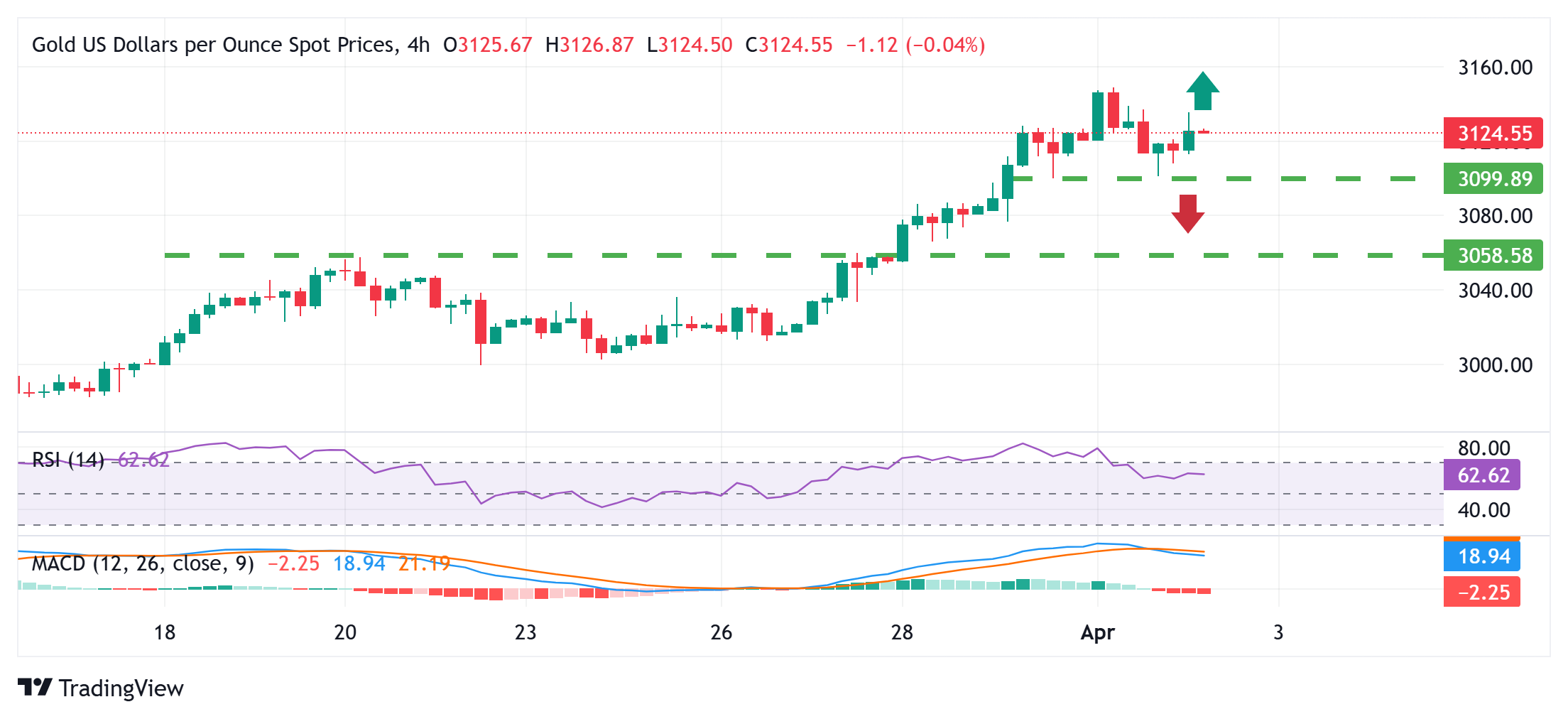
From a technical perspective, the overnight pullback from the all-time peak stalled near the $3,100 mark and the subsequent move up favors bullish traders. That said, the daily Relative Strength Index (RSI) stands well above the 70 mark and points to overbought conditions, making it prudent to wait for some near-term consolidation or a modest pullback before positioning for any further gains. Nevertheless, the constructive setup suggests that the path of least resistance for the Gold price remains to the upside.
In the meantime, the $3,100 round figure might continue to protect the immediate downside and act as a key pivotal point. A convincing break below, however, might prompt some long-unwinding and drag the Gold price below the $3,076 area, or the weekly swing low touched on Monday, towards the $3,057-3,058 resistance breakpoint. The downward trajectory could extend further toward the $3,036-3,035 support zone en route to the $3,000 psychological mark, which should act as a strong base for the XAU/USD.
Fed FAQs
Monetary policy in the US is shaped by the Federal Reserve (Fed). The Fed has two mandates: to achieve price stability and foster full employment. Its primary tool to achieve these goals is by adjusting interest rates. When prices are rising too quickly and inflation is above the Fed’s 2% target, it raises interest rates, increasing borrowing costs throughout the economy. This results in a stronger US Dollar (USD) as it makes the US a more attractive place for international investors to park their money. When inflation falls below 2% or the Unemployment Rate is too high, the Fed may lower interest rates to encourage borrowing, which weighs on the Greenback.
The Federal Reserve (Fed) holds eight policy meetings a year, where the Federal Open Market Committee (FOMC) assesses economic conditions and makes monetary policy decisions. The FOMC is attended by twelve Fed officials – the seven members of the Board of Governors, the president of the Federal Reserve Bank of New York, and four of the remaining eleven regional Reserve Bank presidents, who serve one-year terms on a rotating basis.
In extreme situations, the Federal Reserve may resort to a policy named Quantitative Easing (QE). QE is the process by which the Fed substantially increases the flow of credit in a stuck financial system. It is a non-standard policy measure used during crises or when inflation is extremely low. It was the Fed’s weapon of choice during the Great Financial Crisis in 2008. It involves the Fed printing more Dollars and using them to buy high grade bonds from financial institutions. QE usually weakens the US Dollar.
Quantitative tightening (QT) is the reverse process of QE, whereby the Federal Reserve stops buying bonds from financial institutions and does not reinvest the principal from the bonds it holds maturing, to purchase new bonds. It is usually positive for the value of the US Dollar.
Author

Haresh Menghani
FXStreet
Haresh Menghani is a detail-oriented professional with 10+ years of extensive experience in analysing the global financial markets.















