Gold price rallies on traders seeking safety
- Gold price is poised to reach $2,900 amid an uncertain environment triggered by Trump’s policies.
- US businesses in the services industry are cooling, indicating an ongoing slowdown.
- Fed officials turned unease on Trump tariffs, putting inflation ahead of employment.

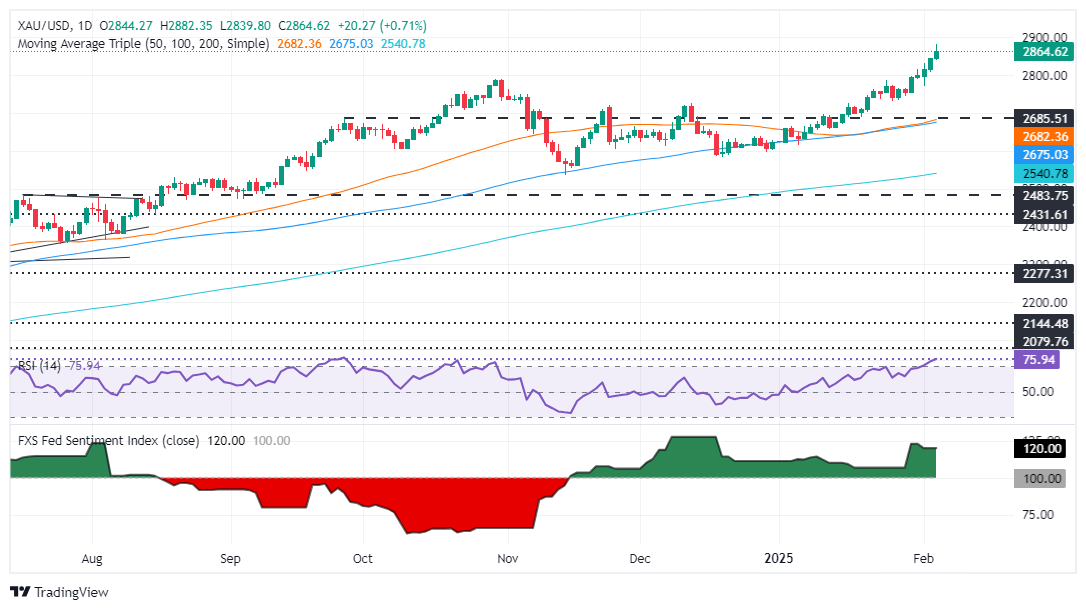
Gold price is set to extend its gains, rising more than 0.90% on Wednesday, sponsored by US Dollar weakness and falling US Treasury bond yields. The escalation of the China-US trade war keeps investors flocking to Gold’s safety appeal, and the XAU/USD trades near $2,870 as bulls target $2,900.
US President Donald Trump's rhetoric and policies continued to drive investors toward the golden metal, which is in unchartered territory. Traders are eyeing the $2,900 mark. Economic data revealed that the labor market remains solid after January’s ADP Employment Change report, which showed that private companies hired more people than foreseen.
However, not everything was positive on the data front. Business activity revealed by S&P Global and the Institute for Supply Management (ISM) showed that the services sector is cooling.
In the meantime, Federal Reserve (Fed) officials had crossed the wires and shown that they were uncertain about the impact of tariffs on inflation. Yet Chicago’s Fed President Austan Goolsbee said that ignoring tariffs' potential impact would be a mistake.
“If we see inflation rising or progress stalling in 2025, the Fed will be in the difficult position of trying to figure out if the inflation is coming from overheating or if it's coming from tariffs,” Goolsbee said.
Given the backdrop that Trump delayed 25% tariffs on Mexico and Canada for 30 days but levied 10% duties on China, uncertainty has kept investors uneasy about the potential disruption to global trade. Hence, they continued to seek the safety of the precious metals and ditched the Greenback.
Daily digest market movers: Gold remains underpinned by falling US yields
- The US Dollar Index (DXY), which tracks the buck’s performance versus a basket of six currencies, drops 0.38% and sits at 107.58 after hitting a three-week high at 109.88.
- The US 10-year Treasury bond yield plunges over nine basis points, down to 4.244%.
- US real yields, which correlate inversely to Bullion prices, dropped three basis points from 2.10% to 2.07%, a tailwind for XAU/USD.
- In January, the US ADP National Employment Change reported an increase in private sector jobs, rising from 176K to 183K and surpassing estimates of 150K.
- Concurrently, the ISM Services PMI for January registered at 52.9, slightly above forecasts of 52.8, although it decreased from December’s 54.0. Additionally, the S&P Global Services PMI decreased from 56.8 to 52.9 for the same period, still outperforming the anticipated 52.8.
- Money market fed funds rate futures are pricing in 52 basis points (bps) of easing by the Federal Reserve in 2025.
XAU/USD technical outlook: Gold prices set to challenge $2,900
After printing a new all-time high of $2,882, the yellow metal is set to challenge $2,890 ahead of the psychological $2,900 figure. Momentum remains bullish, and although the Relative Strength Index (RSI) has pushed well into overbought territory, it hasn’t reached the most extreme level above 80, which could pave the way for a mean-reversion trade.
On the other hand, if Gold tumbles below the $2,800 figure, the first support would be the January 27 swing low of $2,730, followed by $2,700.
Risk sentiment FAQs
In the world of financial jargon the two widely used terms “risk-on” and “risk off'' refer to the level of risk that investors are willing to stomach during the period referenced. In a “risk-on” market, investors are optimistic about the future and more willing to buy risky assets. In a “risk-off” market investors start to ‘play it safe’ because they are worried about the future, and therefore buy less risky assets that are more certain of bringing a return, even if it is relatively modest.
Typically, during periods of “risk-on”, stock markets will rise, most commodities – except Gold – will also gain in value, since they benefit from a positive growth outlook. The currencies of nations that are heavy commodity exporters strengthen because of increased demand, and Cryptocurrencies rise. In a “risk-off” market, Bonds go up – especially major government Bonds – Gold shines, and safe-haven currencies such as the Japanese Yen, Swiss Franc and US Dollar all benefit.
The Australian Dollar (AUD), the Canadian Dollar (CAD), the New Zealand Dollar (NZD) and minor FX like the Ruble (RUB) and the South African Rand (ZAR), all tend to rise in markets that are “risk-on”. This is because the economies of these currencies are heavily reliant on commodity exports for growth, and commodities tend to rise in price during risk-on periods. This is because investors foresee greater demand for raw materials in the future due to heightened economic activity.
The major currencies that tend to rise during periods of “risk-off” are the US Dollar (USD), the Japanese Yen (JPY) and the Swiss Franc (CHF). The US Dollar, because it is the world’s reserve currency, and because in times of crisis investors buy US government debt, which is seen as safe because the largest economy in the world is unlikely to default. The Yen, from increased demand for Japanese government bonds, because a high proportion are held by domestic investors who are unlikely to dump them – even in a crisis. The Swiss Franc, because strict Swiss banking laws offer investors enhanced capital protection.
Author

Christian Borjon Valencia
FXStreet
Markets analyst, news editor, and trading instructor with over 14 years of experience across FX, commodities, US equity indices, and global macro markets.

















