Gold price plummets over 4% this week as risk sentiment improves
- Gold price tumbles over 1.50% on the US-China tariff truce and related capital shift toward risk assets.
- US data shows slowing Retail Sales and mixed housing prints; inflation expectations remain elevated.
- Fed officials remain cautious on cuts despite disinflation progress; Treasury yields rebound, supporting stronger US Dollar.

Gold prices fell by more than 1.50% on Friday and are set to end the week with losses of over 4% as an improvement in market mood prompted investors to sell the precious metal in favor of riskier assets. At the time of writing, the XAU/USD trades at $3,187 after hitting a daily high of $3,252.
Bullion began the week on a lower note as news of a de-escalation of the US-Sino trade war and an agreement to reduce tariffs by 115% sent Gold plunging. Economic data from the United States (US) revealed during the week that the XAU/USD traded within the $3,120-$3,265 range over the last four days, but ultimately buyers seemed to be losing steam.
Earlier, data from the University of Michigan (UoM) showed that American households had become pessimistic about the economy, as revealed in May’s Consumer Sentiment poll. Inflation expectations are skewed to the upside. Earlier housing data was mixed, and import prices rose.
After the data release, Gold trimmed some of its losses as market participants priced in more than 55 basis points of easing by the Federal Reserve (Fed). Nevertheless, as they digested all the data, US Treasury yields paired their earlier losses, and the Greenback turned positive.
This is because US economic data this week has signaled continued progress in the disinflation process. Nonetheless, Fed officials remain cautious about easing policy, citing uncertainty over trade policies and tariffs and their potential impact on inflation.
On the growth side, Retail Sales continued to decelerate in April, but the latest update from the Atlanta Fed’s GDPNow suggests that the US economy could grow at a rate of 2.4% in Q2 2025.
Next week, the US economic docket will feature a slew of Fed speakers, as well as flash PMIs and housing data, which will be closely watched.
Daily digest market movers: Gold treads water as bad US Consumer Sentiment data boosts the USD
- The University of Michigan Consumer Sentiment Index in May dropped to its lowest level since July 2022, at 50.8, below estimates of 53.8, down from April’s 52.2. Americans' inflation expectations for the next year rose from 6.5% to 7.3%. and for the next five years it jumped from 4.4% to 4.6%.
- US Housing Starts in April rose by 1.6% MoM from 1.339 million to 1.361 million, below estimates. Building Permits for the same period plummeted to -4.7% after registering a 1.9% increase in March.
- US Import Prices in April expanded by 0.1% MoM, above forecasts and March’s -0.4% fall.
- Washington and Beijing announced a 90-day pause earlier this week to work out the details of ending their tit-for-tat trade war.
- US Treasury bond yields erased their previous losses, with the US 10-year Treasury note yield flat at around 4.437%. Meanwhile, US real yields are also consolidating at 2.0907%.
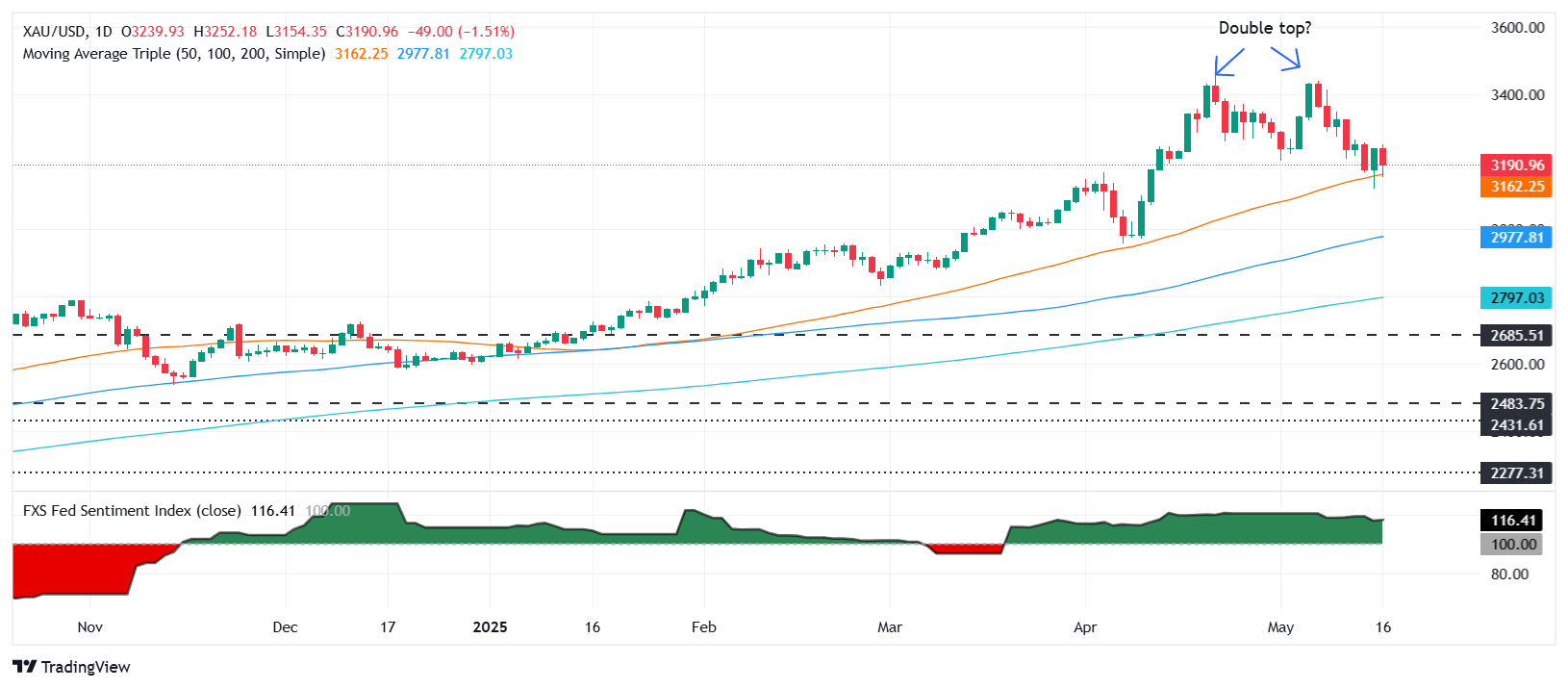
XAU/USD technical outlook: Double top at risk of being negated
As I wrote yesterday, “Gold’s bounce could be short-lived if buyers fail to achieve a daily close above $3,200.” Although it was achieved, sellers stepped in, dragging XAU/USD below the latter and confirming the “double top” remains in play. Momentum favors a further downside, as the Relative Strength Index (RSI) remains bearish.
Therefore, if XAU/USD holds below $3,200, the next support level would be the 50-day Simple Moving Average (SMA) at $3,155, followed by $3,100. On the flip side, if Gold clears $3,200, the next resistance would be the May 14 peak of $3,257 ahead of $3,300.
Gold FAQs
Gold has played a key role in human’s history as it has been widely used as a store of value and medium of exchange. Currently, apart from its shine and usage for jewelry, the precious metal is widely seen as a safe-haven asset, meaning that it is considered a good investment during turbulent times. Gold is also widely seen as a hedge against inflation and against depreciating currencies as it doesn’t rely on any specific issuer or government.
Central banks are the biggest Gold holders. In their aim to support their currencies in turbulent times, central banks tend to diversify their reserves and buy Gold to improve the perceived strength of the economy and the currency. High Gold reserves can be a source of trust for a country’s solvency. Central banks added 1,136 tonnes of Gold worth around $70 billion to their reserves in 2022, according to data from the World Gold Council. This is the highest yearly purchase since records began. Central banks from emerging economies such as China, India and Turkey are quickly increasing their Gold reserves.
Gold has an inverse correlation with the US Dollar and US Treasuries, which are both major reserve and safe-haven assets. When the Dollar depreciates, Gold tends to rise, enabling investors and central banks to diversify their assets in turbulent times. Gold is also inversely correlated with risk assets. A rally in the stock market tends to weaken Gold price, while sell-offs in riskier markets tend to favor the precious metal.
The price can move due to a wide range of factors. Geopolitical instability or fears of a deep recession can quickly make Gold price escalate due to its safe-haven status. As a yield-less asset, Gold tends to rise with lower interest rates, while higher cost of money usually weighs down on the yellow metal. Still, most moves depend on how the US Dollar (USD) behaves as the asset is priced in dollars (XAU/USD). A strong Dollar tends to keep the price of Gold controlled, whereas a weaker Dollar is likely to push Gold prices up.
Author

Christian Borjon Valencia
FXStreet
Markets analyst, news editor, and trading instructor with over 14 years of experience across FX, commodities, US equity indices, and global macro markets.