|

Gold Price News and Forecast: XAU/USD looks north

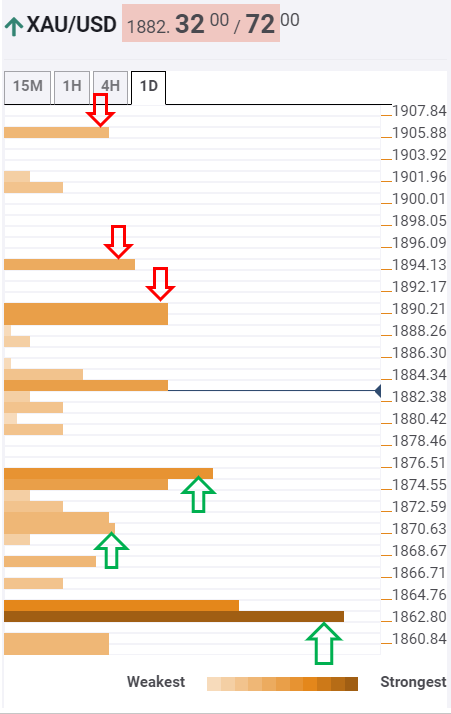
Gold Price Analysis: XAU/USD looks north, two key levels to watch out – Confluence Detector

Gold (XAU/USD) started out the US Non-Farm Payrolls (NFP) week on a solid footing, rallying nearly $20 on Monday. The metal bounced-off the SMA100 one-day support for the third straight day, courtesy of the broad retreat in the US dollar from two-month peaks.

The risk-on mood returned amid upbeat Chinese Industrial Profits data, lifting the sentiment on the global markets at the expense of the safe-haven greenback. Further, hopes of the US Congress reaching a fiscal stimulus deal also added to the broader market optimism.   
Read more ...

fxsoriginal

Asia Update: Stocks fly as banks finally take off

Gold appeared to put in a good a base around $1,850 after a reasonably negative September, with the metal averaging a 1-2% move lower during the month in the past five years. It’s now down almost 5% on the month, and at slightly more compelling levels to enter into longs, given positions are much cleaner than even after last month sell-off. 
 
Gold is up on a weaker US dollar, and more gains could be in the offing as focus shifts to US elections, political uncertainty and geopolitical risks. 

Read more ...

Author

FXStreet Team

Composed of a group of economic journalists and FX experts, the FXStreet content team produces and oversees all content published on FXStreet. It provides a purely journalistic approach to the Forex market.


More from FXStreet Team
Share:

Editor's Picks

AUD/USD holds above 0.6950 as bullish USD caps gains

AUD/USD edges lower during the Asian session on Tuesday, stalling a two-day recovery move from a two-month low, touched last week. An extended rout in the fixed income market keeps US bond yields elevated near multi-year highs. This, along with geopolitical uncertainties, helps the US Dollar retain its bullish tone despite receding October Fed hike bets. However, expectations for another RBA rate hike this month could act as a tailwind for the Aussie.

USD/JPY remains confined in a range; 158.00 holds the key

USD/JPY extends its consolidative move during the Asian session on Tuesday, trading below 158.00 amid diverging forces. Hawkish BoJ expectations support the Japanese Yen amid looming intervention risks. Meanwhile, geopolitical uncertainty and elevated US bond yields keep the US Dollar near its YTD high despite receding October Fed hike bets. This, in turn, holds back traders from placing aggressive directional bets.

Gold holds steady below $4,150 as receding Fed hike bets lend support

Gold continues its struggle to gain any meaningful traction, holding steady below $4,150 during the Asian session on Tuesday. Receding October Fed hike bets act as a tailwind for the non-yielding bullion, though a bullish US Dollar caps the upside. Furthermore, traders await the release of the FOMC Minutes on Wednesday for more cues about the future policy path and some meaningful impetus.

Ethereum: BitMine scoops extra ETH tokens following Q3 outperformance
Ethereum (ETH) treasury firm BitMine Immersion continued its buying streak of the top altcoin last week. The firm acquired 15,112 ETH, lifting its holdings to 6.016 million ETH, representing 4.9% of ETH's circulating supply and worth $16.16 billion at the time of writing. That brings the company roughly 98.5% closer to acquiring 5% of ETH's supply, a goal it tags "Alchemy of 5%."
Markets just priced out rate hikes on financial stress. This chart shows why 2022-23 says they’ll be wrong

Traders have taken about one quarter-point hike out of their European Central Bank forecasts since mid-September, betting the ECB will stop raising rates because of a French debt selloff. The same bet failed twice in 2022 and 2023, when the ECB kept raising rates through financial stress because inflation was above its 2% target. Euro-area inflation came in at 3.8% in September.

Eurozone inflation just hit 3.8%, its highest in three years. This chart shows why the ECB can’t simply hike its way out

The ECB would normally have a relatively straightforward answer to inflation running almost twice its target: raise interest rates. But these are not normal circumstances. This time, the bond market is already doing part of the tightening for it, leaving the ECB facing an increasingly difficult dilemma.