Gold price jumps to fresh record highs as geopolitical risks boost safe-haven flows
- Gold price trades in positive territory in Monday’s early European session.
- The US Fed rate cut and Middle East geopolitical risks continue to underpin the precious metal.
- The renewed US Dollar demand might cap the upside of the XAU/USD.

The Gold price (XAU/USD) reaches a record high on Monday, supported by a softer Greenback. The start of a monetary easing cycle of the Federal Reserve’s (Fed) and the expectation of deeper rate cuts this year might underpin the non-interest-bearing Gold price. Furthermore, the rising geopolitical tensions in the Middle East might lead to fresh allocation towards safe-haven assets like gold.
Looking ahead, traders will keep an eye on the flash reading of the US Purchasing Managers Index (PMI) data, which is due later on Monday. However, the stronger-than-expected outcome could lift the USD and weigh on the USD-denominated Gold price.
Daily Digest Market Movers: Gold price remains stronger amid global factors
- "The forced liquidation of short positions may push the gold price higher into historical highs, as the US dollar generally holds its ground against a basket of major currencies, and rising bond yields create an unfavorable environment for gold," said FxPro analysts.
- Hezbollah and Israel exchanged heavy fire on Sunday, as the Lebanese militant group launched missiles deep into northern Israeli territory after facing some of the most intense bombardment in almost a year of conflict, per CNN.
- Fed Philadelphia President Patrick Harker said on Friday that the US central bank has effectively navigated a challenging economy over the last few years. Harker further stated that "hard" and "soft" data are both important in decision-making.
- Fed Governor Michelle Bowman noted on Friday that it was appropriate to recalibrate the Fed funds rate level, but she preferred a smaller first move as they have not yet achieved the inflation target.
- Fed Governor Christopher Waller noted on Friday that the decision to cut interest rates by an accelerated 50 bps was the right call, but the US central bank could even pause, depending on further data.
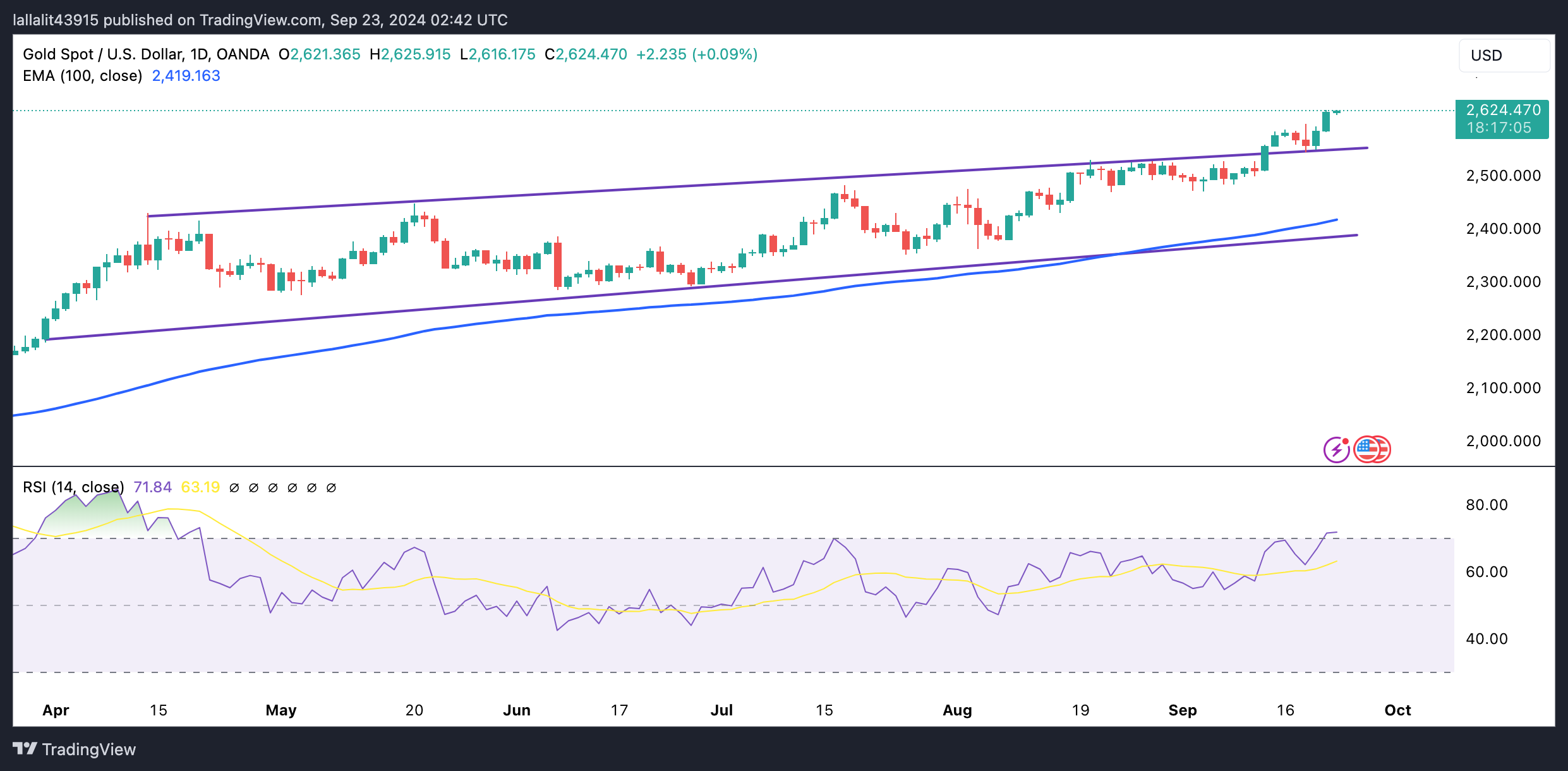
Technical Analysis: Gold price holds above $2,600 amid an overbought RSI
The Gold price edges higher on the day. The precious metal keeps a strong bullish trend on the daily timeframe as the price is well-supported above the key 100-day Exponential Moving Average (EMA). However, the 14-day Relative Strength Index (RSI) stands near 70.50, indicating the overbought RSI condition. This suggests that further consolidation cannot be ruled out before positioning for any near-term Gold price rise.
The yellow metal approaches a major resistance area near the all-time high at $2,625. A decisive break above this level could pave the way to the $2,700 psychological level.
On the flip side, the first downside target emerges at the $2,600 round figure. A breach of this level could see a downward move back towards the resistance-turned-support level at $2,560. The next contention level is located at $2,485, the low of September 6.
Gold FAQs
Gold has played a key role in human’s history as it has been widely used as a store of value and medium of exchange. Currently, apart from its shine and usage for jewelry, the precious metal is widely seen as a safe-haven asset, meaning that it is considered a good investment during turbulent times. Gold is also widely seen as a hedge against inflation and against depreciating currencies as it doesn’t rely on any specific issuer or government.
Central banks are the biggest Gold holders. In their aim to support their currencies in turbulent times, central banks tend to diversify their reserves and buy Gold to improve the perceived strength of the economy and the currency. High Gold reserves can be a source of trust for a country’s solvency. Central banks added 1,136 tonnes of Gold worth around $70 billion to their reserves in 2022, according to data from the World Gold Council. This is the highest yearly purchase since records began. Central banks from emerging economies such as China, India and Turkey are quickly increasing their Gold reserves.
Gold has an inverse correlation with the US Dollar and US Treasuries, which are both major reserve and safe-haven assets. When the Dollar depreciates, Gold tends to rise, enabling investors and central banks to diversify their assets in turbulent times. Gold is also inversely correlated with risk assets. A rally in the stock market tends to weaken Gold price, while sell-offs in riskier markets tend to favor the precious metal.
The price can move due to a wide range of factors. Geopolitical instability or fears of a deep recession can quickly make Gold price escalate due to its safe-haven status. As a yield-less asset, Gold tends to rise with lower interest rates, while higher cost of money usually weighs down on the yellow metal. Still, most moves depend on how the US Dollar (USD) behaves as the asset is priced in dollars (XAU/USD). A strong Dollar tends to keep the price of Gold controlled, whereas a weaker Dollar is likely to push Gold prices up.
Author

Lallalit Srijandorn
FXStreet
Lallalit Srijandorn is a Parisian at heart. She has lived in France since 2019 and now becomes a digital entrepreneur based in Paris and Bangkok.

















