Gold price struggles for firm intraday direction; flat lines near record high amid mixed cues
- Gold price remains well supported by the uncertainty surrounding Trump’s aggressive trade policies.
- Fed rate cut bets further benefit the yellow metal, though a modest USD uptick caps further gains.
- An improvement in global risk sentiment would further warrant some caution for the XAU/USD bulls.

Gold price (XAU/USD) remains confined in a narrow trading band near the all-time peak through the first half of the European session on Friday and seems poised to register strong gains for the second straight week. Investors remain worried about the potential economic fallout from US President Donald Trump's aggressive trade policies. This, along with bets that the Federal Reserve (Fed) will cut interest rates several times in 2025, turn out to be key factors acting as a tailwind for the non-yielding yellow metal.
The XAU/USD bulls, however, refrain from placing fresh bets amid a positive risk tone, bolstered by positive comments out of the US-Canada trade talks and reports that there will be enough Democratic votes to avoid a US government shutdown. Apart from this, a further US Dollar (USD) recovery from a multi-month low touched on Tuesday contributes to capping the upside for the Gold price. Nevertheless, the fundamental backdrop suggests that the path of least resistance for the commodity remains to the upside.
Daily Digest Market Movers: Gold price consolidates before the next leg up amid rising trade tensions, Fed rate cut bets
- US President Donald Trump ups the ante on the tariff war, saying that he would levy a 200% duty on European wine and cognac imports unless the European Union removes surcharges on US whiskey. Trump had earlier threatened that he would respond to any countermeasures announced by the EU.
- This comes on top of Trump's 25% tariff on all steel and aluminum imports, which took effect on Wednesday, fueling concerns about the risk of a further escalation in the tariff war between the US and its top trading partner, and pushing the safe-haven Gold price to a fresh record high on Friday.
- Traders ramp up their bets that the Federal Reserve will have to lower interest rates this year by more than expected amid the rising possibility of an economic downturn on the back of the Trump administration’s aggressive policies. The expectations were lifted by softer US inflation figures this week.
- In fact, data released on Wednesday showed that the headline US Consumer Price Index (CPI) rose less than expected, by 2.8% on a yearly basis in February, down from 3% in the previous month. Moreover, the core gauge eased to the 3.1% YoY rate from the 3.3% increase registered in January.
- Adding to this, the US Producer Price Index (PPI) was unchanged in February and the yearly rate slowed to 3.2% from 3.7% in January. This pointed to signs of easing inflationary pressure in the US, which, along with a cooling US labor market, supports prospects for further easing by the Fed.
- Traders are currently pricing in the possibility of three 25 basis points Fed rate cuts each at the June, July, and October monetary policy meetings. This, in turn, is seen as another factor that underpins the non-yielding yellow metal, though a combination of factors keeps a lid on further gains.
- The global risk sentiment gets a minor lift in reaction to some positive comments out of the White House and from Canadian officials. Ontario Premier Doug Ford said that the meeting with US Commerce Secretary Howard Lutnick has lowered the temperature on the ongoing trade war.
- Moreover, Russian President Vladimir Putin expressed conditional support for a 30-day ceasefire proposal put forward by the US and Ukraine. This, along with reports that there will be enough Democratic votes to avoid a US government shutdown, further boosts investors' confidence.
- Meanwhile, the US Dollar Index (DXY), which tracks the Greenback against a basket of currencies, prolongs its recovery from the lowest level since October 16 for the third successive day. This further contributes to capping the upside for the commodity during the Asian session.
- Traders now look forward to the Preliminary release of the Michigan US Consumer Sentiment and Inflation Expectations Index for short-term opportunities. The market focus will then shift to the crucial two-day FOMC monetary policy meeting starting next Tuesday.
Gold price bulls remain on the sidelines amid slightly overbought conditions on the weekly chart; not ready to give up yet
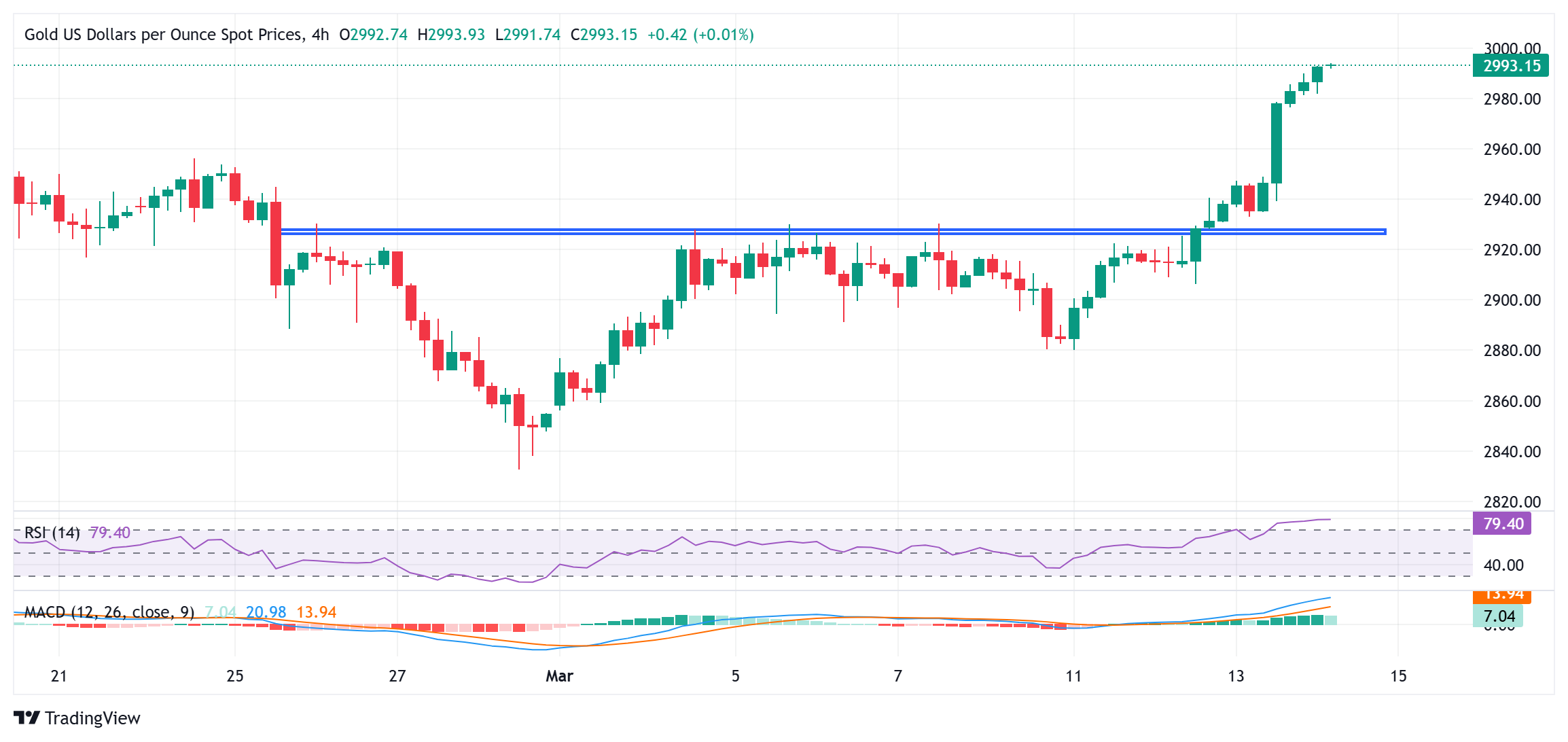
From a technical perspective, this week's breakout through the $2,928-2,930 horizontal resistance and a subsequent move beyond the previous record high, around the $2,956 region, could be seen as a fresh trigger for bulls. That said, the Relative Strength Index (RSI) on the daily chart remains close to the overbought territory and makes it prudent to wait for some near-term consolidation or a modest pullback before the next leg up. The broader setup, however, suggests that the path of least resistance for the Gold price remains to the upside and supports prospects for an extension of a nearly three-month-old well-established uptrend.
In the meantime, any meaningful corrective slide is more likely to attract fresh buyers near the $2,956 area, below which the Gold price could drop to the $2,930-2,928 horizontal resistance breakpoint, now turned support. The latter should act as a key pivotal point and a convincing break below might prompt some technical selling, which should pave the way for deeper losses. The XAU/USD pair might then accelerate the fall towards the $2,900 round figure en route to the $2,880 region, or the weekly low touched on Tuesday.
Risk sentiment FAQs
In the world of financial jargon the two widely used terms “risk-on” and “risk off'' refer to the level of risk that investors are willing to stomach during the period referenced. In a “risk-on” market, investors are optimistic about the future and more willing to buy risky assets. In a “risk-off” market investors start to ‘play it safe’ because they are worried about the future, and therefore buy less risky assets that are more certain of bringing a return, even if it is relatively modest.
Typically, during periods of “risk-on”, stock markets will rise, most commodities – except Gold – will also gain in value, since they benefit from a positive growth outlook. The currencies of nations that are heavy commodity exporters strengthen because of increased demand, and Cryptocurrencies rise. In a “risk-off” market, Bonds go up – especially major government Bonds – Gold shines, and safe-haven currencies such as the Japanese Yen, Swiss Franc and US Dollar all benefit.
The Australian Dollar (AUD), the Canadian Dollar (CAD), the New Zealand Dollar (NZD) and minor FX like the Ruble (RUB) and the South African Rand (ZAR), all tend to rise in markets that are “risk-on”. This is because the economies of these currencies are heavily reliant on commodity exports for growth, and commodities tend to rise in price during risk-on periods. This is because investors foresee greater demand for raw materials in the future due to heightened economic activity.
The major currencies that tend to rise during periods of “risk-off” are the US Dollar (USD), the Japanese Yen (JPY) and the Swiss Franc (CHF). The US Dollar, because it is the world’s reserve currency, and because in times of crisis investors buy US government debt, which is seen as safe because the largest economy in the world is unlikely to default. The Yen, from increased demand for Japanese government bonds, because a high proportion are held by domestic investors who are unlikely to dump them – even in a crisis. The Swiss Franc, because strict Swiss banking laws offer investors enhanced capital protection.
Author

Haresh Menghani
FXStreet
Haresh Menghani is a detail-oriented professional with 10+ years of extensive experience in analysing the global financial markets.