Gold Price Forecast: XAUUSD gets punished by a strong US dollar, meanders around $1730s
- The precious metals complex remains on the defensive, with gold reaching nine-month lows and silver at two-year lows.
- Risk aversion dominates Tuesday’s trading session as investors brace for June’s US CPI report.
- Commerzbank analysts commented that a solid US dollar and gold ETF’s outflows keep XAUUSD heavy.
- Gold Price Forecast (XAUUSD): Tilted to the downside and might test $1700; a correction towards $1750 is on the cards.

Gold (XAUUSD) spot declined during Tuesday’s North American session due to risk-aversion, courtesy of China’s coronavirus reemergence, the EU’s energy crisis, and recession fears. That usually lifts the yellow metal price, though haven flows are going towards the greenback and US Treasuries, as US bond yields are falling across the board.
Gold declines on a firm US dollar, a dismal sentiment, and on ETF’s outflows
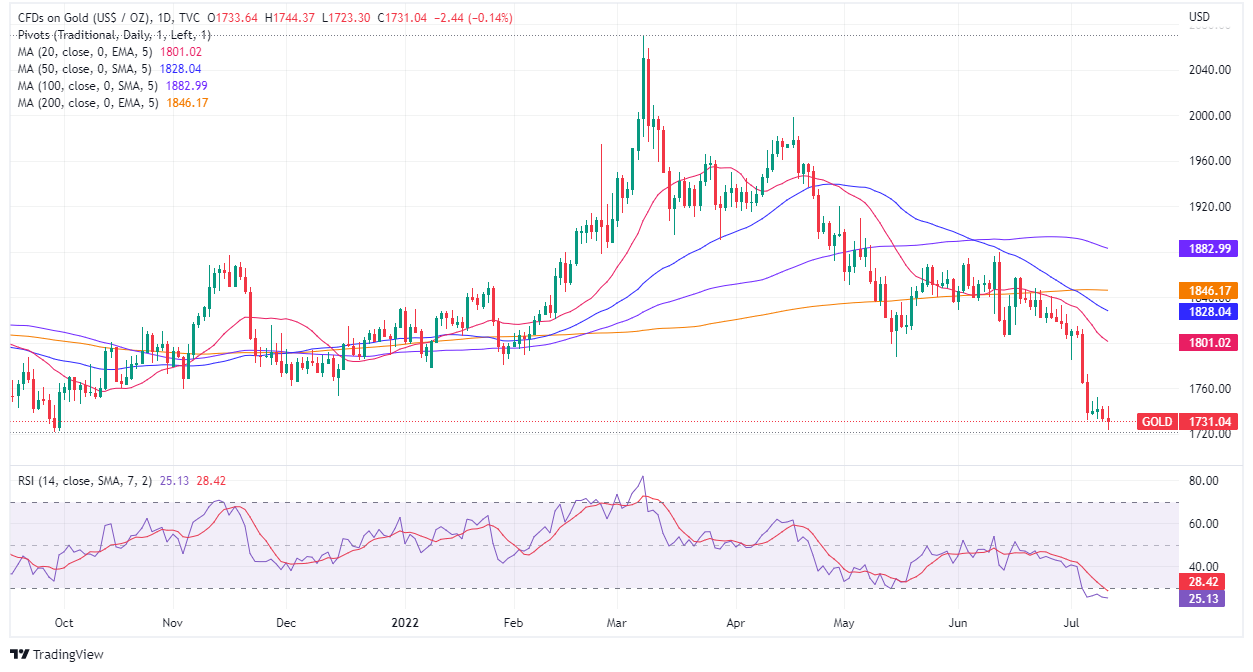
XAUUSD is trading at around $1731 a troy ounce after seesawing between the high/low of the day during the Asian session. The yellow metal recorded its low around $1722, followed by a rally towards the daily high near $1744, and then gold’s price stayed range-bound within the $1728-1740 for the rest of the day.
Sentiment remains dismal as traders brace for the US inflation report on Wednesday. A day later, prices paid by producers would shed some light on raw materials and commodity prices and could be a prelude to what could happen during the Q2 earnings season. According to Press Secretary Jean-Pierre, the White House expressed that the new CPI would be elevated.
Additionally fueling investors’ worries is China’s Covid-19 resurgence witnessed the lockdown of Wugang for three days due to 1 Covid case, while Shanghai remains doing massive tests across the city.
Elsewhere, analysts at Commerzbank expressed that a firm US dollar is not the only reason weighing on lower gold prices but also the ongoing and solid ETF outflows.
“The gold ETFs tracked by Bloomberg registered outflows of 29 tons last week, their most pronounced in eight weeks and the fourth week in a row (with growing momentum). Speculative financial investors have likewise been withdrawing further from the gold of late. According to the CFTC’s statistics, their net long positions are at their lowest level in over three years,” Commerzbank analysts wrote.
What to watch
In the week ahead, the US economic calendar will feature the US Consumer Price Index and the Beige Book on Wednesday, followed by Thursday’s PPI and Initial Jobless Claims. On Friday, the University of Michigan Consumer Sentiment could be again the spotlight ahead of the Federal Reserve July meeting.
Gold Price Forecast (XAUUSD): Technical outlook
XAUUSD is downward biased, despite remaining in choppy trading conditions, as sellers cannot challenge the $1700 figure. Gold traders should be aware that oscillators are showing oversold readings, indicating that selling pressure eases, though the RSI’s slope keeps aiming downwards, opening the door for a challenge of $1700.
Therefore, XAUUSD’s break below September 29, 2021 low at $1721.71 would expose the $1700 figure. On the upside, XAUUSD’s first resistance would be $1750. A breach of the latter would expose the 20-day EMA at around $1800.
Author

Christian Borjon Valencia
FXStreet
Markets analyst, news editor, and trading instructor with over 14 years of experience across FX, commodities, US equity indices, and global macro markets.

















