Gold attracts some buyers on global growth worries, rising Fed rate cut bets
- Gold price rises in Monday’s early European session.
- Concerns over the US economy boost the safe-haven flows, supporting the Gold price.
- Senators reach a tentative deal to end the government shutdown.
Gold price (XAU/USD) jumps to near $4,075 during the early European trading hours on Monday. The precious metal edges higher amid uncertainty over the US economic outlook. Traders ramped up bets on a US rate cut following weak US private jobs data and a downbeat University of Michigan (UoM) Consumer Sentiment Index survey. Lower interest rates could reduce the opportunity cost of holding Gold, supporting the non-yielding precious metal.
On the other hand, signs that the US government shutdown may end could undermine safe-haven assets such as Gold. US senators are voting on a deal on Monday that could end the longest government shutdown in history. Furthermore, easing trade tensions between the US and China, the world’s two largest economies, could also drag the yellow metal lower in the near term.
Traders will closely monitor the US October Consumer Price Index (CPI) inflation data later on Thursday. The headline CPI is expected to show an increase of 0.2% MoM in October, while the core CPI is projected to show a rise of 0.3% MoM during the same period. The US Retail Sales will be in the spotlight on Friday.
Daily Digest Market Movers: Gold gains momentum as uncertainty grows
- The Senate has adjourned until 11 a.m. on Monday, when it will continue considering legislation to reopen the government after tonight's breakthrough. Meanwhile, House Democratic leadership has informed members that votes are planned later this week. Lawmakers will be given 36 hours' notice before any votes are called as they manage travel delays and cancellations during the shutdown.
- The US government shutdown is nearing an end after a group of centrist Senate Democrats agreed to support a deal to reopen the government and fund some departments and agencies for the next year, per Bloomberg. The measure would fund certain departments through January 30.
- China's Ministry of Commerce said on Sunday that it would temporarily lift its ban on approving exports of “dual-use items” related to gallium, germanium, antimony, and super-hard materials to the US. The suspension takes effect from Sunday until November 27, 2026.
- The latest measure followed a similar announcement on Friday, when China suspended additional export controls imposed in October on some rare earth metals and lithium battery components.
- The University of Michigan (UoM) revealed on Friday that the Consumer Sentiment Index eased to 50.3 in November, the lowest level since June 2022, from a final reading of 53.6 in October. This figure came in weaker than the expectation of 53.2.
- Markets now see nearly a 66% possibility of a 25 basis points (bps) rate cut in December, according to the CME FedWatch tool.
Gold’s bullish tone intact above the key 100-day EMA
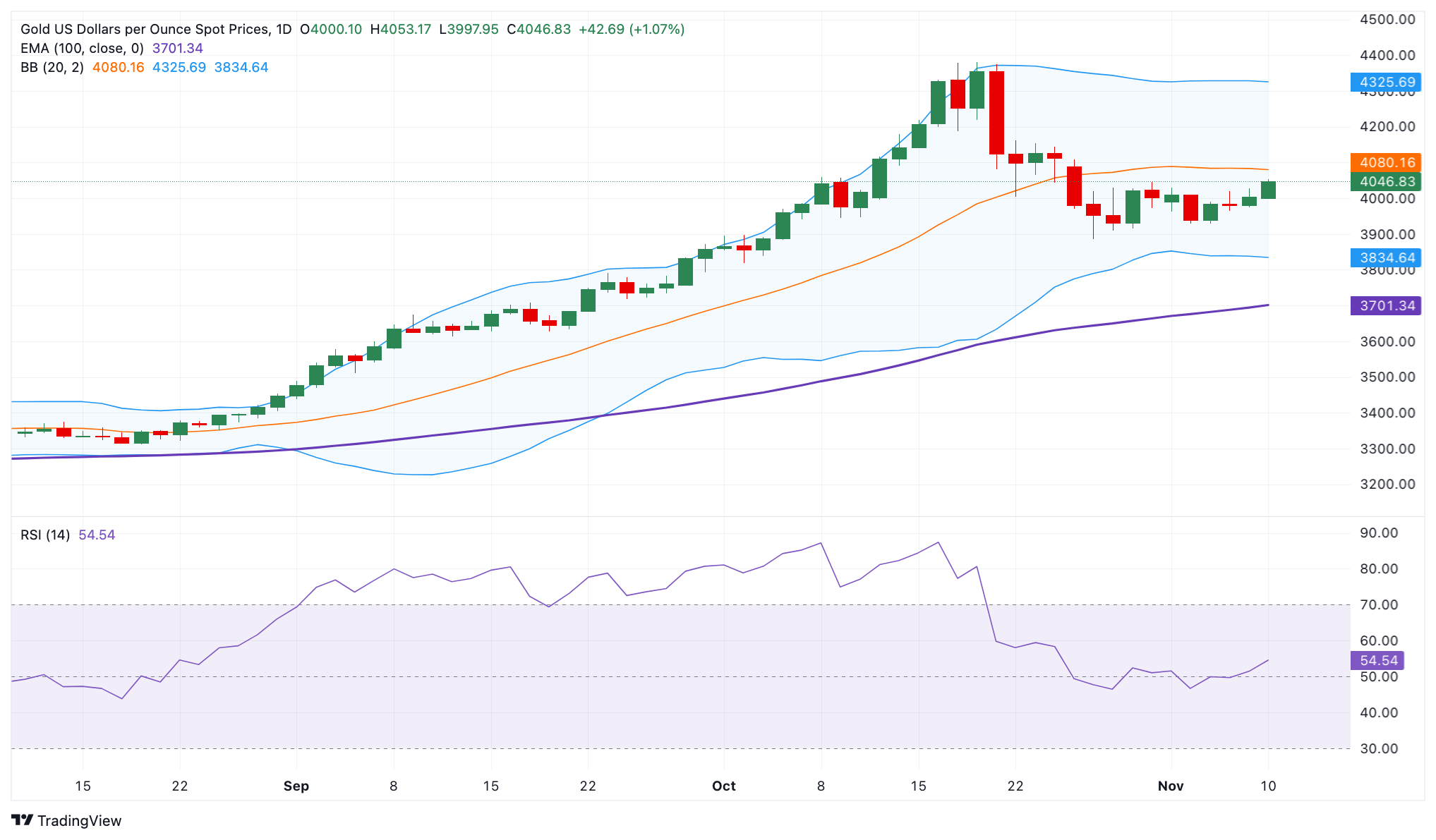
Gold price trades in positive territory on the day. According to the daily chart, the positive outlook of the precious metal remains in play as the price holds above the key 100-day Exponential Moving Average. The path of least resistance is to the upside, with the 14-day Relative Strength Index (RSI) standing above the midline near 55.0. This displays the bullish momentum for the yellow metal in the near term.
Sustained trading above the October 22 high of $4,161 could send the yellow metal toward the $4,200 psychological level. Further north, the next hurdle to watch is the upper boundary of the Bollinger Band at $4,325.
If we start seeing bearish candlesticks and consistent trading below $4,000, that could signal that sellers are back in control. In that case, XAU/USD might return to the lower limit of the Bollinger Band of $3,835, followed by the 100-day EMA of $3,705.
Fed FAQs
Monetary policy in the US is shaped by the Federal Reserve (Fed). The Fed has two mandates: to achieve price stability and foster full employment. Its primary tool to achieve these goals is by adjusting interest rates. When prices are rising too quickly and inflation is above the Fed’s 2% target, it raises interest rates, increasing borrowing costs throughout the economy. This results in a stronger US Dollar (USD) as it makes the US a more attractive place for international investors to park their money. When inflation falls below 2% or the Unemployment Rate is too high, the Fed may lower interest rates to encourage borrowing, which weighs on the Greenback.
The Federal Reserve (Fed) holds eight policy meetings a year, where the Federal Open Market Committee (FOMC) assesses economic conditions and makes monetary policy decisions. The FOMC is attended by twelve Fed officials – the seven members of the Board of Governors, the president of the Federal Reserve Bank of New York, and four of the remaining eleven regional Reserve Bank presidents, who serve one-year terms on a rotating basis.
In extreme situations, the Federal Reserve may resort to a policy named Quantitative Easing (QE). QE is the process by which the Fed substantially increases the flow of credit in a stuck financial system. It is a non-standard policy measure used during crises or when inflation is extremely low. It was the Fed’s weapon of choice during the Great Financial Crisis in 2008. It involves the Fed printing more Dollars and using them to buy high grade bonds from financial institutions. QE usually weakens the US Dollar.
Quantitative tightening (QT) is the reverse process of QE, whereby the Federal Reserve stops buying bonds from financial institutions and does not reinvest the principal from the bonds it holds maturing, to purchase new bonds. It is usually positive for the value of the US Dollar.
Author

Lallalit Srijandorn
FXStreet
Lallalit Srijandorn is a Parisian at heart. She has lived in France since 2019 and now becomes a digital entrepreneur based in Paris and Bangkok.
















