Gold Price Forecast: XAU/USD drops back closer to $1,800 amid surging US bond yields
- A combination of factors prompted aggressive selling around gold on Monday.
- The prevalent risk-on mood acted as a headwind for the safe-haven commodity.
- Rising US bond yields, resurgent USD demand contributed to the intraday selling.

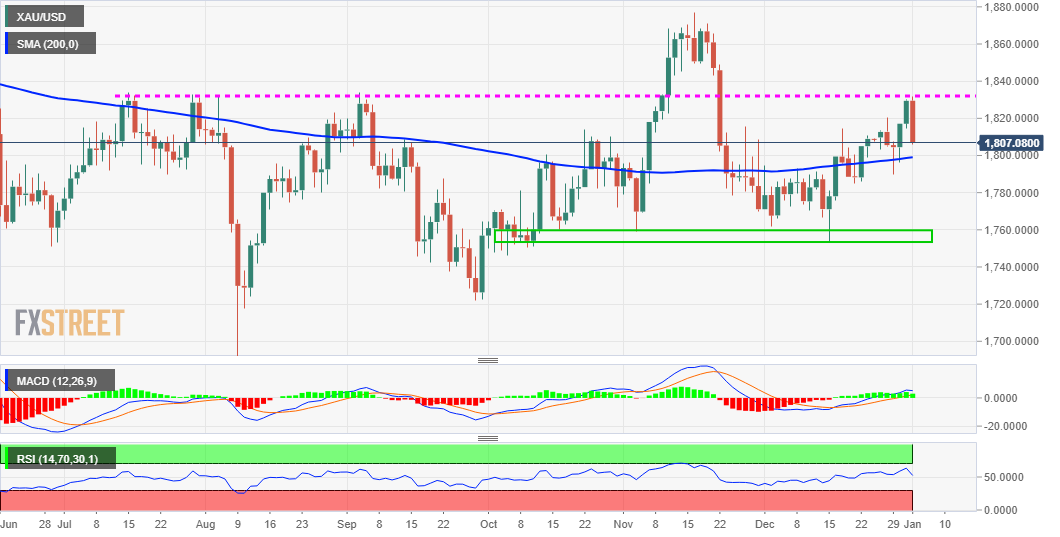
Gold witnessed aggressive selling on the first trading day of the new year and stalled a near three-week-old uptrend around the $1,830-32 supply zone, or the highest level since November 22. The intraday selling pressure picked up pace during the early North American session and dragged spot prices to a fresh daily low, around the $1,805 region in the last hour.
Signs that the Omicron variant might be less severe than feared and is unlikely to derail the economic recovery overshadowed concerns about the continuous surge in new COVID-19 cases. The optimism was evident from an extension of the recent bullish run in the equity markets, which was seen as a key factor that acted as a headwind for the safe-haven gold.
Meanwhile, the risk-on mood, along with the Fed's hawkish outlook triggered a fresh leg up in the US Treasury bond yields and further drove flows away from the non-yielding yellow metal. In fact, the yield on the benchmark 10-year US government bond ended 2021 with the largest rise since 2013 and shot to back closer to 1.58%, or over a one-month high on Monday.
Moreover, the so-called dot plot indicated that the Fed officials expect to raise the fed funds rate at least three times in 2022. The combination of factors allowed the US dollar to regain positive traction and recover a major part of Friday's losses. This further undermined demand for the dollar-denominated gold and contributed to the intraday slide.
With the latest leg down, the XAU/USD has now reversed last week's positive move and a subsequent slide below the $1,800 mark will set the stage for further losses. That said, traders might refrain from placing aggressive bets amid quiet holiday trading and ahead of important US macro data scheduled at the beginning of a new month.
This week's US economic docket highlights the release of ISM PMIs and the ADP report. The market focus, however, will remain on the closely-watched US monthly jobs report (NFP) on Friday. Hence, it will be prudent to wait for a strong follow-through selling before confirming that gold has topped out and positioning for any further depreciating move.
Technical outlook
From a technical perspective, a sustained break below the $1,800 mark might prompt some technical selling and turn the XAU/USD vulnerable to slide further. The downward trajectory could drag spot prices further towards the $1,785 horizontal zone en-route the next relevant support near the $1,770 region and December swing low, around the $1,753 area.
On the flip side, the $1,830-32 region should continue to act as a key barrier, which if cleared decisively should push gold prices further towards the $1,850 region. The upward trajectory could further get extended towards November 2021 swing high, around the $1,877 with some intermediate hurdle near the $1,870 area.
Gold daily chart
Levels to watch
Author

Haresh Menghani
FXStreet
Haresh Menghani is a detail-oriented professional with 10+ years of extensive experience in analysing the global financial markets.