Gold Price Forecast: XAU/USD holds near $2,000 as markets digest alarming risks
- Gold is attempting to recover ground in the $2,000 mark as Ukraine crisis risk prevails.
- Global stagflation concerns are mounting, with fears of a recession in a commodity boom.
- The pressure from the weekly -61.8% Fibo may keep a lif on rallies for the time being.

Update: The gold price is firm in Asia and balancing around the $2,000/oz mark following another turbulent day of trade in financial markets. US stocks finished the day lower on Thursday, led by a drop in technology shares, with markets fearing the worst in what was the US consumer prices in February surging in a 7.9% annual growth rate. This was the largest annual increase in inflation in 40 years.
Meanwhile, the developments in Russia's invasion of Ukraine also kept investors worried. With no let-up in the bombardment of the nation, and with talks between Ukraine and Russia's foreign ministers on Thursday failing to bring any respite in the conflict, traders took to safe havens such as gold.
End of update
Helping to limit the day's decline, energy shares gained even though oil prices fell after recent sharp gains.
The gold price was firming on Thursday as equity markets retraced some of Wednesday’s optimism as the Ukraine-Russia talks failed to deliver progress on a ceasefire.
Additionally, higher inflation expectations are not a welcomed theme in financial markets. US inflation also made new 40-year highs and the ECB delivered a hawkish recalibration of planned bond purchases for Q2 and Q3.
Gold is up by some 0.1% on the day and has steadied near the $2,000 an ounce level as its safe-haven appeal was supported by a lack of progress in talks between Russia and Ukraine. Gold futures settled up 0.6% at $2,000.40.
A gold rush to safe-haven assets earlier this week had pushed the yellow metal near the record levels hit in August 2020, however, they collapsed as profit-taking ensued with very little substance to the flip in risk sentiment.
Markets are looking for reasons to buy at bargain based prices in the global stock markets and the slightest hint of the potential for a ceasefire between Russia and Ukraine has been enough to spark off a Black Friday sale stampede into discounted assets.
Ukraine crisis at the helm of gold prices
In an ABC News interview at the start of the week, Ukraine's president, Volodymyr Zelensky said he is open to "compromise" on the status of two breakaway pro-Russian territories that President Vladimir Putin recognized as independent just before unleashing the invasion on February 24.
"I have cooled down regarding this question a long time ago after we understood that ... NATO is not prepared to accept Ukraine," Zelensky said.
"The alliance is afraid of controversial things, and confrontation with Russia," the president added.
Referring to NATO membership, Zelensky said through an interpreter that he does not want to be president of a "country which is begging something on its knees."
Investors took stock and piled out of gold. The move was fast and unforgiving for trapped bulls which resulted in a cascade of supply. However, in more recent headlines, the foreign ministers of Ukraine and Russia failed to reach peace during the highest-level meeting in three weeks of war Thursday.
The bombardment and airstrikes continue to devastate Ukraine, specifically the city of Mariupol this week. Both Ukraine’s Dmytro Kuleba and Russian counterpart Sergei Lavrov have made clear in duelling news conferences after the face-to-face, that they had made no progress. Consequently, traders are moving back into safe-haven assets such as gold.
The Ukrainian tweeted that his counterpart “seemed to have come to talk, not to decide.” “They seek Ukraine’s surrender. This is not going to happen,” Kuleba said.
Meanwhile, as well as the Simmering uncertainties surrounding Russia's invasion of Ukraine, Wall Street was also bleeding out heavily on Thursday as US inflation data hit a four-decade high. The data has sealed the deal that the US Federal Reserve would hike key interest rates at the conclusion of next week's monetary policy meeting.
All three major indexes are in the red, though up from session lows. Consumer prices surged in February to a 7.9% annual growth rate, according to the Labor Department, the hottest reading in forty years. As a consequence, the dollar index (DXY) moved up by over 0.50% to 98.512 following the report, after falling 1.17% on Wednesday.
The risk is not that the Fed will hike, but the decades-high CPI data suggested the FOMC could move more aggressively to curb inflation in the upcoming year, as promised by Fed Chair Jerome Powell last week.
''Will the 'stag' fade at a faster pace than the 'inflation'?'' analysts at TD Securities wrote as a title to their research notes on gold on Thursday,
''That is the central question facing markets, as participants assess the nature of the supply shock. Globally, central banks fear that inflation could be self-reinforcing should the shock de-anchor inflation expectations. In this context, a more persistent inflation shock than growth shock could spark a rise in expectations for future hikes,'' they explained.
''For global macro participants, this is particularly concerning as the probability of a recession is creeping higher in the midst of a broad-based commodity price shock. Certainly, such a scenario would be bearish for gold prices, but the yellow metal is rather benefiting from a rise in ETF flows associated with rising recession risks, alongside significant safe-haven flows and the expectation for central banks to re-emerge as a key pillar of support for gold bugs.''
Gold technical analysis

The price is generally under pressure following the daily bearish engulfing candle's close on Wednesday. There is some stability moving in, although unless matters significantly deteriorate on the geopolitical side of the fence, then gold prices might move back into more regular price ranges.
Should there be a lack of follow-through in the current bullish phase, then the support area below could be tested towards $1,950 prior to a more consistent move to the upside again. recalling prior analysis, the price was rejected at a critical weekly level as follows:
Gold Price Forecast: XAU/USD holds below a key technical -61.8% golden ratio
Gold weekly chart
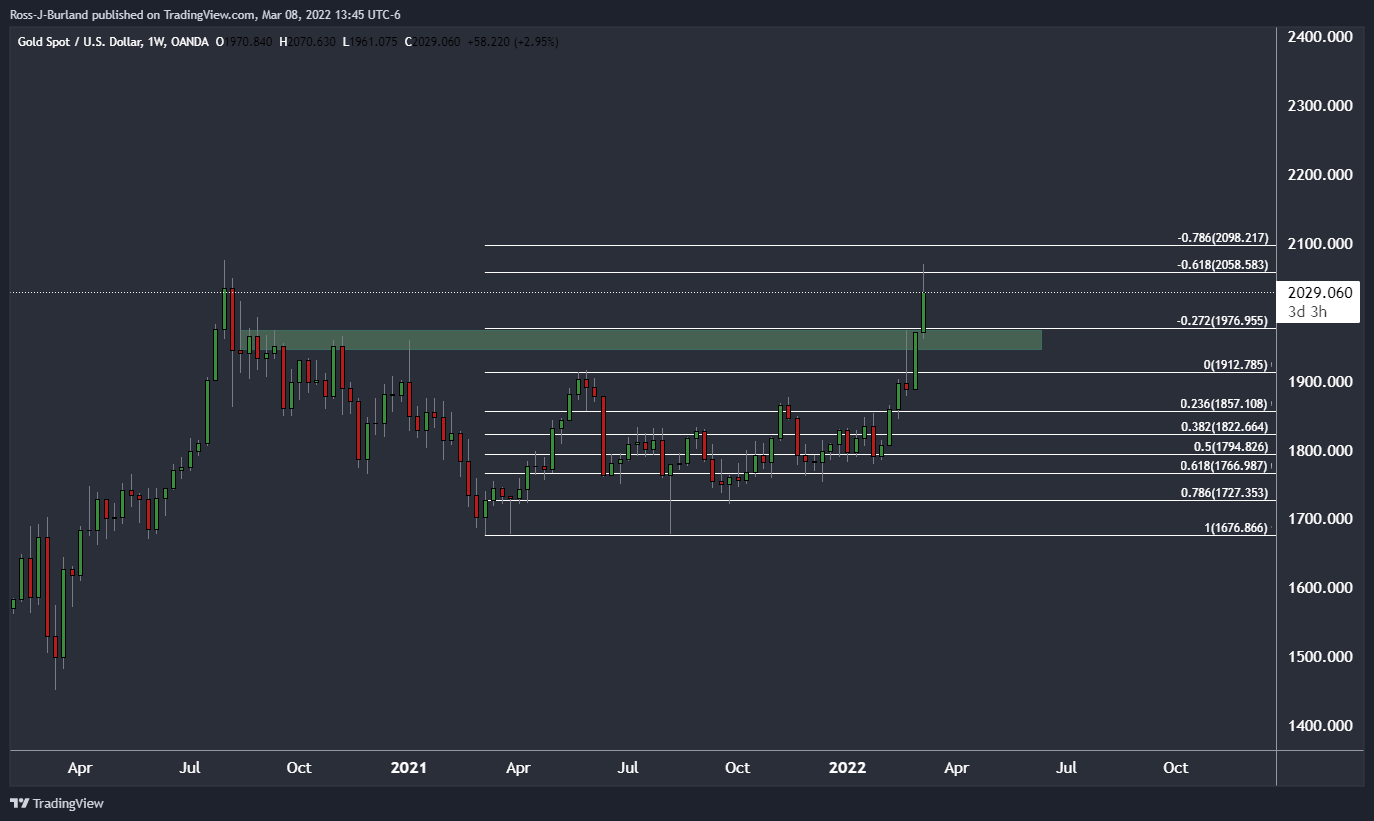
''The weekly chart shows that the price has reached a -61.8% golden ratio of the 2021 range.''
Author

Ross J Burland
FXStreet
Ross J Burland, born in England, UK, is a sportsman at heart. He played Rugby and Judo for his county, Kent and the South East of England Rugby team.