|

Gold Price Forecast: XAU/USD brights and surpasses $2000 amid mixed US economic data

  • Gold climbs 0.61% to $2003.50, buoyed by falling US Treasury yields and uncertain economic indicators.
  • January's Retail Sales fall 0.8%, highlighting economic volatility amid poor weather affecting auto and gasoline sales.
  • Fed's cautious inflation outlook and lower CPI than forecast weaken the Dollar, boosting gold's appeal.

Gold price recovered some ground on Thursday, as it reclaimed the $2000 mark due to falling US Treasury bond yields. A tranche of mixed US economic data weighed on the Greenback. Therefore, the XAU/USD posted gains of 0.61%, but as the Asian session begins, it trades at $2003.50.

Mixed US economic data and lower US Treasury yields boost Gold’s appeal

The latest data from the United States was mixed. Retail Sales for January saw a decrease of -0.8% month-over-month, falling short of both the previous month's figures and the estimated -0.1% contraction. This decline was largely attributed to reduced sales at auto dealerships and gasoline service stations, with stormy weather conditions further dampening sales.

Concurrently, Initial Jobless Claims for the latest week came at 212K, lower than both the forecasts and the previous week's reading of 220K. This comes as a somewhat unexpected development, given that claims were anticipated to increase following announcements of layoffs by several companies.

On Thursday, US Treasury bond yields lost two basis points and finished at 4.236%, while the US Dollar Index (DXY) dropped 0.41% to 104.28.

In the meantime, Federal Reserve Vice-Chairman for Supervision Michael Barr crossed the wires on Wednesday. He said that the path to 2% inflation would be ‘bumpy’ following the latest US inflation report. On Tuesday, the Consumer Price Index (CPI) came in at 3.1% YoY, below the previous reading of 3.4%, but missed estimates of 2.9%.

XAU/USD Price Analysis: Technical outlook

Gold price is neutral to downward biased, even though the yellow metal trades above the 200-day moving average (DMA). From a price action standpoint, Gold has achieved successive series of lower highs and lows, opening the door for further downside. However, sellers must reclaim the 100-DMA at $1996.01, which could open the door to test the December 13 low of $1973.13, followed by the 200-DMA at $1965.41. Conversely, if buyers push prices above the 50-DMA at $2031.80, Gold could aim towards the February 1 high at $2065.60.
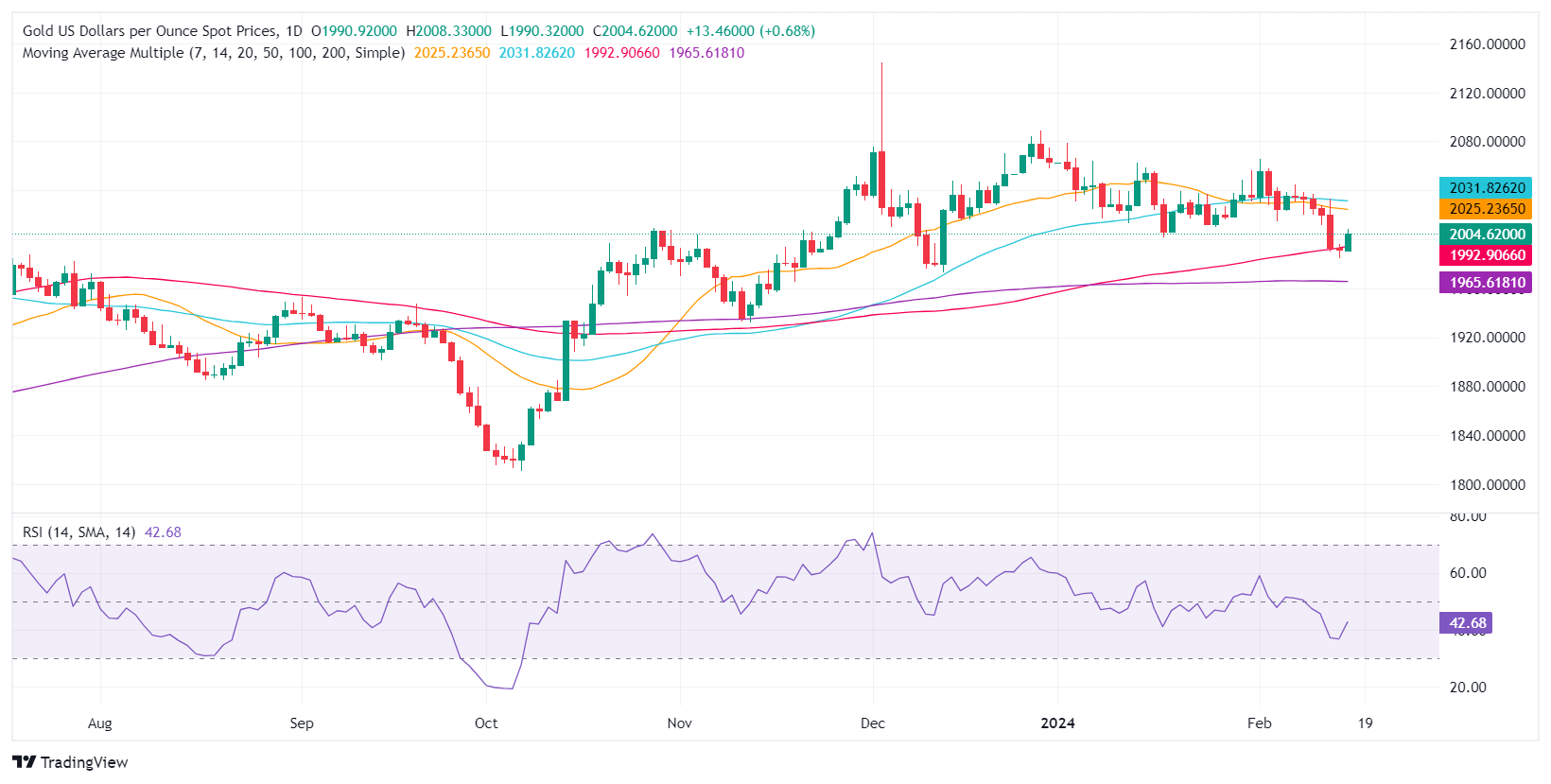
XAU/USD

Overview
Today last price2004.89
Today Daily Change13.73
Today Daily Change %0.69
Today daily open1991.16
 
Trends
Daily SMA202025.24
Daily SMA502031.83
Daily SMA1001992.91
Daily SMA2001965.62
 
Levels
Previous Daily High1996.17
Previous Daily Low1984.26
Previous Weekly High2044.63
Previous Weekly Low2014.92
Previous Monthly High2079.01
Previous Monthly Low2001.9
Daily Fibonacci 38.2%1988.81
Daily Fibonacci 61.8%1991.62
Daily Pivot Point S11984.89
Daily Pivot Point S21978.62
Daily Pivot Point S31972.98
Daily Pivot Point R11996.8
Daily Pivot Point R22002.44
Daily Pivot Point R32008.71

Author

Christian Borjon Valencia

Markets analyst, news editor, and trading instructor with over 14 years of experience across FX, commodities, US equity indices, and global macro markets.


More from Christian Borjon Valencia
Share:

Editor's Picks

AUD/USD pulls back from monthly high but holds above 0.7000

AUD/USD retreats from the monthly high set earlier this Thursday, sliding back to 0.7000 during the Asian session as a further escalation of tensions in the Middle East undermines the risk-sensitive Aussie. However, recent hawkish comments from RBA officials could support the Australian Dollar. Furthermore, the prevailing US Dollar selling bias, despite Fed hike bets and geopolitical uncertainties, could limit losses for the pair.

USD/JPY declines to a one-week low; eyes trading range support near 157.50 on weaker USD

USD/JPY drops to a one-week low during Thursday’s Asian session, with bears now awaiting a break below multi-week range support near mid-157.00s before placing fresh bets amid a broadly weaker US Dollar. Despite bets for a December Fed rate hike and Middle East jitters, the recent decline in US bond yields keeps USD depressed near a three-week low. Moreover, hawkish BoJ expectations and intervention risks underpin the Japanese Yen, further weighing on the currency pair.

Gold bounces off monthly low as USD selling remains unabated amid falling bond yields

Gold pares heavy intraday losses to the monthly trough, though it retains an intraday bearish tone below $4,100 during Thursday’s early European session. The US Dollar selling bias remains unabated as Federal Reserve officials recently signaled there is no urgency to raise interest rates at the upcoming October 27–28 meeting. Furthermore, US bond yields extend their retracement slide from multi-year highs, keeping USD bulls on the back foot and offering some support to the precious metal.

Dogecoin stays weak despite whales and new deal

Dogecoin price remains under pressure, trading below $0.081 despite a modest rebound earlier this week. Santiment data shows signs of accumulation, and Wednesday’s announcement of a Dogecoin Labs partnership with the Dogecoin Foundation adds a mildly bullish sentiment. Meanwhile, mixed derivatives metrics and weakening momentum indicators continue to limit the meme coin recovery.

3 Gold forecasts at $4,100: A bullish Arc rejection, a bearish Fed setup and a festival tiebreaker

Gold (XAU/USD) is trading near $4,100, and the three latest analyses cannot agree on what the level means: one sees the bounce from support as confirmation of a potential push toward $4,227, another argues every rally is vulnerable while price sits under its 20-day EMA, and the third points to India's Diwali buying season as the physical test about to meet the market.

The US Dollar fell. Gold didn't rally. That tells you everything
Gold (XAU/USD) is struggling to capitalize on a weaker US Dollar (USD), after repeatedly failing to establish itself above the $4,200 level. The precious metal remains confined to a relatively narrow trading range despite a combination of developments that would normally support higher prices.