|

Gold Price Forecast: XAU/USD attempts stabilization above $1,820, Fed Powell in focus

  • Gold price is attempting to hold itself above $1,820.00 ahead of Fed Powell.
  • The DXY is trading lackluster as investors see US PCE stable at 7%.
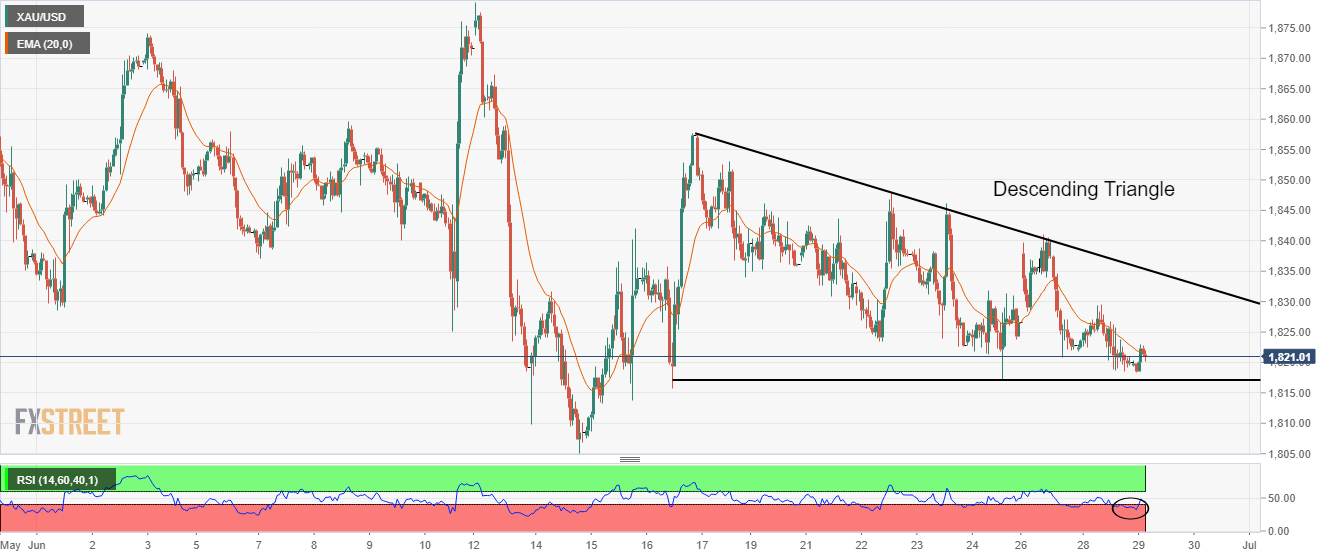
  • A Descending Triangle formation dictates that the gold prices will remain rangebound a little longer.

Gold price (XAU/USD) has rebounded modestly after re-testing Tuesday’s low at $1,818.33 in the Asian session. The precious metal has attempted to contain $1,822.50 and is focusing to sustain above the critical support of $1,820.00. Investors should brace for extreme volatility in the gold prices in today’s session as the speech from Federal Reserve (Fed) Jerome Powell will provide hints about the likely monetary policy action in July.

No matter what inflation rate for June will be released by the US Bureau of Labor Statistics, the Fed will definitely announce a rate hike in July monetary policy meeting. What signifies more is the extent of the rate hike that will be dictated by the Fed. If we scrutiny the prior data, one thing is clear the former rate hikes by the Fed have failed to make any dent in the inflation rate. The price rise is stalwart at a four-decade high with a figure of 8.6% and Fed is ‘fully committed' to bringing price stability.

Meanwhile, the US dollar index (DXY) is hovering below 104.50 ahead of US Personal Consumption Expenditure (PCE). As per the market consensus, the PCE is seen stabled at 7%.

Gold technical analysis

The gold prices are trading in a Descending Triangle pattern that signals a volatility contraction. The downward sloping trendline is plotted from June 16 high at $1,857.58 while the horizontal support is placed from June 16 low at $1,815.73. The gold bulls have attached the 20-period Exponential Moving Average (EMA) at $1,821.22. Meanwhile, the Relative Strength Index (RSI) (14) has managed to reclaim the 40.00-60.00 range, which indicates that a fresh leg of downside move has been postponed for now.

Gold hourly chart  
XAU/USD

Overview
Today last price1820.75
Today Daily Change0.75
Today Daily Change %0.04
Today daily open1820
 
Trends
Daily SMA201839.5
Daily SMA501855.57
Daily SMA1001892.07
Daily SMA2001844.71
 
Levels
Previous Daily High1829.51
Previous Daily Low1818.47
Previous Weekly High1847.95
Previous Weekly Low1816.99
Previous Monthly High1909.83
Previous Monthly Low1786.94
Daily Fibonacci 38.2%1822.69
Daily Fibonacci 61.8%1825.29
Daily Pivot Point S11815.81
Daily Pivot Point S21811.62
Daily Pivot Point S31804.77
Daily Pivot Point R11826.85
Daily Pivot Point R21833.7
Daily Pivot Point R31837.89


Author

Sagar Dua

Sagar Dua

FXStreet

Sagar Dua is associated with the financial markets from his college days. Along with pursuing post-graduation in Commerce in 2014, he started his markets training with chart analysis.


More from Sagar Dua
Share:

Editor's Picks

GBP/USD bounces off lows, back above 1.3200

After bottoming out near 1.3160, GBP/USD manages to regain a bit of shine and reclaim the 1.3200 mark and beyond at the end of the week. Stronger-than-expected UK Retail Sales data seem to be helping the British Pound limit its losses, while the chaotic UK political environment keeps the bulls at bay for now.

EUR/USD looks consolidative around 1.1460

EUR/USD stages a modest rebound after slipping to a three-month low below 1.1420 at the end of the week. That said, the pair now looks to consolidate humble gains just above 1.1460 despite growing uncertainty surrounding the next round of US-Iran negotiations, which keeps the US Dollar’s downside contained.

Gold slips back to six-day lows, targets $4,100

Gold retreats for the third consecutive day on Friday, eroding gains seen in the first half of the week and approaching the key $4,100 mark per troy ounce. Indeed, the precious metal continues to face headwinds from the Fed's hawkish stance and renewed uncertainty surrounding the next round of US-Iran negotiations.

Breaking: Iran closes the Strait of Hormuz amid ceasefire deal violation
Iran says it is closing the Strait of Hormuz after accusing the United States (US) and Israel of violating the ceasefire. According to Iran, the decision came over the continued Israeli strikes in Lebanon. The Iranian Revolutionary Guard Corps Navy issued a warning to all vessels: "Do not approach the Strait of Hormuz; otherwise, your security will be jeopardized."
The Iran war didn't break the US economy, but what happens next?

Nearly four months after the start of the Iran war, the US economy remains remarkably resilient. While the conflict initially triggered a severe disruption to global energy markets and a sharp rise in Oil prices, recent diplomatic progress between Washington and Tehran has eased concerns about a prolonged supply shock.

Regime change: Inside Kevin Warsh's first move to make the Fed unreadable on purpose

The rate did not move. That was the least interesting thing about Kevin Warsh's first meeting in charge of the Fed. The FOMC held its benchmark at 3.50%-3.75% for the fourth straight meeting, exactly as priced, and then the new chair used his first press conference to dismantle the machinery the market has leaned on for a decade.