Gold Price Forecast: Bund yields drag XAU/EUR below €1,600 ahead of German Inflation data
- Gold prices in Euro refresh intraday low during two-day declines.
- ECB’s Kazaks, risk-off mood propel yields, European currency.
- German HICP, US PMIs and covid headlines can entertain traders ahead of Friday’s US NFP.

Gold (XAU/EUR) drops for the second consecutive day, down 0.22% intraday around €1,596 while heading into Thursday’s European session. The yellow metal bears the burden of firmer yields, at home and abroad, amid escalating chatters over monetary policy tightening and covid woes.
Although global markets cheered hawkish bias of the Fed policymakers, suggesting a faster rate-hike and plans to discuss balance-sheet normalization, comments from ECB’s Kazaks also threatened easy money policies in the bloc.
“In light of elevated inflation pressures and the strengthening labor market, participants judged that the increase in policy accommodation provided by the ongoing pace of net asset purchases was no longer necessary,” per the Federal Open Market Committee (FOMC) Meeting Minutes. On the other hand, Latvian central bank governor and ECB governing council member Martins Kazaks said on Wednesday that the ECB is ready to raise rates and cut stimulus if needed.
On a different page, record cases of covid and doubling of infections strain the medical systems, which in turn challenge the previous optimism backed by global studies suggesting Omicron be less severe. On the same line were the updates from France relating to a new and fast-spreading coronavirus strain, namely IHU.
Amid these plays, the US 10-year Treasury yields jumped to the highest level since April 2021 by the end of Wednesday’s North American session and drowned the Wall Street benchmark. Recently, the US 10-year bond yields refresh a nine-month high of around 1.71%, which in turn weighed on the S&P 500 Futures.
It should be noted that Germany’s 10-year bund yields refresh a two-month high while rising to -0.115% at the latest.
That said, Germany’s preliminary readings of Harmonized Index of Consumer Prices (HICP) for December, expected 5.7% YoY versus 6.0% prior, will offer immediate direction to the XAU/EUR prices. Should the inflation figures keep rising the ECB hawks may propel the quote. Following that, the monthly prints of the US Good Trade Balance and ISM Services PMI for December, as well as weekly US Jobless Claims, will entertain short-term market players. However, Friday’s US Nonfarm Payrolls (NFP) is the key.
Technical analysis
Gold prices remain pressured inside a three-week-old rising wedge bearish chart formation. Although descending RSI and bearish MACD signals keep sellers hopeful, the 100-SMA adds strength to the support line of wedge near €1,593.
Hence, a clear downside break of €1,593 becomes necessary for the XAU/EUR bears to aim for December’s low surrounding €1,555.
During the fall, €1,580 may act as an intermediate halt while July 2021 top surrounding €1,550 will add to the downside filters past €1,555.
Alternatively, 50% Fibonacci retracement (Fibo.) of November-December downside around €1,605 guards immediate recovery moves of the gold prices (in Euro).
Also acting as important resistance is the 61.8% Fibo. level and the upper line of the stated wedge, respectively near €1,616 and €1,618.
XAU/EUR: Four-hour chart
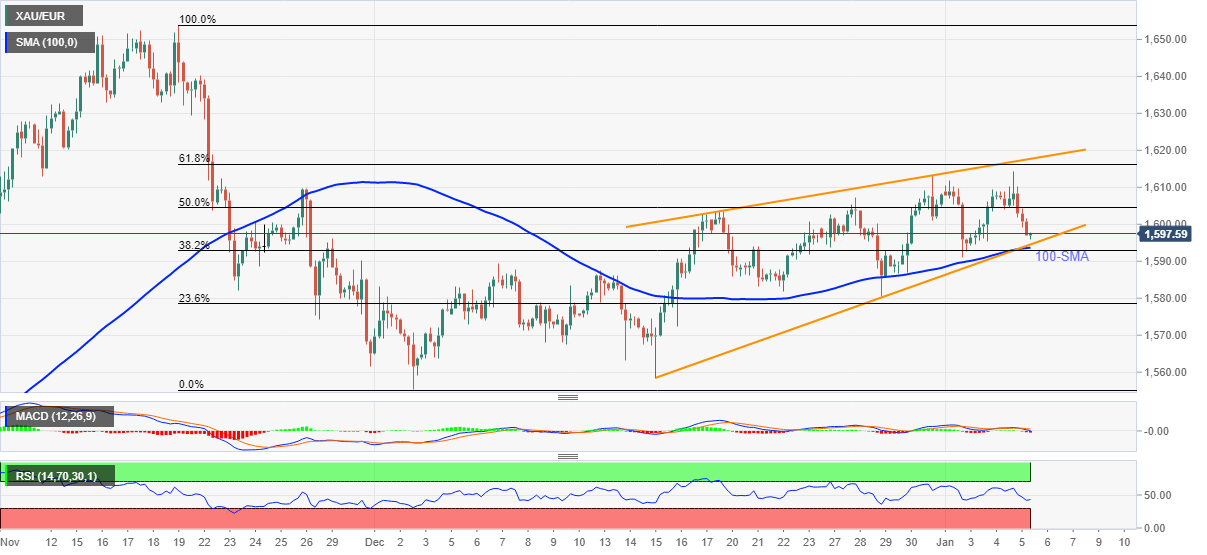
Trend: Further weakness expected
Author

Anil Panchal
FXStreet
Anil Panchal has nearly 15 years of experience in tracking financial markets. With a keen interest in macroeconomics, Anil aptly tracks global news/updates and stays well-informed about the global financial moves and their implications.