Gold price falls below $3,300 on strong US Dollar as Trump reignites China tensions
- XAU/USD drops as strong US Dollar pressures Bullion; tariff uncertainty rattles markets.
- US core PCE dips in April, but strong data lifts yields, dampening Gold's appeal.
- Trump accuses China of violating trade deal, reviving geopolitical and tariff concerns.

Gold price slumped on Friday as the US Dollar recovered some ground despite witnessing a drop in US Treasury bond yields following a strong inflation report, which keeps traders hopeful that the US Federal Reserve (Fed) will ease policy in 2025. XAU/USD trades at $3,289, down 0.83%.
Sentiment shifted sour as US President Donald Trump complained that China is not fulfilling the agreement negotiated between both parties in Switzerland. He wrote, “China, perhaps not surprisingly to some, HAS TOTALLY VIOLATED ITS AGREEMENT WITH US. So much for being Mr. NICE GUY!”
Consequently, US equities fell, while the American Dollar recovered from near daily lows, according to the US Dollar Index (DXY).
Turning to trade-related news, a US Federal Appeals Court reinstated most of Trump’s tariffs imposed on April 2, “Liberation Day,” following a decision by a US Court of International Trade, which blocked most of the duties as they were considered illegal.
The US Core Personal Consumption Expenditures (PCE) Price Index dipped in April compared to March’s meeting. Other data showed that the University of Michigan's (UoM) Consumer Sentiment in May's final reading improved compared to estimates, while inflation expectations declined.
Gold daily market movers: Tumbles despite soft US inflation data amid US Dollar strength
- Gold price is pressured due to a strong US Dollar.The DXY, which tracks the US Dollar’s value against a basket of six currencies, edges up 0.11% to 99.44.
- US Treasury bond yields are falling. The US 10-year Treasury note yield falls two basis points to 4.40%, while US real yields are also edging down by the same amount 2.086%, slightly below the May 29 close.
- The US core PCE in April showed the evolution of the disinflation process, which was driven by the Fed's restrictive interest rates. The reading came in at 2.5% YoY, down from 2.6%. Headline inflation came in at 2.1% YoY, below March’s 2.3% rise.
- Despite witnessing a lower inflation environment, Bullion prices failed to gain traction as US Dollar short positions in the futures market were trimmed in the last week, according to Commitments of Traders (COT) data.
- The UoM Consumer Sentiment in May improved from 50.8 to 52.2, exceeding estimates on its final reading. It is worth noting that inflation expectations fell. For the 12 months ahead, expectations fell from 7.3% to 6.6%, and for the next five years, they dropped from 4.6% to 4.2%.
- After the data release, the Atlanta Fed’s GDPNow preliminary reading of economic growth for Q2 2025 rose sharply from 2.2% to 3.8%.
- Federal Reserve officials crossed the wires on Thursday, emphasizing that the monetary policy is in a good place and that it would take some time to see a shift in the balance of risks for the Fed's dual mandate.
- San Francisco’s Fed President Mary Daly said the labor market is in solid shape and revealed that it would not reach the 2% inflation goal in 2025. Despite this, she said that if jobs are solid and the disinflation process continues, it would make sense to cut rates twice as markets expect.
- Money markets suggest that traders are pricing in 52 basis points of easing toward the end of the year, following the release of US data, according to Prime Market Terminal data.
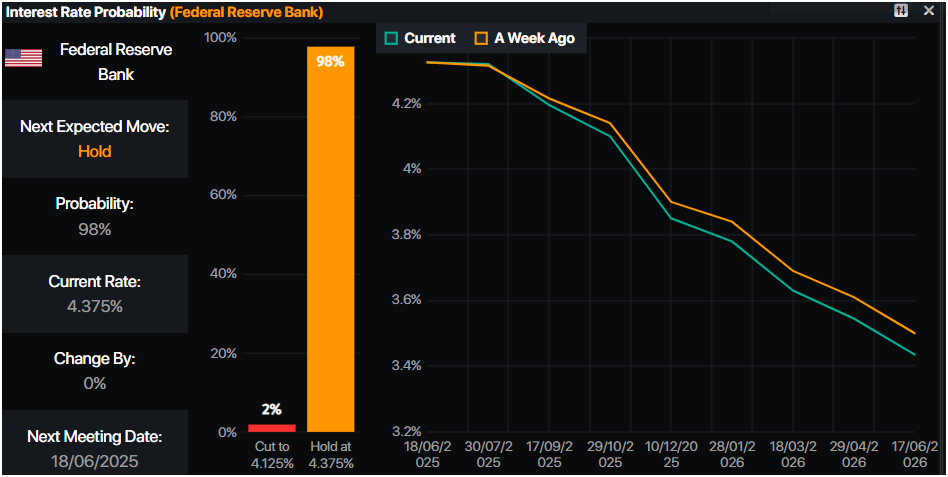
Source: Prime Market Terminal
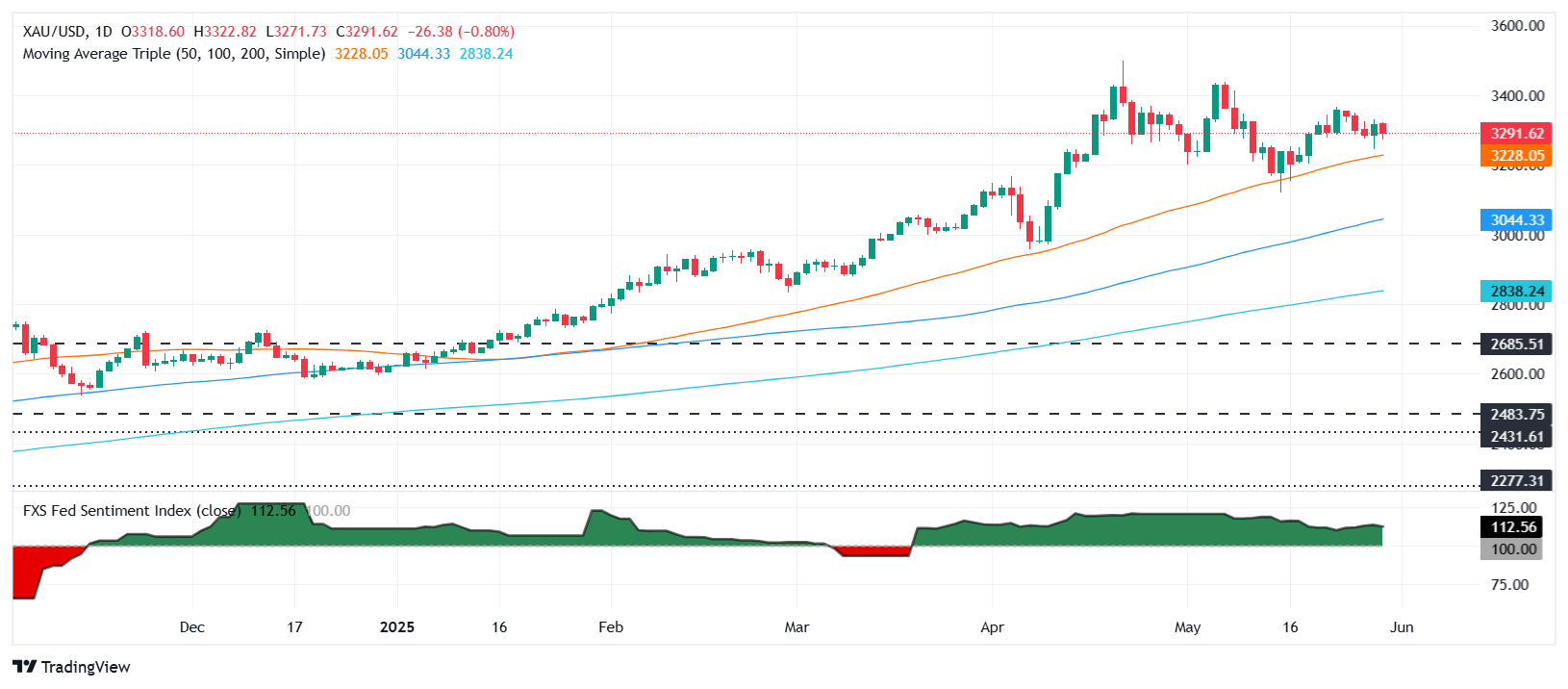
XAU/USD technical outlook: Tumbles and poised to test $3,250
Gold price uptrend is intact, though XAU/USD spot prices achieving a daily/weekly close below $3,300 could sponsor some sideways trading action within the $3,250-$3,300 range amid the lack of fresh catalysts ahead of the weekend.
For a bearish resumption, sellers must drive Gold prices below $3,250, ahead of the 50-day Simple Moving Average (SMA) at $3,221. A breach of the latter will expose the April 3 high turned support at $3,167.
Conversely, if bulls push XAU/USD past $3,300, the next key resistance levels will be $3,350, $3,400, the May 7 swing high of $3,438 and the record high $3,500.
Gold FAQs
Gold has played a key role in human’s history as it has been widely used as a store of value and medium of exchange. Currently, apart from its shine and usage for jewelry, the precious metal is widely seen as a safe-haven asset, meaning that it is considered a good investment during turbulent times. Gold is also widely seen as a hedge against inflation and against depreciating currencies as it doesn’t rely on any specific issuer or government.
Central banks are the biggest Gold holders. In their aim to support their currencies in turbulent times, central banks tend to diversify their reserves and buy Gold to improve the perceived strength of the economy and the currency. High Gold reserves can be a source of trust for a country’s solvency. Central banks added 1,136 tonnes of Gold worth around $70 billion to their reserves in 2022, according to data from the World Gold Council. This is the highest yearly purchase since records began. Central banks from emerging economies such as China, India and Turkey are quickly increasing their Gold reserves.
Gold has an inverse correlation with the US Dollar and US Treasuries, which are both major reserve and safe-haven assets. When the Dollar depreciates, Gold tends to rise, enabling investors and central banks to diversify their assets in turbulent times. Gold is also inversely correlated with risk assets. A rally in the stock market tends to weaken Gold price, while sell-offs in riskier markets tend to favor the precious metal.
The price can move due to a wide range of factors. Geopolitical instability or fears of a deep recession can quickly make Gold price escalate due to its safe-haven status. As a yield-less asset, Gold tends to rise with lower interest rates, while higher cost of money usually weighs down on the yellow metal. Still, most moves depend on how the US Dollar (USD) behaves as the asset is priced in dollars (XAU/USD). A strong Dollar tends to keep the price of Gold controlled, whereas a weaker Dollar is likely to push Gold prices up.
Author

Christian Borjon Valencia
FXStreet
Markets analyst, news editor, and trading instructor with over 14 years of experience across FX, commodities, US equity indices, and global macro markets.