Gold price eyes $3,400 as Fed cut bets grow, Trump eyes new Fed pick
- Gold trades up 0.20% following last week’s weak NFP and ISM Services miss.
- Trump to appoint new Fed Governor after Kugler’s resignation; Bessent declines Chair nomination.
- Effective US tariffs to rise on August 7; average duties hit 18.3%, the highest since 1934.

Gold price advances during the North American session as speculation grows that the Federal Reserve (Fed) could begin to cut rates at the next meeting. At the same time, investors await US President Donald Trump's appointment of a new Fed Governor. The XAU/USD trades at $3,381, up 0.20%.
Since last Friday, Bullion prices have recovered after July’s Nonfarm Payrolls (NFP) report revealed a significant downward revision to May and June figures. Investors, caught off guard, began to price in the first 25-basis-point rate cut at the September meeting.
On Tuesday, the Institute for Supply Management (ISM) revealed the Services Purchasing Managers Index (PMI), which showed a deceleration in business activity, contrary to economists' expectations. Other data from the Commerce Department indicated that the trade deficit narrowed in June.
The resignation of Fed Governor Adriana Kugler opened the door for Trump to nominate someone to succeed Jerome Powell as the next Fed Chair. The US Treasury Secretary Scott Bessent was one of the nominees, but he told Trump that he is not interested.
Trade news revealed that effective tariffs on August 7 would be between 10% and 41%. The Budget Lab at Yale estimates the average of overall US duties rose to 18.3%, its highest level since 1934.
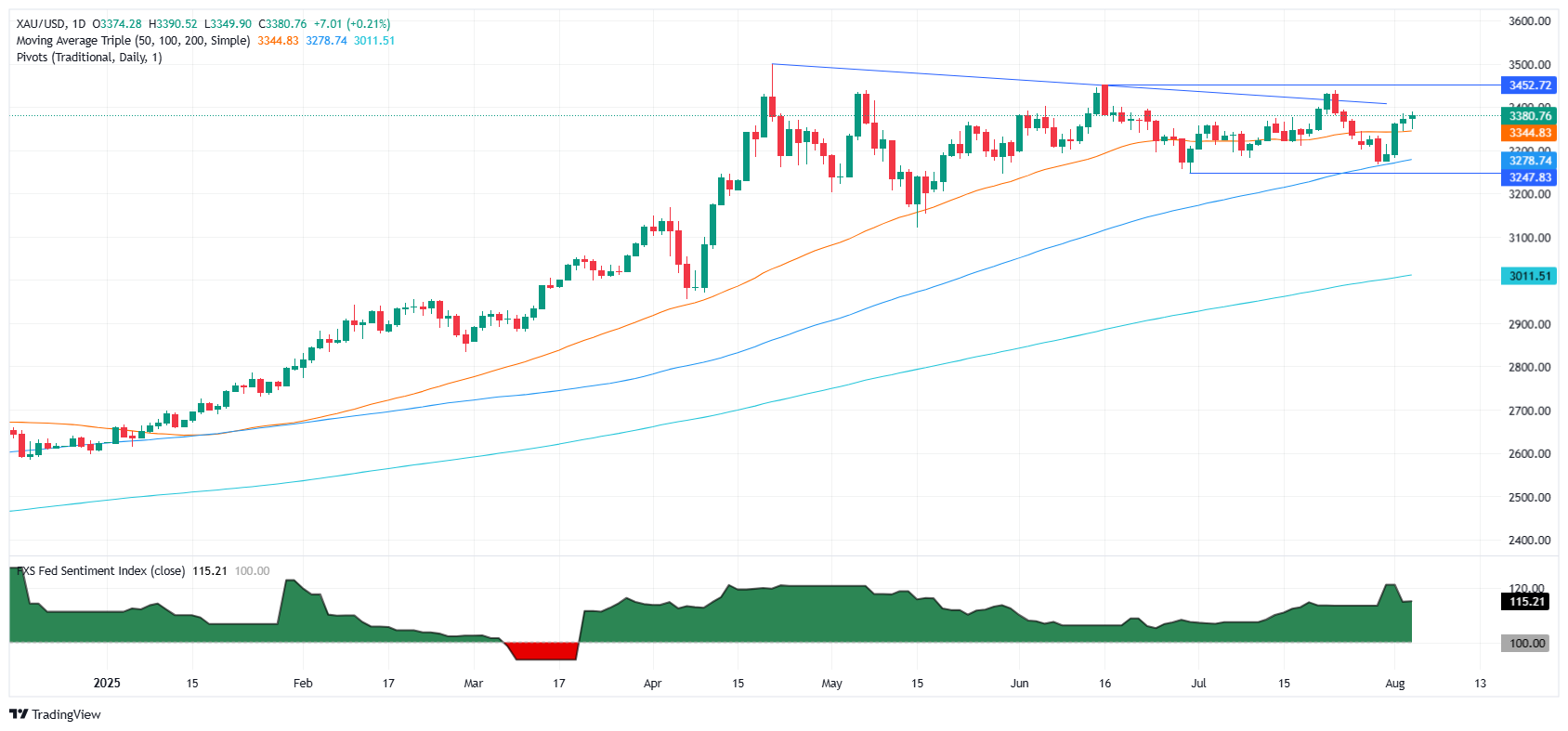
Given the fundamental backdrop, Gold seems poised to challenge the $3,400 mark. However, the recovery of US Treasury yields and the Greenback could cap Bullion’s advance after reaching an eight-day high of $3,390.
This week, the US economic docket will feature Jobless Claims, Consumer Sentiment data and Fed speakers.
Daily digest market movers: Gold climbs as Services PMI slows, increasing odds of Fed easing
- US economic data showed a slowdown in services sector activity, with the ISM Services PMI falling to 50.1 in July from 50.8 in June, missing expectations for an increase to 51.5. Earlier data also revealed that the US trade deficit narrowed to its lowest level in nearly two years, signaling improving trade dynamics despite softer domestic demand.
- The US Goods and Services Trade Balance in June printed a deficit of $-60.2 billion, below May’s $-71.7 billion and forecasts of $-61.6 billion. The trade gap with China shrank to its lowest level in almost 21 years, according to the Bureau of Economic Analysis (BEA).
- Investors bought Gold as sentiment shifted sour, questioning the credibility of the upcoming US economic data releases after the removal of the head of the Bureau of Labor Statistics (BLS).
- Citi updated its Gold forecast for the next three months from $3,300 to $3,500 per troy ounce on Monday. They mentioned in the note that “US growth and tariff-related inflation concerns are set to remain elevated during 2H’25, which, alongside a weaker US Dollar, are set to drive Gold moderately higher to new all-time highs.”
XAU/USD technical outlook: Gold rallies with buyers targeting $3,400
Gold price trades at nine-day highs shy of the $3,400 figure after clearing the confluence of the 50-day and 20-day Simple Moving Averages (SMAs) near $3,343 and the $3,350 figure. Despite this, the uptrend is questionable, but it should resume once buyers drive XAU/USD above the July 23 high of $3,438, putting in place a test of the June 16 high of $3,452.
Conversely, XAU/USD tumbling below $3,350 exposes $3,300, ahead of the 100-day SMA at $3,267.
Gold FAQs
Gold has played a key role in human’s history as it has been widely used as a store of value and medium of exchange. Currently, apart from its shine and usage for jewelry, the precious metal is widely seen as a safe-haven asset, meaning that it is considered a good investment during turbulent times. Gold is also widely seen as a hedge against inflation and against depreciating currencies as it doesn’t rely on any specific issuer or government.
Central banks are the biggest Gold holders. In their aim to support their currencies in turbulent times, central banks tend to diversify their reserves and buy Gold to improve the perceived strength of the economy and the currency. High Gold reserves can be a source of trust for a country’s solvency. Central banks added 1,136 tonnes of Gold worth around $70 billion to their reserves in 2022, according to data from the World Gold Council. This is the highest yearly purchase since records began. Central banks from emerging economies such as China, India and Turkey are quickly increasing their Gold reserves.
Gold has an inverse correlation with the US Dollar and US Treasuries, which are both major reserve and safe-haven assets. When the Dollar depreciates, Gold tends to rise, enabling investors and central banks to diversify their assets in turbulent times. Gold is also inversely correlated with risk assets. A rally in the stock market tends to weaken Gold price, while sell-offs in riskier markets tend to favor the precious metal.
The price can move due to a wide range of factors. Geopolitical instability or fears of a deep recession can quickly make Gold price escalate due to its safe-haven status. As a yield-less asset, Gold tends to rise with lower interest rates, while higher cost of money usually weighs down on the yellow metal. Still, most moves depend on how the US Dollar (USD) behaves as the asset is priced in dollars (XAU/USD). A strong Dollar tends to keep the price of Gold controlled, whereas a weaker Dollar is likely to push Gold prices up.
Author

Christian Borjon Valencia
FXStreet
Markets analyst, news editor, and trading instructor with over 14 years of experience across FX, commodities, US equity indices, and global macro markets.