Gold price extends its decline as traders brace for US PMI data
Most recent article: Gold price stumbles below $2,500 as market participants eye NFP report
- Gold price trades in negative territory for the third consecutive day in Tuesday’s early European session.
- The rising US Fed rate cut bets and geopolitical risks might help limit Gold’s losses.
- Investors await the US August ISM PMI for fresh impetus.
The Gold price (XAU/USD) loses ground amid the stronger US Dollar (USD) and higher US Treasury bond yields on Tuesday. Nonetheless, the anticipation that the US Federal Reserve (Fed) will cut interest rates in September might underpin the precious metal price as lower interest rates reduce the opportunity cost of holding non-yielding gold. Additionally, the ongoing geopolitical tensions in the Middle East might boost safe-haven assets like Gold.
Looking ahead, the Institute for Supply Management’s (ISM) Manufacturing Purchasing Managers Index (PMI) will be published on Tuesday. The highlight for this week will be the US Nonfarm Payrolls (NFP) for August, which might determine the pace of the interest rate cut by the Fed and could influence the Gold price in the near term.
Daily Digest Market Movers: Gold price faces selling pressure amid the rebound of USD
- Protests broke out across Israel in fresh fury on Monday over the government’s failure to secure a ceasefire-for-hostages deal with Hamas, per CNN. The move is fuelled by the killing in Gaza of six hostages, whose bodies were retrieved by Israeli soldiers this weekend.
- China's Caixin Manufacturing PMI climbed to 50.4 in August from 49.8 in July, above the market consensus of 50.0.
- The US ISM Manufacturing PMI for August is expected to improve to 47.5 in August from 46.8 in July, while the Services PMI is estimated to drop to 51.1 in August versus 51.4 prior.
- The US economy is expected to see 163K job additions in August. The Unemployment Rate is expected to tick lower to 4.2%.
- The markets are now pricing in a nearly 69% possibility of 25 basis points (bps) rate cut by the Fed in September, while the chance of a 50 bps reduction is standing at 31%, according to the CME FedWatch tool.
Technical Analysis: Gold price maintains positive view in the longer term
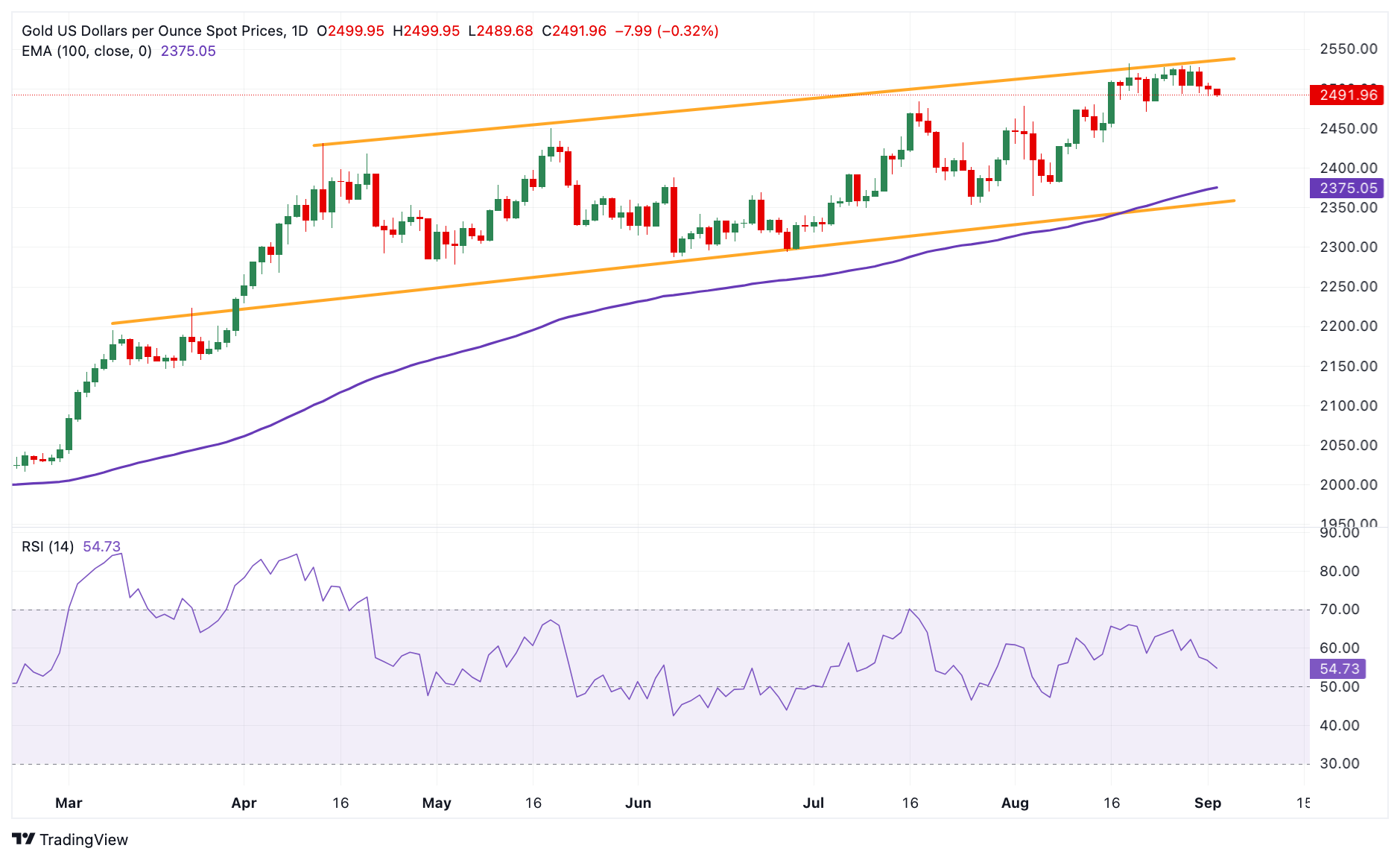
The Gold price drifts lower on the day. According to the daily chart, the constructive outlook of the precious metal prevails as the price is well above the key 100-day Exponential Moving Average (EMA). The upward momentum is reinforced by the 14-day Relative Strength Index (RSI), which stands above the midline around 55.70, suggesting the climb is more likely to resume than to reverse.
The key resistance level for XAU/USD emerges in the $2,530-$2,540 zone, portraying the five-month-old ascending channel’s upper boundary and the all-time high. A decisive break above the mentioned level could see a rally to the $2,600 psychological level.
On the flip side, the low of August 22 at $2,470 acts as an initial support level for the yellow metal. A break below this level could drag the price further south to $2,432, the low of August 15. The next contention level to watch is $2,372, the 100-day EMA.
Gold FAQs
Gold has played a key role in human’s history as it has been widely used as a store of value and medium of exchange. Currently, apart from its shine and usage for jewelry, the precious metal is widely seen as a safe-haven asset, meaning that it is considered a good investment during turbulent times. Gold is also widely seen as a hedge against inflation and against depreciating currencies as it doesn’t rely on any specific issuer or government.
Central banks are the biggest Gold holders. In their aim to support their currencies in turbulent times, central banks tend to diversify their reserves and buy Gold to improve the perceived strength of the economy and the currency. High Gold reserves can be a source of trust for a country’s solvency. Central banks added 1,136 tonnes of Gold worth around $70 billion to their reserves in 2022, according to data from the World Gold Council. This is the highest yearly purchase since records began. Central banks from emerging economies such as China, India and Turkey are quickly increasing their Gold reserves.
Gold has an inverse correlation with the US Dollar and US Treasuries, which are both major reserve and safe-haven assets. When the Dollar depreciates, Gold tends to rise, enabling investors and central banks to diversify their assets in turbulent times. Gold is also inversely correlated with risk assets. A rally in the stock market tends to weaken Gold price, while sell-offs in riskier markets tend to favor the precious metal.
The price can move due to a wide range of factors. Geopolitical instability or fears of a deep recession can quickly make Gold price escalate due to its safe-haven status. As a yield-less asset, Gold tends to rise with lower interest rates, while higher cost of money usually weighs down on the yellow metal. Still, most moves depend on how the US Dollar (USD) behaves as the asset is priced in dollars (XAU/USD). A strong Dollar tends to keep the price of Gold controlled, whereas a weaker Dollar is likely to push Gold prices up.
Author

Lallalit Srijandorn
FXStreet
Lallalit Srijandorn is a Parisian at heart. She has lived in France since 2019 and now becomes a digital entrepreneur based in Paris and Bangkok.