Gold price soars on haven-demand, hits record high
- Gold rises 0.23% as risk aversion fuels safe-haven flows.
- Fed Minutes highlight inflation concerns amid Trump’s trade policies.
- Traders eye S&P Global Flash PMIs for further market direction.

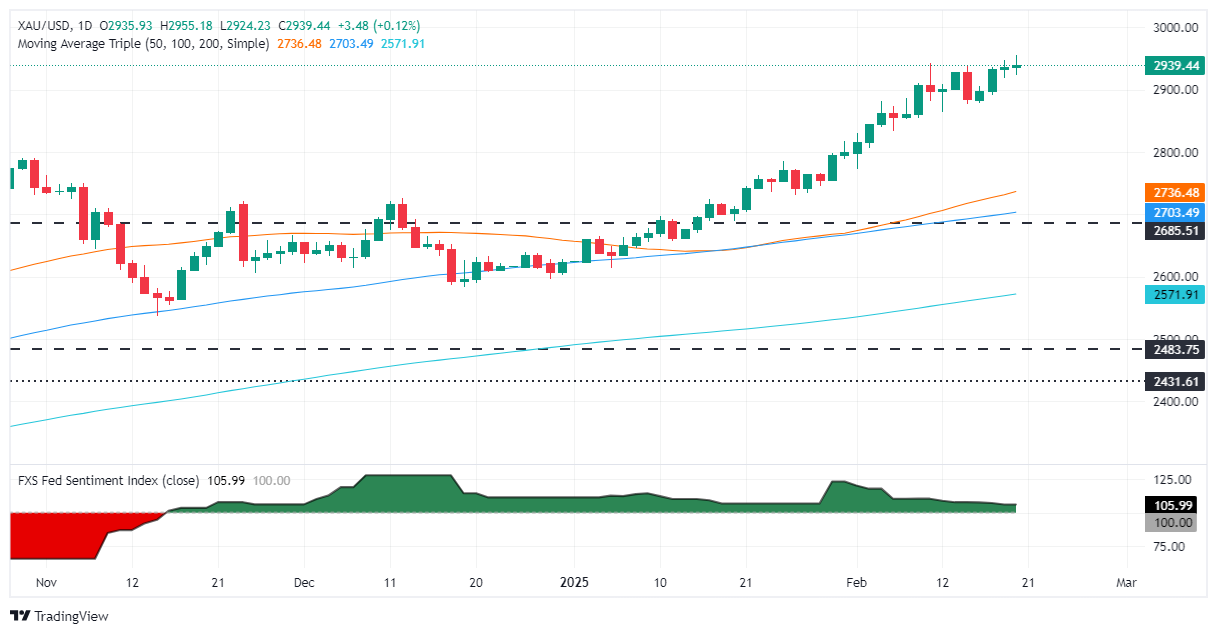
Gold's price advanced late in the North American session yet traded off record highs of $2,954 as traders took profits. Trade war woes, a weak US Dollar, and falling US Treasury bond yields kept XAU/USD trading with modest gains of 0.23% near the $2,939 mark at the time of writing.
Bullion’s demand remains fueled by uncertainty about global trade. Risk aversion sparked flows toward the safe-haven appeal of Gold alongside the Japanese Yen (JPY), which posted substantial gains during the day.
The Federal Reserve’s (Fed) Meeting Minutes from Wednesday revealed that Trump’s trade and immigration policies fueled concerns over rising prices. Hence, the Fed Chair Jerome Powell and Co. decided to hold rates unchanged at the January meeting as they assess the current economic data.
In the meantime, some Fed speakers crossed the wires and have turned slightly cautious. Atlanta Fed President Raphael Bostic sees two rate cuts this year and emphasizes that the economy is not facing a new burst of inflation. St. Louis Fed President Alberto Musalem sees some policy shifts and increased risks of inflation stalling above the Fed’s 2% goal.
Finally, Chicago’s Fed President Austan Goolsbee said that before the recent policy and geopolitical uncertainties, overall inflation "looked pretty good" and was down substantially. However, Trump's broad-based and higher tariffs currently in development keep the Fed nervous.
Data-wise, US job data was softer than expected as the number of Americans filling out unemployment benefits came below estimates. On Friday, Gold traders are eyeing the release of S&P Global Flash PMIs.
Daily digest market movers: Gold price boosted by Trump’s tariff threats fueling safe-haven demand
- US President Donald Trump recently announced that tariffs on cars, automobiles, and computer chips would be around 25%. He also said on Wednesday that duties would broaden to other commodities like lumber.
- US Initial Jobless Claims for the week ending February 15 increased by 219K, exceeding forecasts of 215K.
- The US 10-year Treasury bond yield falls three basis points (bps) and yields 4.505%.
- US real yields, which correlate inversely to Bullion prices, drop three basis points to 2.04%, a tailwind for Bullion prices.
- The World Gold Council revealed that central bank purchases rose more than 54% YoY to 333 tonnes following Trump’s victory, according to its data.
- Money market fed funds futures are pricing in 41.5 basis points of easing by the Fed in 2025.
XAU/USD technical outlook: Gold price faces stir resistance and retreats
Gold price uptrend remains intact, even though it has failed to decisively clear the $2,950 figure, opening the door for a pullback. Momentum shows overstretched as the Relative Strength Index (RSI) exited from overbought conditions, suggesting that sellers are gathering momentum.
In that outcome, the first support would be the February 14 swing low of $2,877, followed by the February 12 daily low of $2,864.
On the other hand, if XAU/USD rises past $2,954, the first resistance would be the psychological $2,950, followed by $3,000.
Risk sentiment FAQs
In the world of financial jargon the two widely used terms “risk-on” and “risk off'' refer to the level of risk that investors are willing to stomach during the period referenced. In a “risk-on” market, investors are optimistic about the future and more willing to buy risky assets. In a “risk-off” market investors start to ‘play it safe’ because they are worried about the future, and therefore buy less risky assets that are more certain of bringing a return, even if it is relatively modest.
Typically, during periods of “risk-on”, stock markets will rise, most commodities – except Gold – will also gain in value, since they benefit from a positive growth outlook. The currencies of nations that are heavy commodity exporters strengthen because of increased demand, and Cryptocurrencies rise. In a “risk-off” market, Bonds go up – especially major government Bonds – Gold shines, and safe-haven currencies such as the Japanese Yen, Swiss Franc and US Dollar all benefit.
The Australian Dollar (AUD), the Canadian Dollar (CAD), the New Zealand Dollar (NZD) and minor FX like the Ruble (RUB) and the South African Rand (ZAR), all tend to rise in markets that are “risk-on”. This is because the economies of these currencies are heavily reliant on commodity exports for growth, and commodities tend to rise in price during risk-on periods. This is because investors foresee greater demand for raw materials in the future due to heightened economic activity.
The major currencies that tend to rise during periods of “risk-off” are the US Dollar (USD), the Japanese Yen (JPY) and the Swiss Franc (CHF). The US Dollar, because it is the world’s reserve currency, and because in times of crisis investors buy US government debt, which is seen as safe because the largest economy in the world is unlikely to default. The Yen, from increased demand for Japanese government bonds, because a high proportion are held by domestic investors who are unlikely to dump them – even in a crisis. The Swiss Franc, because strict Swiss banking laws offer investors enhanced capital protection.
Author

Christian Borjon Valencia
FXStreet
Markets analyst, news editor, and trading instructor with over 14 years of experience across FX, commodities, US equity indices, and global macro markets.

















