Gold price extends the downside on Fed's hawkish stance
- Gold price trades with a negative bias on Thursday.
- The hawkish stance of the FOMC minutes from last month's meeting might cap the precious metal’s upside.
- Investors will focus on the first reading of US PMI data for May, due on Thursday.

Gold price (XAU/USD) attracts some sellers on Wednesday. The further upside of the yellow metal might be limited, as the FOMC minutes were interpreted as significantly more hawkish than previous releases. The cautious approach of the US Fed to hold its restrictive policy for longer boosts the Greenback broadly and exerts some selling pressure on the gold price.
Gold traders will closely watch the preliminary reading of the US Manufacturing and Services Purchasing Managers Index (PMI) for May. A weaker reading might trigger hope for Fed rate cuts and support gold. Additionally, geopolitical tensions, uncertainties, and sticky inflation could support the precious metal and cap the downside in the near term. Apart from this, the Chicago Fed National Activity Index, weekly Initial Jobless Claims, New Home Sales, and Fed’s Bostic will be in focus.
Daily Digest Market Movers: Gold price remains sensitive to the Fed’s hawkish remarks
- The minutes from the recent policy meeting of the FOMC released Wednesday indicated that “participants observed that while inflation had eased over the past year, in recent months there had been a lack of further progress toward the Committee’s 2 percent objective.”
- The minutes further stated that “participants assessed that maintaining the current target range for the federal funds rate at this meeting was supported by data indicating continued solid economic growth.”
- Investors have priced in nearly a 60% chance of the first cut to happen in September and two reductions of a quarter percentage point before the end of the year, according to the CME FedWatch Tool.
- The preliminary of US S&P Global Manufacturing and Service PMI is expected to remain unchanged at 50.0 and 51.3 in May, respectively.
- The People's Bank of China (PBoC) has been the largest buyer among its worldwide counterparts over the past year. Its addition of 225 tonnes to its gold reserves last year was the highest on record since at least 1977.
Technical Analysis: Gold price keeps the bullish outlook on the daily chart, eyes are on a Bearish Divergence
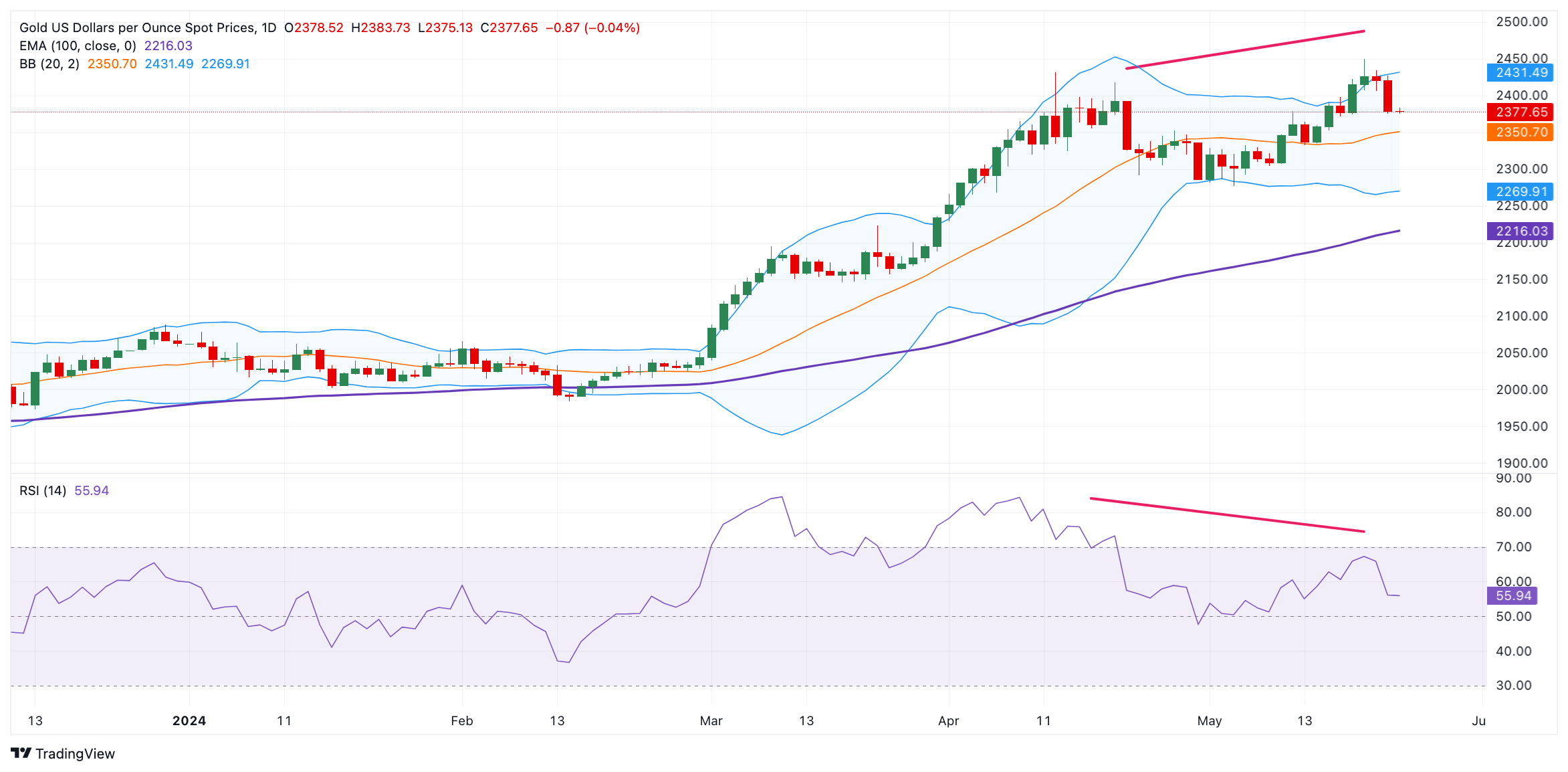
Gold price trades softer on the day. The constructive view of the yellow metal remains intact as it is above the key 100-period Exponential Moving Average (EMA) on the daily timeframe. The 14-day Relative Strength Index (RSI) holds above the bullish zone near 56.10, supporting the buyers for the time being. Nonetheless, XAU/USD has formed a bearish divergence as the price has moved to an all-time high on May 20, but the RSI indicator has formed lower highs, suggesting the momentum is slowing and there will likely be a correction or consolidation in price in the near term.
The key resistance level for the precious metal will emerge near the the upper boundary of Bollinger Band and an all-time high of $2,450. A break above this level will expose the $2,500 psychological round mark.
On the downside, a low of May 13 at $2,332 acts as an initial support level for gold. The additional downside filter to watch is the lower limit of the Bollinger Band at $2,270. A breach of the mentioned level will see a drop to the 100-period EMA of $2,216.
US Dollar price in the last 7 days
The table below shows the percentage change of US Dollar (USD) against listed major currencies in the last 7 days. US Dollar was the strongest against the Swiss Franc.
| USD | EUR | GBP | CAD | AUD | JPY | NZD | CHF | |
| USD | 0.59% | -0.25% | 0.62% | 1.14% | 1.50% | 0.30% | 1.60% | |
| EUR | -0.60% | -0.86% | 0.03% | 0.57% | 0.91% | -0.30% | 1.02% | |
| GBP | 0.26% | 0.84% | 0.88% | 1.42% | 1.76% | 0.55% | 1.85% | |
| CAD | -0.62% | -0.03% | -0.88% | 0.55% | 0.91% | -0.33% | 0.97% | |
| AUD | -1.17% | -0.59% | -1.43% | -0.54% | 0.35% | -0.88% | 0.44% | |
| JPY | -1.51% | -0.91% | -1.79% | -0.89% | -0.32% | -1.23% | 0.08% | |
| NZD | -0.28% | 0.27% | -0.55% | 0.32% | 0.87% | 1.22% | 1.30% | |
| CHF | -1.63% | -1.02% | -1.87% | -0.99% | -0.44% | -0.07% | -1.32% |
The heat map shows percentage changes of major currencies against each other. The base currency is picked from the left column, while the quote currency is picked from the top row. For example, if you pick the Euro from the left column and move along the horizontal line to the Japanese Yen, the percentage change displayed in the box will represent EUR (base)/JPY (quote).
Gold FAQs
Gold has played a key role in human’s history as it has been widely used as a store of value and medium of exchange. Currently, apart from its shine and usage for jewelry, the precious metal is widely seen as a safe-haven asset, meaning that it is considered a good investment during turbulent times. Gold is also widely seen as a hedge against inflation and against depreciating currencies as it doesn’t rely on any specific issuer or government.
Central banks are the biggest Gold holders. In their aim to support their currencies in turbulent times, central banks tend to diversify their reserves and buy Gold to improve the perceived strength of the economy and the currency. High Gold reserves can be a source of trust for a country’s solvency. Central banks added 1,136 tonnes of Gold worth around $70 billion to their reserves in 2022, according to data from the World Gold Council. This is the highest yearly purchase since records began. Central banks from emerging economies such as China, India and Turkey are quickly increasing their Gold reserves.
Gold has an inverse correlation with the US Dollar and US Treasuries, which are both major reserve and safe-haven assets. When the Dollar depreciates, Gold tends to rise, enabling investors and central banks to diversify their assets in turbulent times. Gold is also inversely correlated with risk assets. A rally in the stock market tends to weaken Gold price, while sell-offs in riskier markets tend to favor the precious metal.
The price can move due to a wide range of factors. Geopolitical instability or fears of a deep recession can quickly make Gold price escalate due to its safe-haven status. As a yield-less asset, Gold tends to rise with lower interest rates, while higher cost of money usually weighs down on the yellow metal. Still, most moves depend on how the US Dollar (USD) behaves as the asset is priced in dollars (XAU/USD). A strong Dollar tends to keep the price of Gold controlled, whereas a weaker Dollar is likely to push Gold prices up.
Author

Lallalit Srijandorn
FXStreet
Lallalit Srijandorn is a Parisian at heart. She has lived in France since 2019 and now becomes a digital entrepreneur based in Paris and Bangkok.

















