Gold price sticks to modest intraday losses; holds above $3,300 amid weaker USD
- Gold price edges lower on Tuesday amid diminishing odds for a rate cut by the Fed in July.
- Concerns about the economic fallout from Trump’s tariffs weigh on investors’ sentiment.
- The emergence of some USD weakness contributes to limiting losses for the XAU/USD pair.

Gold price (XAU/USD) remains depressed through the first half of the European session on Tuesday, though a combination of factors helps limit the downside. Expectations that US President Donald Trump's tariffs would underpin US inflation in the coming months and force the Federal Reserve (Fed) to keep interest rates steady seem to undermine the non-yielding yellow metal.
The US Dollar (USD), however, struggles to lure buyers amid concerns about the worsening US fiscal condition. Furthermore, worries about the potential economic downfall from Trump's trade tariffs and geopolitical risks keep investors on edge. This, in turn, holds back traders from placing aggressive bearish bets around the safe-haven Gold price and acts as a tailwind.
Daily Digest Market Movers: Gold price lacks firm direction amid mixed fundamental cues
- US President Donald Trump extended the deadline for the imposition of reciprocal tariffs to August 1 and also released letters outlining higher trade tariffs against a slew of Asian and African countries. Trump also threatened that any Country aligning with the anti-American policies of BRICS will be charged an additional 10% tariff and there will be no exceptions to this policy.
- The Federal Reserve is now expected to keep interest rates elevated in anticipation of worsening inflation as a result of higher import taxes and a still resilient US labor market. This, in turn, lifted the US Dollar to a nearly two-week high on Monday and turned out to be a key factor that undermines demand for the non-yielding Gold price during the Asian session on Tuesday.
- The USD bulls, however, seem reluctant amid the uncertainty over the potential economic impact of Trump's tariffs and US fiscal concerns. Adding to this, a fresh wave of the global risk-aversion trade – as depicted by a sea of red across the global equity markets – could lend support to the safe-haven precious metal and warrants caution for aggressive bearish traders.
- In the absence of any relevant market-moving economic data from the US on Tuesday, the market focus will remain glued to the release of FOMC meeting minutes on Wednesday. Investors will look for more cues about the Fed's rate-cut path, which, in turn, will drive the USD demand in the near term and provide a fresh directional impetus to the non-yielding yellow metal.
Gold price might continue with its struggle to make it through 100-SMA hurdle on H4
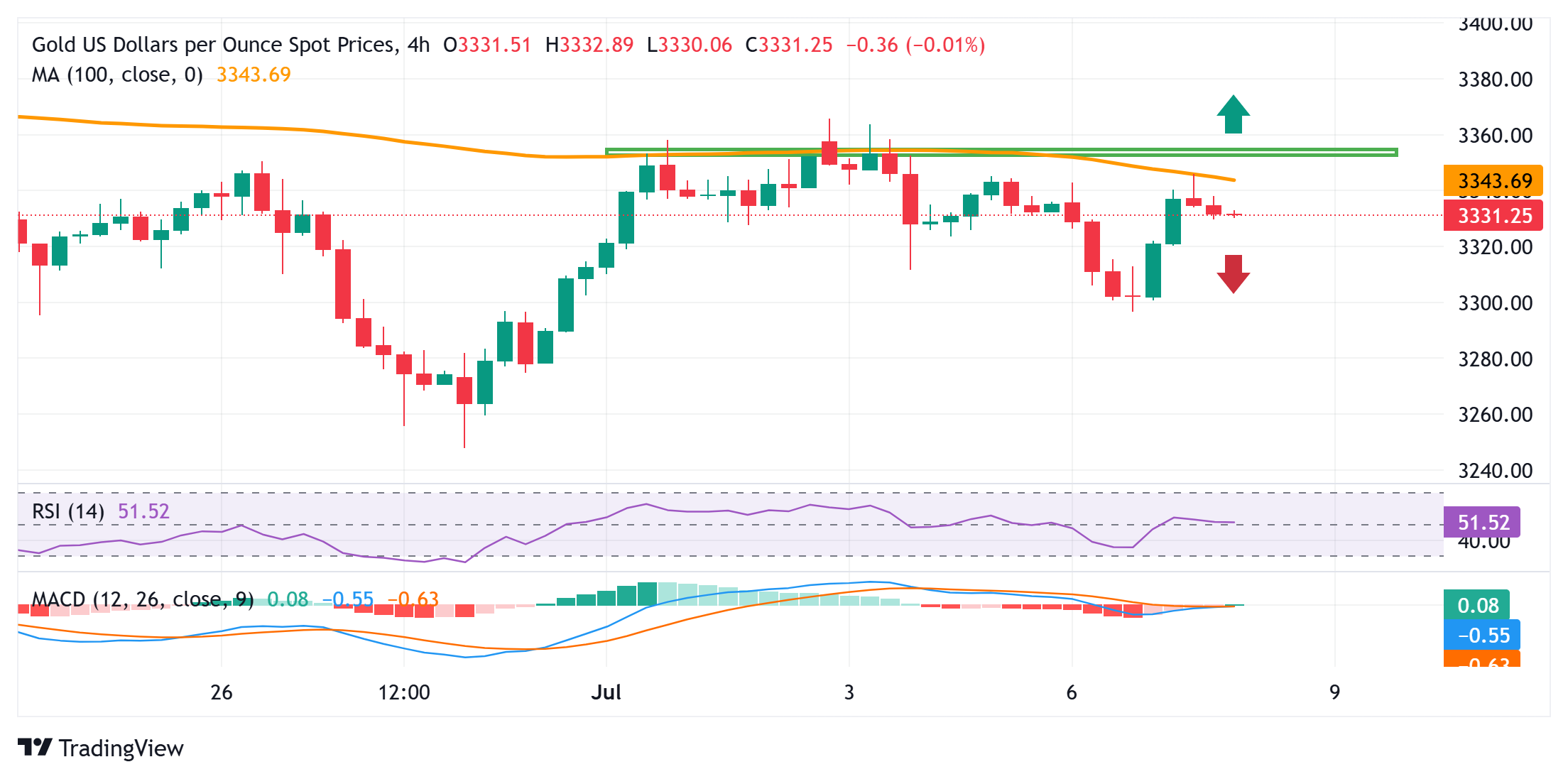
The overnight goodish rebound faced rejection near the 100-period Simple Moving Average (SMA) on the 4-hour chart. The said barrier is currently pegged near the $3,347-3,348 region and is followed by $3,358-3,360 supply zone. A sustained strength beyond the latter could trigger a short-covering move and allow the Gold price to reclaim the $3,400 round figure.
On the flip side, the $3,300-3,295 area might continue to protect the immediate downside, below which the XAU/USD pair could accelerate the fall towards the next relevant support near the $3,270 horizontal zone. The downward trajectory could get extended and eventually drag the Gold price to the $3,248-3,247 region, or the June monthly swing low.
US Dollar FAQs
The US Dollar (USD) is the official currency of the United States of America, and the ‘de facto’ currency of a significant number of other countries where it is found in circulation alongside local notes. It is the most heavily traded currency in the world, accounting for over 88% of all global foreign exchange turnover, or an average of $6.6 trillion in transactions per day, according to data from 2022. Following the second world war, the USD took over from the British Pound as the world’s reserve currency. For most of its history, the US Dollar was backed by Gold, until the Bretton Woods Agreement in 1971 when the Gold Standard went away.
The most important single factor impacting on the value of the US Dollar is monetary policy, which is shaped by the Federal Reserve (Fed). The Fed has two mandates: to achieve price stability (control inflation) and foster full employment. Its primary tool to achieve these two goals is by adjusting interest rates. When prices are rising too quickly and inflation is above the Fed’s 2% target, the Fed will raise rates, which helps the USD value. When inflation falls below 2% or the Unemployment Rate is too high, the Fed may lower interest rates, which weighs on the Greenback.
In extreme situations, the Federal Reserve can also print more Dollars and enact quantitative easing (QE). QE is the process by which the Fed substantially increases the flow of credit in a stuck financial system. It is a non-standard policy measure used when credit has dried up because banks will not lend to each other (out of the fear of counterparty default). It is a last resort when simply lowering interest rates is unlikely to achieve the necessary result. It was the Fed’s weapon of choice to combat the credit crunch that occurred during the Great Financial Crisis in 2008. It involves the Fed printing more Dollars and using them to buy US government bonds predominantly from financial institutions. QE usually leads to a weaker US Dollar.
Quantitative tightening (QT) is the reverse process whereby the Federal Reserve stops buying bonds from financial institutions and does not reinvest the principal from the bonds it holds maturing in new purchases. It is usually positive for the US Dollar.
Author

Haresh Menghani
FXStreet
Haresh Menghani is a detail-oriented professional with 10+ years of extensive experience in analysing the global financial markets.