Gold price advances due to increased safe-haven demand, ISM Services PMI eyed
- Gold price receives support from safe-haven demand amid the implementation of US tariffs.
- Rising US Treasury yields weigh on non-yielding assets.
- Gold drew buyers due to geopolitical concerns as the US halted military aid to Ukraine.

Gold price (XAU/USD) extends its winning streak for the third successive day on Wednesday. The precious metal receives upward support from safe-haven demand amid the implementation of US tariffs. However, the price of the Gold faced challenges as rising US Treasury yields pressured non-yielding assets.
Trump's 25% levies on Mexican and Canadian imports took effect on Tuesday, alongside a hike in Chinese duties to 20%, escalating trade tensions and prompting retaliation. Investors now turn their focus to key US economic data, including the ISM Services PMI and ADP Employment Change, set for release in the North American session.
However, US Commerce Secretary Howard Lutnick suggested in a Fox News interview that Trump may reconsider his tariff policy less than 48 hours after its implementation. He noted that if the USMCA rules are followed, relief could be offered. However, the New York Times reported that Trump has privately signaled that he intends to maintain the tariffs.
The safe-haven Gold attracted buyers as the US paused military aid to Ukraine. Bloomberg cited a defense official stating that all US military equipment not yet in Ukraine would be grounded, including weapons in transit via aircraft and ships, as well as those waiting in transit areas in Poland. On Friday, tensions escalated between US President Donald Trump and Ukrainian leader Volodymyr Zelenskyy during peace deal negotiations.
US President Donald Trump has delivered a joint session address at the Capitol Building in Washington, DC, on Wednesday. This marks his first Congressional speech since returning to power.
Daily Digest Market Movers: Gold price edges lower amid rising US Treasury yields
- The US Dollar Index (DXY), which measures the USD against six major currencies, trades around 105.70 at the time of writing, edging higher amid rising US Treasury yields with 2- and 10-year yields on US bonds standing at 3.98% and 4.25%, respectively.
- However, USD faced downward pressure amid growing concerns over slowing economic growth and the impact of tariffs on the US economy. Markets bet that President Trump will find a reason to walk back his tariff threats.
- US Commerce Secretary Howard Lutnick stated in a televised interview on Fox News that President Trump may reconsider his tariff policy less than 48 hours after its implementation. Lutnick indicated that if the USMCA rules are followed, Trump is considering offering relief. President Trump's 25% tariffs on goods from Canada and Mexico took effect on Tuesday, alongside a doubling of duties on Chinese imports to 20%.
- Canada confirmed that it will impose retaliatory tariffs on US imports. China’s Commerce Ministry announced on Tuesday that it will slap additional tariffs of up to 15% on imports of key farm products from the US.
- This raises the risk of a global trade war and weighs on investors' sentiment, which should act as a tailwind for the safe-haven precious metal and help limit any deeper losses amid a bearish tone surrounding the US Dollar.
- The Institute for Supply Management's (ISM) Manufacturing PMI slipped to 50.3 in February from 50.9 in the previous month, while the Prices Paid Index jumped to a nearly three-year high amid worries about duties on imports.
- This comes on top of worries that Trump's trade tariffs would undermine consumer spending and fuel concerns about the outlook for the world’s largest economy. This could further lend support to the XAU/USD pair.
Technical Analysis: Gold price holds key psychological support at $2,900 near nine-day EMA
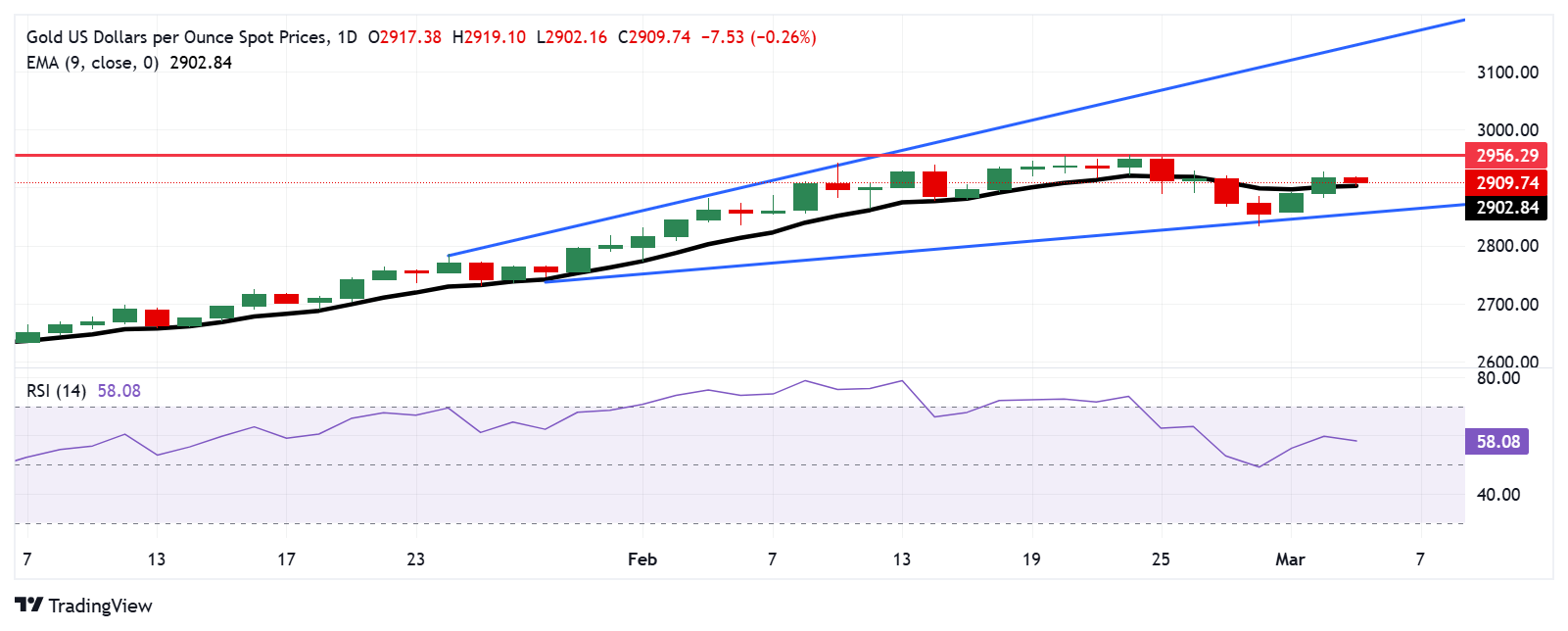
Gold price (XAU/USD) is trading around $2,910 per troy ounce on Wednesday. Technical analysis of the daily chart suggests that the metal price consolidates within an ascending channel pattern, suggesting the bullish bias is intact. Additionally, the 14-day Relative Strength Index (RSI) stays above 50, reinforcing a bearish outlook.
The XAU/USD could target primary resistance at the all-time high of $2,956, recorded on February 24.
On the downside, the immediate support is found at the nine-day Exponential Moving Average (EMA) of $2,902. A break below this level could weaken the short-term price momentum and lead the price to test the lower boundary of the ascending channel at $2,583 level.
XAU/USD: Daily Chart
Tariffs FAQs
Tariffs are customs duties levied on certain merchandise imports or a category of products. Tariffs are designed to help local producers and manufacturers be more competitive in the market by providing a price advantage over similar goods that can be imported. Tariffs are widely used as tools of protectionism, along with trade barriers and import quotas.
Although tariffs and taxes both generate government revenue to fund public goods and services, they have several distinctions. Tariffs are prepaid at the port of entry, while taxes are paid at the time of purchase. Taxes are imposed on individual taxpayers and businesses, while tariffs are paid by importers.
There are two schools of thought among economists regarding the usage of tariffs. While some argue that tariffs are necessary to protect domestic industries and address trade imbalances, others see them as a harmful tool that could potentially drive prices higher over the long term and lead to a damaging trade war by encouraging tit-for-tat tariffs.
During the run-up to the presidential election in November 2024, Donald Trump made it clear that he intends to use tariffs to support the US economy and American producers. In 2024, Mexico, China and Canada accounted for 42% of total US imports. In this period, Mexico stood out as the top exporter with $466.6 billion, according to the US Census Bureau. Hence, Trump wants to focus on these three nations when imposing tariffs. He also plans to use the revenue generated through tariffs to lower personal income taxes.
Author

Akhtar Faruqui
FXStreet
Akhtar Faruqui is a Forex Analyst based in New Delhi, India. With a keen eye for market trends and a passion for dissecting complex financial dynamics, he is dedicated to delivering accurate and insightful Forex news and analysis.