Gold price weakens further below $3,300, refreshes monthly low ahead of the US PCE data
- Gold price dives to a fresh monthly low and seems poised to register heavy weekly losses.
- Fed rate cut bets and a bearish USD do little to lend support to XAU/USD or stall the downfall.
- Traders look forward to the release of the US PCE Price Index for a fresh directional impetus.

Gold price (XAU/USD) extends its steady intraday descent through the first half of the European session on Friday and drops to the $3,283-3,282 area, or a fresh monthly low in the last hour. The optimism over the Israel-Iran ceasefire remains supportive of the upbeat market mood, which, in turn, is seen undermining demand for the safe-haven commodity. Apart from this, the downfall could further be attributed to some repositioning trade ahead of the key US inflation data.
The US Personal Consumption Expenditure (PCE) Price Index is due for release later today and should provide cues about the Federal Reserve's (Fed) rate-cut path. This, in turn, will play a key role in influencing the US Dollar (USD) price dynamics and provide some meaningful impetus to the non-yielding Gold price. In the meantime, concerns about the Fed's independence, and rate cut bets keep the USD depressed near a multi-year low, though it fails to support the XAU/USD pair.
Daily Digest Market Movers: Gold price selling bias remains unabated amid positive risk tone
- The Commerce Department's third and final estimate released on Thursday showed that the US economy contracted more than previously estimated at the start of 2025 on the back of muted consumer spending and tariff-related disruptions. In fact, the US Gross Domestic Product (GDP) fell at an annualized rate of 0.5% during the January-March period, a steeper decline than the 0.2% reported in the second estimate.
- A separate report published by the US Labor Department showed that the number of Americans filing unemployment benefits for the first time dropped by 10,000 to a seasonally adjusted 236,000 for the week ended June 21. However, Continuing Claims rose by 37,000 to 1.974 million for the week ending June 14. That marked the highest level since November 2021 and suggested a sluggish hiring environment.
- The data fueled speculations that the US Unemployment Rate might tick up to at least 4.3% in June from 4.2% in May. This could force the Federal Reserve to resume its rate-cutting cycle in July and lower borrowing costs further by the end of this year. The outlook drags the US Dollar to its lowest level since March 2022 and might continue to lend some support to the non-yielding Gold price.
- Investors now await the release of the US Personal Consumption Expenditure (PCE) Price Index data, due later this Friday, for further cues about the Fed's rate-cut path. Consensus estimates point to a 0.1% monthly increase in the core PCE Price Index and a 2.6% annual rise in May. A surprisingly stronger print would validate Fed Chair Jerome Powell's wait-and-see approach to rate cuts and boost the USD.
- In fact, Powell reiterated this week that the Fed is well-positioned to wait to cut interest rates until they have a better handle on the impact of steep tariffs on consumer prices. The comments prompted fresh criticism from US President Donald Trump, who has been calling for lower interest rates. Moreover, reports suggest that Trump was considering naming Powell's successor by September or October.
- The development fuels concerns about the potential erosion of the Fed's independence, which should limit any immediate USD positive reaction to the crucial inflation data. This, in turn, suggests that the path of least resistance for the XAU/USD pair is to the upside and any further slide might still be seen as a buying opportunity.
Gold price breakdown below the $3,300 mark backs the case for further depreciating move
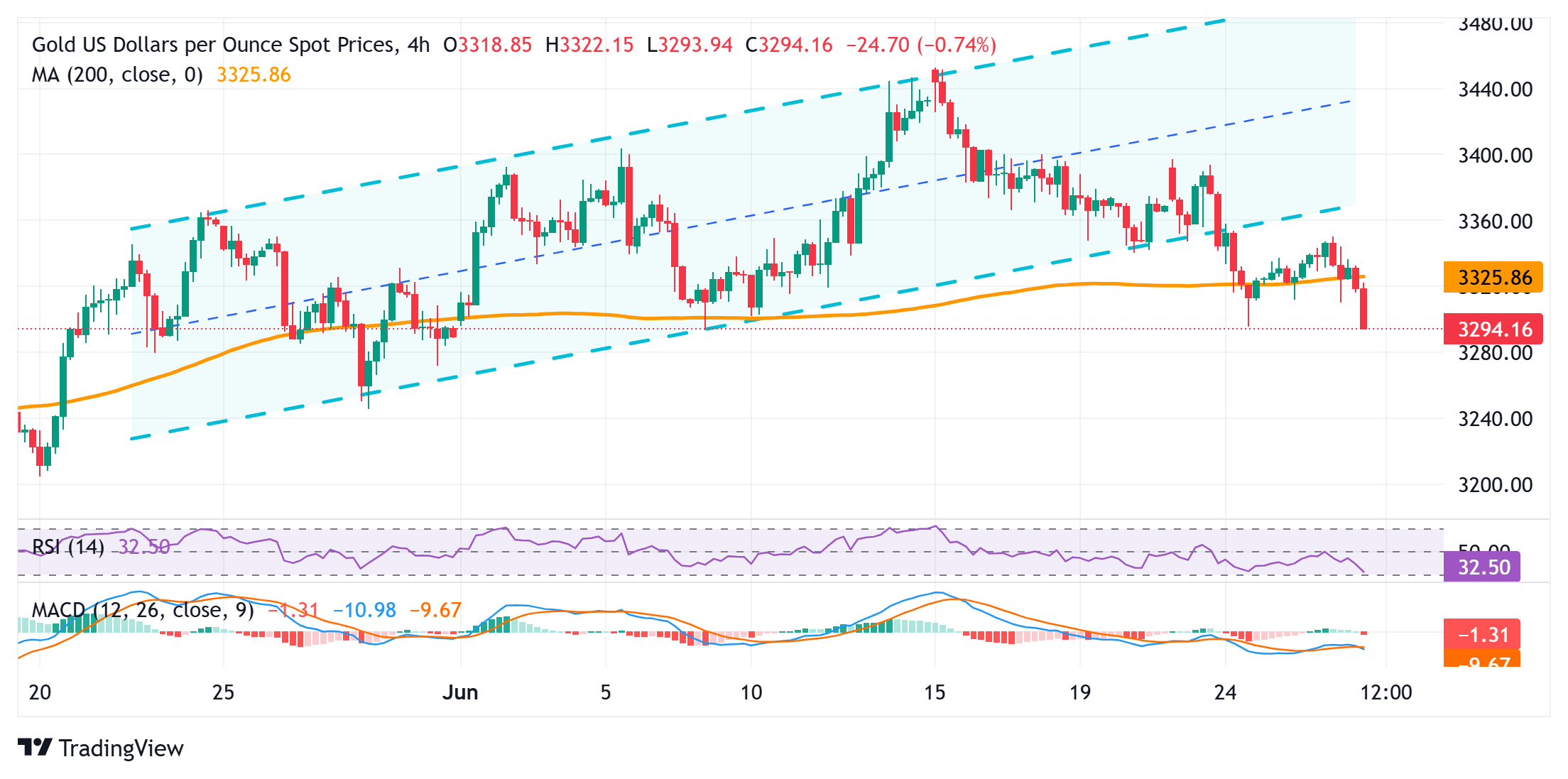
From a technical perspective, an intraday slide below the 200-period Simple Moving Average (SMA) on the 4-hour chart could be seen as a fresh trigger for the XAU/USD bears against the backdrop of this week's breakdown through a short-term ascending channel. Given that oscillators on the daily chart have just started gaining negative traction, the Gold price might then accelerate the fall towards the $3,245 region before eventually dropping to the $3,210-$3,200 horizontal support and the $3,175 area.
On the flip side, the $3,324-3,325 area now seems to act as an immediate hurdle ahead of the overnight swing high, around the $3,350 region. This is followed by the trend-channel support breakpoint, around the $3,368-3,370 region, which should cap any further gains for the Gold price. A sustained strength beyond the latter, however, could allow the XAU/USD pair to reclaim the $3,400 mark. Some follow-through buying would negate the negative outlook and shift the bias in favor of bulls.
Economic Indicator
Personal Consumption Expenditures - Price Index (YoY)
The Personal Consumption Expenditures (PCE), released by the US Bureau of Economic Analysis on a monthly basis, measures the changes in the prices of goods and services purchased by consumers in the United States (US). The YoY reading compares prices in the reference month to a year earlier. Price changes may cause consumers to switch from buying one good to another and the PCE Deflator can account for such substitutions. This makes it the preferred measure of inflation for the Federal Reserve. Generally, a high reading is bullish for the US Dollar (USD), while a low reading is bearish.
Read more.Next release: Fri Jun 27, 2025 12:30
Frequency: Monthly
Consensus: 2.3%
Previous: 2.1%
Source: US Bureau of Economic Analysis
Author

Haresh Menghani
FXStreet
Haresh Menghani is a detail-oriented professional with 10+ years of extensive experience in analysing the global financial markets.