Gold price trims a part of intraday gains to all-time peak ahead of Trump's tariffs announcement
- Gold price retreats after touching a fresh all-time peak earlier this Tuesday.
- A positive risk tone and a modest USD uptick prompt some profit-taking.
- Global trade war fears and geopolitical risks should support the commodity.

Gold price (XAU/USD) surrenders a major part of its early gains to a fresh record high as traders opt to take some profits off the table amid overbought conditions and ahead of US President Donald Trump's reciprocal tariffs announcement. Adding to this, a positive tone around the Asian equity markets undermines the precious metal, which, along with a modest US Dollar (USD) uptick, contributes to the intraday pullback.
However, persistent worries about the potential economic fallout from the Trump administration's aggressive trade policies should act as a tailwind for the safe-haven Gold price. Furthermore, expectations that the Federal Reserve (Fed) would resume its rate-cutting cycle soon, amid worries about a tariff-driven slowdown in US economic growth, should keep a lid on the USD gains and underpin the non-yielding yellow metal.
Daily Digest Market Movers: Gold price bulls opt to take some profits off the table ahead of Trump's reciprocal tariffs
- The US President dashed hopes the levies would be limited to a smaller group of countries with the biggest trade imbalances and said on Sunday that reciprocal tariffs would essentially include all nations. This comes on top of Trump's 25% tariff on steel and aluminum, and auto imports, stoking worries about a widening global trade war.
- Furthermore, investors now seem convinced that a tariff-driven slowdown in the US economic activity would force the Federal Reserve (Fed) to resume its rate-cutting cycle soon, despite sticky inflation. This, in turn, assists the safe-haven Gold price to register its strongest quarter since 1986 and hit a fresh record high on Tuesday.
- The markets are currently pricing in the possibility that the US central bank will lower borrowing costs by 80 basis points by the end of this year. This keeps the US Treasury bond yields depressed, which, in turn, does little to help the US Dollar attract any meaningful buyers and further underpins the non-yielding yellow metal.
- On the geopolitical front, Ukrainian officials said early on Monday that Russia bombed the city of Kharkiv in north-eastern Ukraine for the second night in a row. Moreover, Ukraine’s President, Volodymyr Zelenskyy said that Russia had fired more than 1,000 drones in the past week and called for a response from the US and other allies.
- Israel earlier this month ended its ceasefire with the Hamas militant group and renewed its air and ground strikes. Adding to this, the Israeli military has issued mass evacuation orders for Rafah, signaling a possible new ground operation in the city, raising the risk of a further escalation of tensions in the region.
- Traders now look to this week's key US macro releases, scheduled at the beginning of a new month, starting with the JOLTS openings and ISM Manufacturing PMI on Tuesday. This will be followed by the ADP report on Wednesday, US ISM Services PMI on Thursday, and the closely-watched US Nonfarm Payrolls (NFP) on Friday.
- The focus, however, will remain glued to Trump's impending reciprocal tariffs announcement later today, at 19:00 GMT. This will play a key role in influencing the broader risk sentiment and the USD price dynamics, which, in turn, should provide some meaningful impetus to the XAU/USD pair.
Gold price dip-buying should help limit any correcive slide; the $3,100 mark holds the key for bullish traders
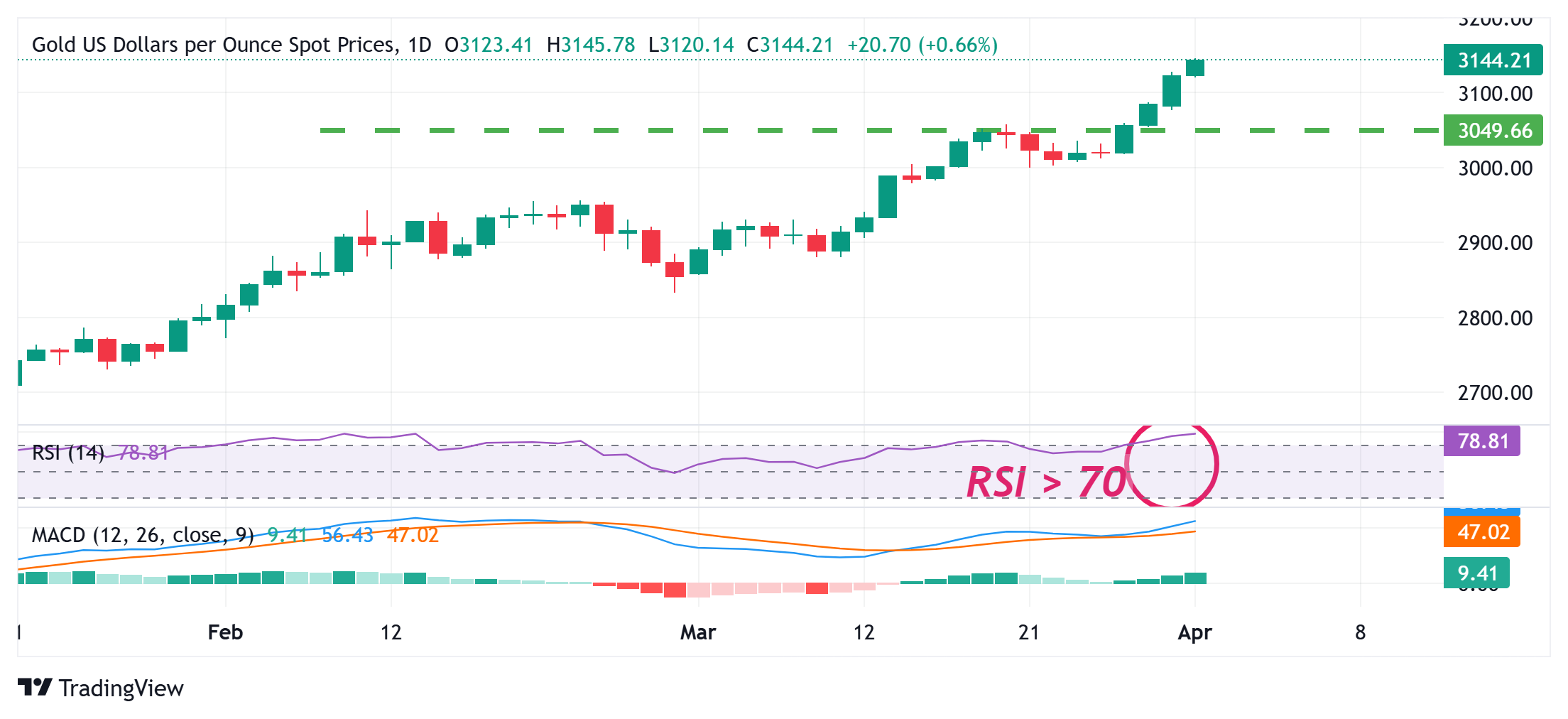
From a technical perspective, the daily Relative Strength Index (RSI) stands well above the 70 mark and indicates overbought conditions. This, in turn, makes it prudent to wait for some near-term consolidation or a modest pullback before traders start positioning for any further appreciating move. Nevertheless, the overnight breakout above the $3,100 mark and the subsequent move up suggest that the path of least resistance for the Gold price remains to the upside. Hence, any corrective pullback could be seen as a buying opportunity and is more likely to remain limited.
In the meantime, the $3,128-3,127 region could act as immediate support ahead of the $3,100 round figure. A convincing break below the latter might prompt some long-unwinding and drag the Gold price below the $3,076 area, or the overnight swing low, towards the $3,057-3,058 resistance breakpoint en route to the $3,036-3,035 support zone. This is followed by the $3,000 psychological mark, which should act as a strong base for the XAU/USD and key pivotal point for short-term traders.
Economic Indicator
ISM Manufacturing PMI
The Institute for Supply Management (ISM) Manufacturing Purchasing Managers Index (PMI), released on a monthly basis, is a leading indicator gauging business activity in the US manufacturing sector. The indicator is obtained from a survey of manufacturing supply executives based on information they have collected within their respective organizations. Survey responses reflect the change, if any, in the current month compared to the previous month. A reading above 50 indicates that the manufacturing economy is generally expanding, a bullish sign for the US Dollar (USD). A reading below 50 signals that factory activity is generally declining, which is seen as bearish for USD.
Read more.Next release: Tue Apr 01, 2025 14:00
Frequency: Monthly
Consensus: 49.5
Previous: 50.3
Source: Institute for Supply Management
The Institute for Supply Management’s (ISM) Manufacturing Purchasing Managers Index (PMI) provides a reliable outlook on the state of the US manufacturing sector. A reading above 50 suggests that the business activity expanded during the survey period and vice versa. PMIs are considered to be leading indicators and could signal a shift in the economic cycle. Stronger-than-expected prints usually have a positive impact on the USD. In addition to the headline PMI, the Employment Index and the Prices Paid Index numbers are watched closely as they shine a light on the labour market and inflation.
Author

Haresh Menghani
FXStreet
Haresh Menghani is a detail-oriented professional with 10+ years of extensive experience in analysing the global financial markets.
















