Gold smashes all-time high as market sentiment shifts sour on US trade uncertainty
- Gold hits fresh all-time high amid speculation Trump’s April 2 tariffs could target all trade partners.
- Goldman ups US recession odds to 35% as sentiment deteriorates and Washington signals tolerance for slowdown.
- DXY and yields rise but fail to dent Gold’s rally as safe-haven flows dominate ahead of key US data.

Gold prints another record high on Monday, surpassing the $3,100 threshold for the first time and extends its gains to an all-time high of $3,127 before retreating somewhat. Uncertainty surrounding US trade policies and the April 2 Liberation Day is lingering, with investors shifting risk-averse and flocking to the yellow metal’s safe-haven appeal. At the time of writing, XAU/USD trades at $3,119, up more than 1%.
Risk appetite deteriorates as traders await the announcement of additional tariffs on Wednesday. Goldman Sachs revealed that the odds of a recession in the United States (US) rose from 20% to 35%, primarily due to business and household pessimism about the outlook, as well as Washington's tolerance of a deeper economic slowdown.
Trump’s comments on Sunday on Air Force One increased the chances that tariffs could be universal, instead of the 10 or 15 revealed by US Treasury Secretary Scott Bessent. “Who told you 10 or 15? You might have heard it, but you didn’t hear it from me,” the President said. “You’d start with all countries. So let’s see what happens.”
Therefore, Bullion prices exploded, even though US Treasury bond yields had recovered some ground, particularly the coupon of the 10-year T-note. The US Dollar Index (DXY), which tracks the value of the buck against a basket of six currencies, climbs 0.24% to 104.25.
On the data front, the Chicago PMI improved, despite remaining in contractionary territory for the sixteenth straight month. Ahead this week, the US economic docket will feature the ISM Manufacturing and Services PMI, as well as Nonfarm Payrolls figures.
Daily digest market movers: Gold prices rises amid firm US Treasury yields
- The US 10-year T-note yield is flat at 4.257%. US real yields edge down two bps to 1.86%, according to US 10-year Treasury Inflation-Protected Securities (TIPS) yields.
- The Chicago PMI data for March rose by 47.6 points from 45.5 and exceeded forecasts of 45.2. Notably, it is the largest level since November 2023, yet it remains in contractionary territory for the sixteenth consecutive month.
- Some of the subcomponents improved, like Production, New Orders, Employment, and Order Backlogs. Supplier Deliveries, Inventories and Prices Paid dipped, according to the poll.
- Last week’s US inflation data held steady, according to the US Bureau of Economic Analysis. Nevertheless, the risks of a recession drove market participants to price in over 74 basis points of easing toward the end of 2025, according to data from the Chicago Board of Trade.
- In the geopolitics space, US President Donald Trump threatened to impose secondary tariffs of 25%-50% on buyers of Russian oil, if Moscow blocks his efforts to end the war in Ukraine.
- Wall Street’s banks had updated their Gold forecasts last week. Economists at Goldman Sachs, Société Générale, and Bank of America identified $3,300 as the next target, according to a Kitco article.
XAU/USD technical outlook: Gold price rallies past $3,050, eyes on $3,100
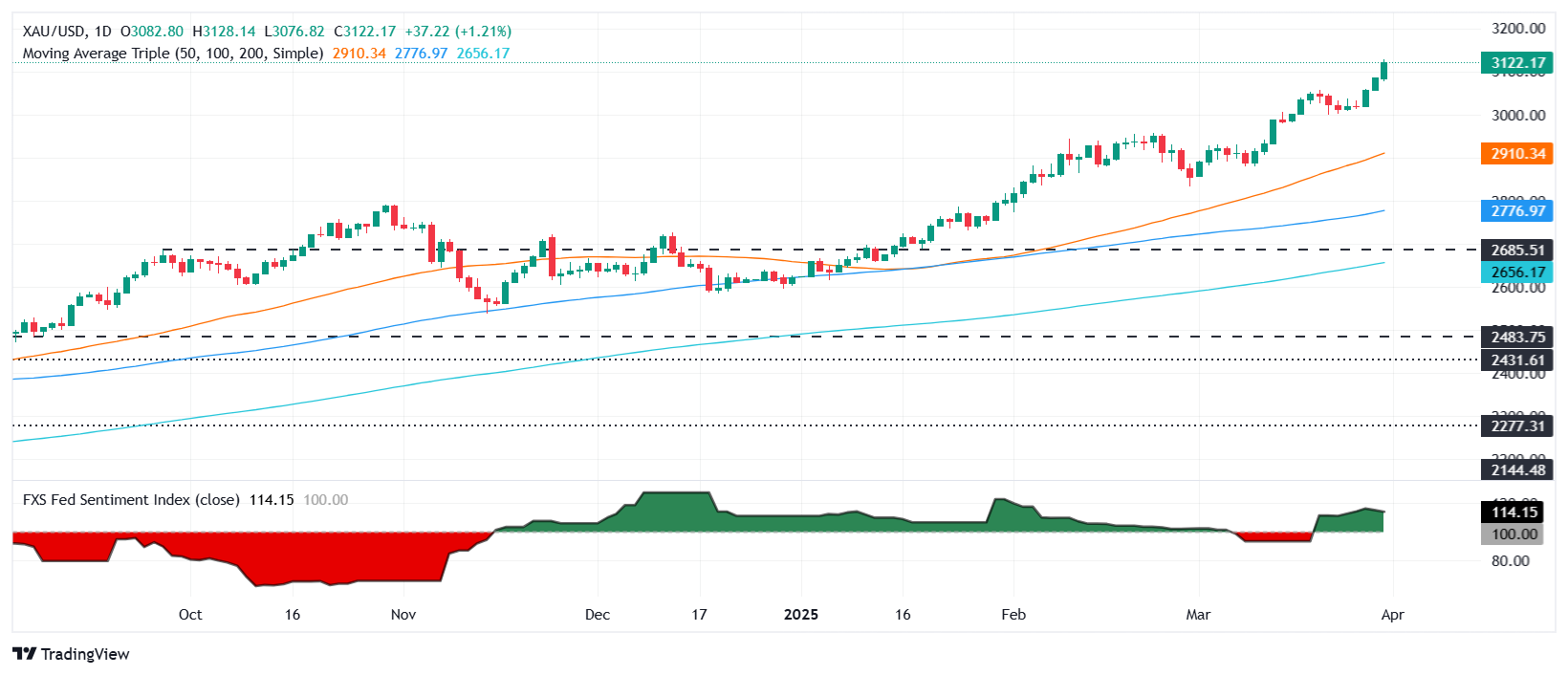
Gold’s rally expands. The yellow metal is up 18.96% so far this year, and due to uncertainty in the financial markets, the uptrend could continue. Although the Relative Strength Index (RSI) is overbought, traders should be aware that, due to the aggressiveness of the move, the most extreme level is 80.
The XAU/USD’s next resistance would be the psychological $3,150 and $3,200 on the upside. On the other hand, Bullion’s first support would be $3,100. A breach of the latter will expose the March 20 high turned support at $3,057, followed by the $3,000 figure.
Tariffs FAQs
Tariffs are customs duties levied on certain merchandise imports or a category of products. Tariffs are designed to help local producers and manufacturers be more competitive in the market by providing a price advantage over similar goods that can be imported. Tariffs are widely used as tools of protectionism, along with trade barriers and import quotas.
Although tariffs and taxes both generate government revenue to fund public goods and services, they have several distinctions. Tariffs are prepaid at the port of entry, while taxes are paid at the time of purchase. Taxes are imposed on individual taxpayers and businesses, while tariffs are paid by importers.
There are two schools of thought among economists regarding the usage of tariffs. While some argue that tariffs are necessary to protect domestic industries and address trade imbalances, others see them as a harmful tool that could potentially drive prices higher over the long term and lead to a damaging trade war by encouraging tit-for-tat tariffs.
During the run-up to the presidential election in November 2024, Donald Trump made it clear that he intends to use tariffs to support the US economy and American producers. In 2024, Mexico, China and Canada accounted for 42% of total US imports. In this period, Mexico stood out as the top exporter with $466.6 billion, according to the US Census Bureau. Hence, Trump wants to focus on these three nations when imposing tariffs. He also plans to use the revenue generated through tariffs to lower personal income taxes.
Author

Christian Borjon Valencia
FXStreet
Markets analyst, news editor, and trading instructor with over 14 years of experience across FX, commodities, US equity indices, and global macro markets.