|

Gold Price Analysis: XAU/USD tumbles hitting levels under $1720 as US yields rebound

Gold Price Analysis: XAU/USD tumbles hitting levels under $1720 as US yields rebound

Gold prices dropped more than $20 from the daily high and bottomed at $1719 during the American session. The decline took place as US yields bounced to the upside. The recovery of XAU/USD is being challenged.

After the European Central Bank meeting, following Lagarde’s press conference and ahead of the results of the 30-year bond auction, US yield turned to the upside. The 10-year rose from a one-week low at 1.475% to 1.546%. The move offered some support to the dollar that trimmed losses only modestly.

Read more...

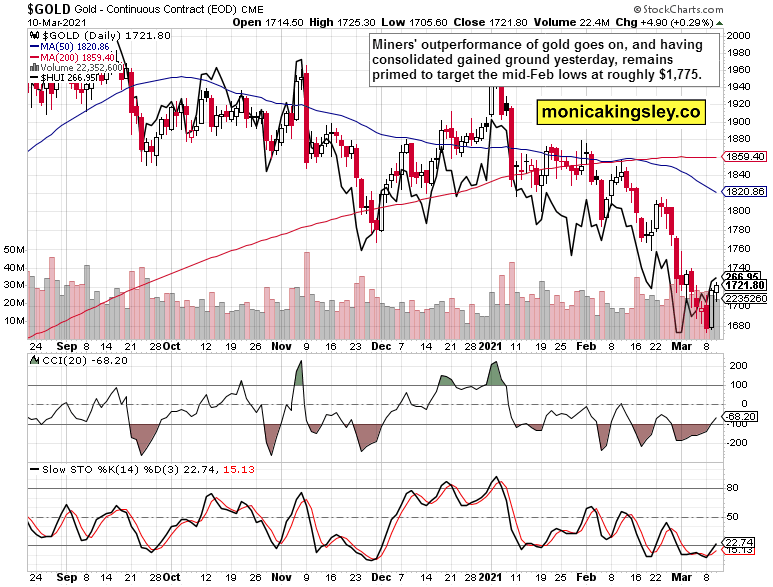
Stocks bulls can take a rest – But gold ones can‘t

The daily banging on the 3,900 threshold shows in yesterday‘s upper knot, and this milestone has very good chances of being conquered today. More important than the exact timing though, are the internals marking the setup –" we‘ve indeed progressed very far into this correction. While not historically among the longest ones, it‘s still getting long in the tooth –" just as I was writing throughout the week.

And it is getting stale, even if I look at the star non-cofirnation, the high yield corporate bonds. Relatively modest daily upswing, outshined by investment grade corporate bonds. Yes, the credit markets are calming down, and the tiny daily long-term Treasuries upswing doesn‘t reflect that fully just yet. Besides giving breathing room to defensives such as utilities and consumer staples, it‘s also very conducive to the precious metals sector.
Read more...

Author

FXStreet Team

Composed of a group of economic journalists and FX experts, the FXStreet content team produces and oversees all content published on FXStreet. It provides a purely journalistic approach to the Forex market.


More from FXStreet Team
Share:

Editor's Picks

GBP/USD stays below 1.3400 after soft UK CPI data

GBP/USD struggles to gain traction and stays below 1.3400 in the second half of the day on Wednesday. The UK annual Consumer Price Index (CPI) inflation cooled to 2.6% in June against the market forecast of 2.7%, making it difficult for the British Pound gather recovery momentum. Meanwhile, investors keep a close eye on headlines coming out of the Middle East.

EUR/USD stabilizes near 1.1400 as markets focus on geopolitics

EUR/USD trades in a narrow channel at around 1.1400 on Wednesday. In the absence of high-impact data releases, escalating geopolitical tensions in the Middle East caps the pair's upside. On Thursday, the European Central Bank (ECB) will announce monetary policy decisions.

Gold extends rally as Middle East concerns intensify

Gold extends gains for the fourth consecutive day, standing comfortably above $4,100, unfazed by the risk-off market amid rising tensions in Iran and higher Oil prices. The pair has rallied nearly 2.5% so far this week and is on track for its best weekly performance in more than three months.

Australia unemployment rate set to steady at 4.4% in June, signaling strong job market

Australia will publish the June monthly employment report on Thursday at 01:30 GMT, and market participants expect a modest increase in job creation in the land Down Under. The Australian Bureau of Statistics is expected to announce that the country added 15K new jobs in the month, while the Unemployment Rate is forecast at 4.4%, unchanged from May.

Hyperliquid, Robinhood could lead crypto’s next bull market as DeFi and TradFi converge

The next crypto bull market could be driven by the growing convergence between blockchain-based financial infrastructure and traditional finance, according to Bitwise CIO Matt Hougan. In a report published late Tuesday, Hougan argued that crypto may be showing early signs of a market bottom, with Bitcoin gaining 9% since July 1 even as the NASDAQ 100 declined 6%.

US Dollar mid-year outlook: Exceptional currency, exceptional risks?
The US Dollar enters the second half of 2026 in a markedly different position from a year ago. The King currency has recovered, reflecting persistent US inflation, changing expectations for Fed policy, geopolitical tensions and renewed demand for defensive assets.