|

Gold Price Analysis: XAU/USD sellers eye 100-SMA inside immediate falling triangle

  • Gold extends pullback from $1,733 towards intraday low.
  • Downward sloping momentum line suggests further weakness but triangle formation will test the sellers.
  • Bulls are less likely to enter below 200-SMA.

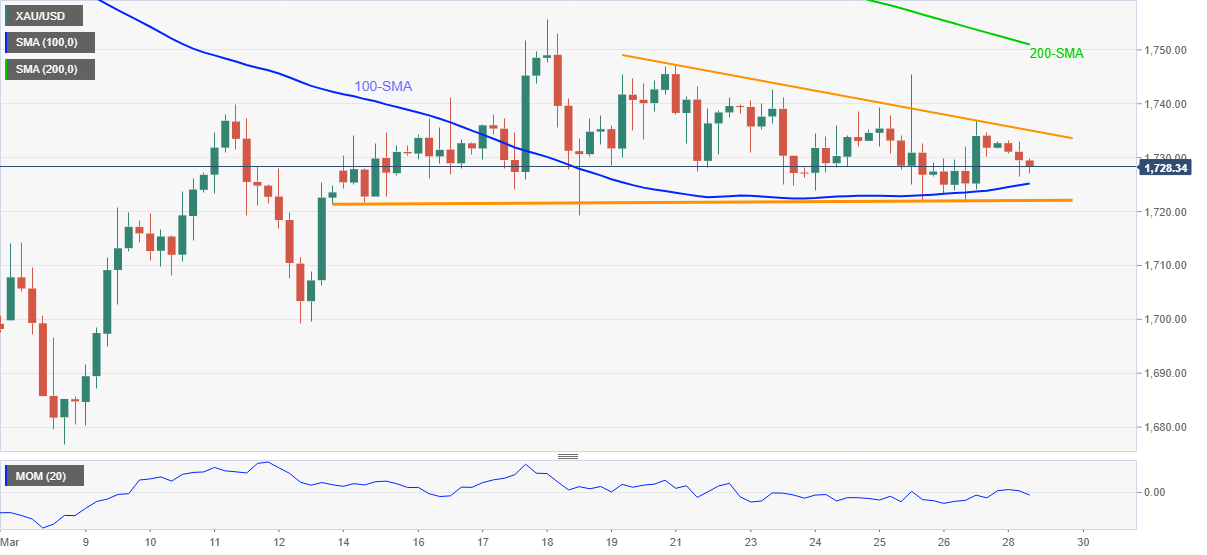
Gold takes offers around $1,727, down 0.32% intraday, while heading into Monday’s European session. In doing so, the yellow metal stays inside a short-term falling triangle bullish chart pattern.

Given the descending Momentum, 100-SMA around $1,725 can offer an intermediate halt during the fall targeting the triangle’s support line close to $1,722.

However, any further downside past-$1,722 becomes less likely and the same may not refrain from challenging the $1,700 if broken.

Alternatively, gold buyers will wait for a clear upside break of the stated triangle’s resistance line, at $1,735 by the press time, to confirm the bullish formation.

While November 2020 lows near $1,765 could lure the bullion buyers past-$1,735, 200-SMA around $1,751 may offer an intermediate halt during the rise.

To sum up, gold is weak but is near to the short-term supports and risks rebound.

Gold four-hour chart
Trend: Pullback expected

additional important levels

Overview
Today last price1727.76
Today Daily Change-4.93
Today Daily Change %-0.28%
Today daily open1732.69
 
Trends
Daily SMA201724.42
Daily SMA501782.75
Daily SMA1001821.99
Daily SMA2001860.61
 
Levels
Previous Daily High1736.82
Previous Daily Low1721.69
Previous Weekly High1747.12
Previous Weekly Low1721.69
Previous Monthly High1871.9
Previous Monthly Low1717.24
Daily Fibonacci 38.2%1731.04
Daily Fibonacci 61.8%1727.47
Daily Pivot Point S11723.98
Daily Pivot Point S21715.27
Daily Pivot Point S31708.85
Daily Pivot Point R11739.11
Daily Pivot Point R21745.53
Daily Pivot Point R31754.24

Author

Anil Panchal

Anil Panchal

FXStreet

Anil Panchal has nearly 15 years of experience in tracking financial markets. With a keen interest in macroeconomics, Anil aptly tracks global news/updates and stays well-informed about the global financial moves and their implications.


More from Anil Panchal
Share:

Editor's Picks

GBP/USD falls as US Dollar receives from internal FOMC policy split

GBP/USD loses ground after three days of gains, trading around 1.3450 during the Asian hours on Friday. The pair depreciates as the US Dollar gains support from a hawkish pause by the Federal Reserve and an internal FOMC policy split.


EUR/USD softens to near 1.1500 as US-Iran war widens

The EUR/ USD pair loses ground to near 1.1515 during the early Asian trading hours on Friday. The Euro softens against the US Dollar amid risk-off sentiment and fears of wider war in the Middle East. The preliminary reading of the Harmonized Index of Consumer Prices from the Eurozone for July and the Michigan Consumer Sentiment Index will be released later on Friday. 


Gold: Looks to snap four-month losing streak but sellers refuse to give up

Gold fails to hold above $4,100 once again as sellers return early Friday. The US Dollar rebounds on fresh US-Iran tensions and month-end profit-taking. Gold closed above $4,100 on Thursday, but the daily RSI remains below 50.  

Why is IDR near historic lows despite Bank Indonesia's 5.75% rate?

The Indonesian Rupiah has faced persistent depreciation pressures against the US Dollar during the first half of 2026, with the USD/IDR pair stabilizing around the 18,100–18,200 range at the time of writing after reaching a record high at 18,247 on June 8, marking the Rupiah's weakest level on record against the Greenback.

9-3: Is the Federal Reserve’s vote tally Warsh's new forward guidance?
The rate did not move. Neither did the statement, and that’s the more interesting fact. Set the July 29 Federal Open Market Committee (FOMC) statement beside the one issued on June 17, and the two documents are identical apart from a single verb and a paragraph at the bottom naming three dissenters.
9-3: Is the Federal Reserve’s vote tally Warsh's new forward guidance?
The rate did not move. Neither did the statement, and that’s the more interesting fact. Set the July 29 Federal Open Market Committee (FOMC) statement beside the one issued on June 17, and the two documents are identical apart from a single verb and a paragraph at the bottom naming three dissenters.