|

Gold Price Analysis: XAU/USD drops 0.5% on dollar strength

  • Gold drops as dollar gains on Fed statement. 
  • The yellow metal risks falling to its 50-day SMA support. 

Gold is feeling the pull of gravity on Thursday with the US dollar gaining ground against major currencies. 

The yellow metal is trading near $1,950 at press time – down 0.5% on the day. Meanwhile, the dollar index, which gauges the greenback's value against majors, is up 0.30% at 93.41. 

The dollar seems to be drawing bids on the back of the not-so-dovish Fed statement released Wednesday. 

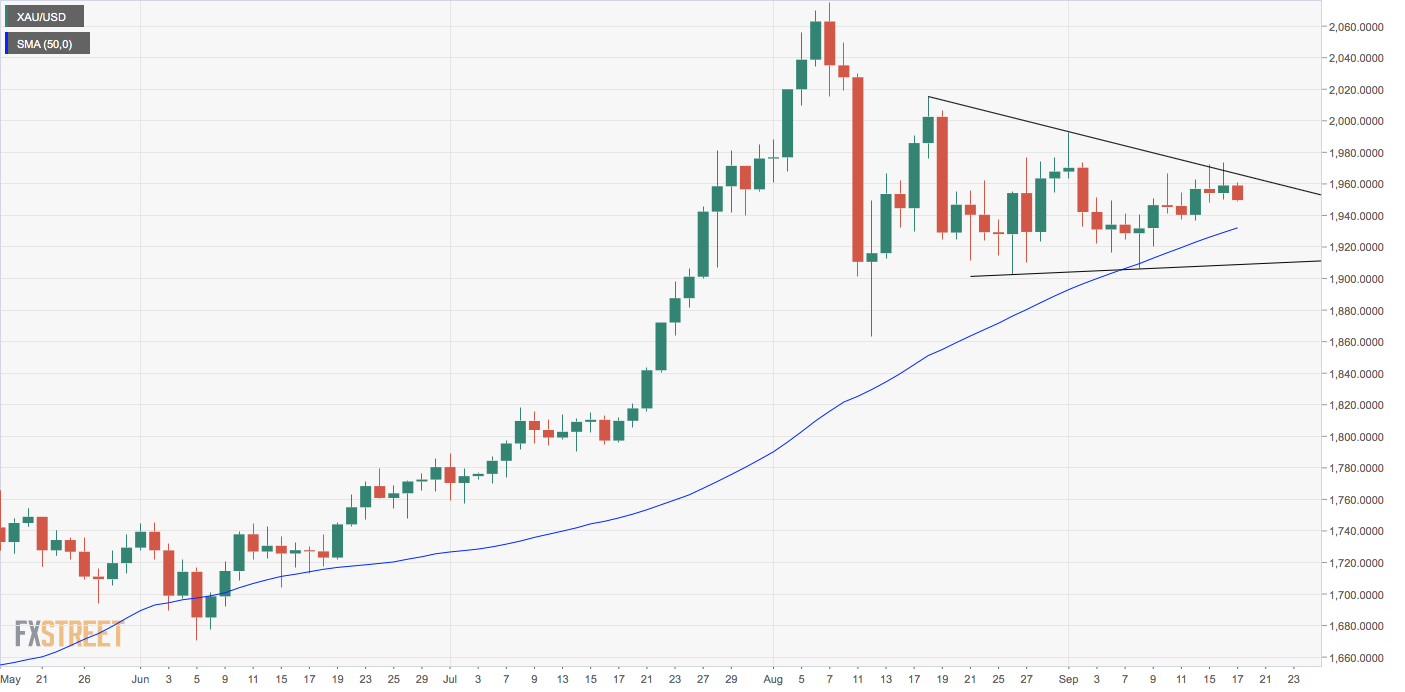
From a technical analysis perspective, gold looks south, having faced rejection at the top end of a one-month-long descending triangle for the second straight day on Wednesday. 

The 50-day simple moving average (SMA) at $1,931 could offer support, which, if breached, would expose the lower end of the descending triangle, currently at $1,909. 

Alternatively, a daily close above Wednesday's high of $1,973 would revive the broader uptrend and open doors for a break above $2,000. 

Daily chart
Trend: Neutral-to-bearish

Technical levels

XAU/USD

Overview
Today last price1950
Today Daily Change-3.72
Today Daily Change %-0.50
Today daily open1959
 
Trends
Daily SMA201945.01
Daily SMA501929.24
Daily SMA1001831.41
Daily SMA2001709.96
 
Levels
Previous Daily High1973.64
Previous Daily Low1949.93
Previous Weekly High1966.54
Previous Weekly Low1906.62
Previous Monthly High2075.32
Previous Monthly Low1863.24
Daily Fibonacci 38.2%1964.58
Daily Fibonacci 61.8%1958.99
Daily Pivot Point S11948.07
Daily Pivot Point S21937.15
Daily Pivot Point S31924.36
Daily Pivot Point R11971.78
Daily Pivot Point R21984.57
Daily Pivot Point R31995.49

Author

Omkar Godbole

Omkar Godbole

FXStreet Contributor

Omkar Godbole, editor and analyst, joined FXStreet after four years as a research analyst at several Indian brokerage companies.


More from Omkar Godbole
Share:

Editor's Picks

British Pound eases to 1.3450 area following downwardly revised Manufacturing PMI data

The British Pound is trimming previous gains against the US Dollar on Monday, returning to the mid-range of the 1.3400s down from fresh seven-week highs, above 1.3500 earlier on the day. Weaker-than-expected UK manufacturing data added pressure on the Pound, which rallied at the Asian session opening, amid news of a halt to the hostilities in Iran.

EUR/USD remains under pressure; looks at 1.1500 on firm US ISM

EUR/USD now accelerates its downtrend and trades in the low 1.1500s on the back of the marginal improvement in the US Dollar, all in the wake of solid US ISM Manufacturing data on Wednesday. The Greenback, in the meantime, remains far from a sustainable rebound in the current context of cooling geopolitical tensions.

Gold remains supported near $4,000

Gold adds to Friday’s pullback, although it remains well underpinned by the key $4,000 threshold per troy ounce on Monday. The US Dollar’s inconclusive price action seems enough to cap the yellow metal’s potential upside, although renewed hopes for a US-Iran peace deal and fading expectations of a Fed rate hike could limit the Greenback’s recovery.

Week ahead: US payrolls report and AI earnings to keep investors on edge

After the Fed decision, NFP report awaited for more rate hike clues. Employment also on the agenda in Canada and New Zealand. Chinese trade and Japanese wage data to be watched too. But Iran and AI headlines to remain in driver’s seat for risk sentiment.

The Bitcoin futures yield collapse: Once over 20%, now less than Treasury notes
Once a goldmine for carry traders, Bitcoin futures have flipped, consistently underperforming plain‑vanilla U.S. Treasuries every month since February. Carry trades consistently yielded 20% or more across regulated and unregulated crypto exchanges during the 2021 bull market. The strategy involved shorting Bitcoin futures while simultaneously buying a spot exchange-traded fund (ETF).
9-3: Is the Federal Reserve’s vote tally Warsh's new forward guidance?
The rate did not move. Neither did the statement, and that’s the more interesting fact. Set the July 29 Federal Open Market Committee (FOMC) statement beside the one issued on June 17, and the two documents are identical apart from a single verb and a paragraph at the bottom naming three dissenters.