|

Gold Price Analysis: XAU/USD clings to 200-HMA inside one-week-old triangle

  • Gold eases inside a choppy range around the key moving average.
  • Normal RSI conditions also tame directional moves between $1,725-38.
  • 61.8% Fibonacci retracement, monthly high act as extra filters beyond the triangle.

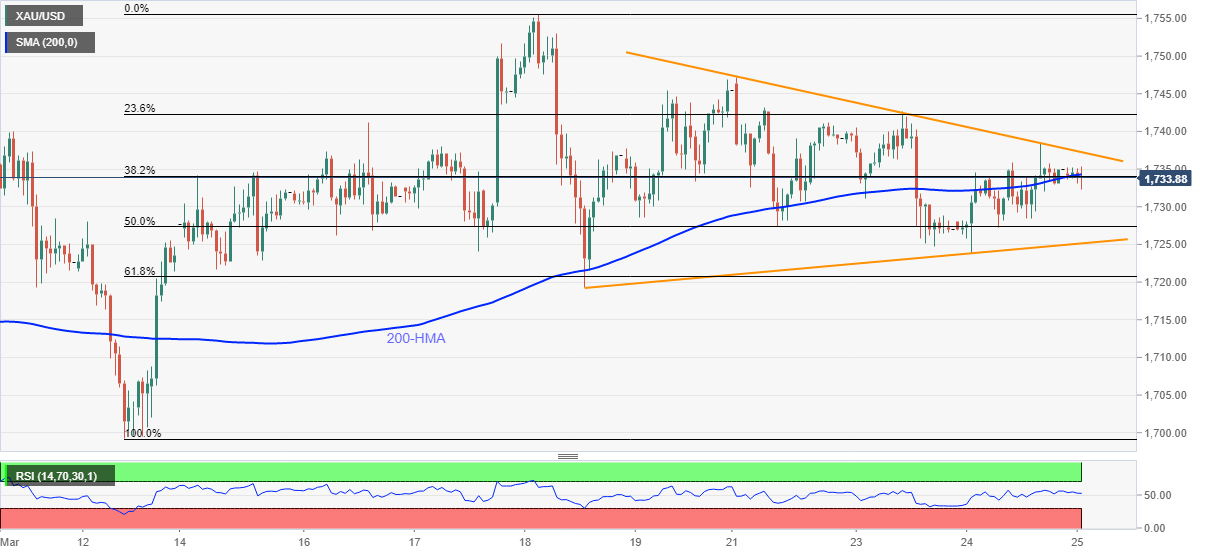
Gold prices refrain from breaking the less than $5 intraday range, bouncing off lows to around $1,735 by the press time of early Thursday. In doing so the yellow metal stays bear near 200-HMA while funneling down the one-week-old symmetrical triangle.

Not only the triangle formation and rigid moves inside the key moving average, but RSI conditions also challenge the momentum traders.

Hence, the bullion moves are likely to pick-up pace only if breaking the $1,725 support or $1,738 resistance. Also acting as additional challenges to the precious metal traders are the 61.8% Fibonacci retracement of March 12-18 upside and the monthly peak, respectively around $1,720 and $1,755.

It should, however, be noted that the commodity’s failures to keep the early March recovery moves and the US dollar strength suggest brighter days for the bears.

Overall, gold prices are stuck in a small range and need a decisive push for clear direction.

Gold hourly chart
Trend: Sideways

additional important levels

Overview
Today last price1734.48
Today Daily Change-0.48
Today Daily Change %-0.03%
Today daily open1734.96
 
Trends
Daily SMA201726.26
Daily SMA501787.01
Daily SMA1001826.41
Daily SMA2001860.65
 
Levels
Previous Daily High1738.48
Previous Daily Low1723.86
Previous Weekly High1755.59
Previous Weekly Low1719.3
Previous Monthly High1871.9
Previous Monthly Low1717.24
Daily Fibonacci 38.2%1732.9
Daily Fibonacci 61.8%1729.44
Daily Pivot Point S11726.39
Daily Pivot Point S21717.81
Daily Pivot Point S31711.77
Daily Pivot Point R11741.01
Daily Pivot Point R21747.05
Daily Pivot Point R31755.63

Author

Anil Panchal

Anil Panchal

FXStreet

Anil Panchal has nearly 15 years of experience in tracking financial markets. With a keen interest in macroeconomics, Anil aptly tracks global news/updates and stays well-informed about the global financial moves and their implications.


More from Anil Panchal
Share:

Editor's Picks

160.80: Japanese Yen remains close to nearly two-year lows

USD/JPY inches lower after four days of gains, trading around 160.60 during the Asian hours. The USD/JPY pair surged to 160.80 the previous day, marking its highest level since July 2024 and significantly heightening speculation that Japanese authorities could soon intervene to support the struggling Yen.

AUD/USD eyes 0.7050 on weaker USD; 100-day SMA holds the key for bulls

The AUD/USD pair regains positive traction during the Asian session, reversing part of the previous day's slide to sub-0.7000 levels, or the weekly low. Spot prices currently trade around the 0.7040 region, up nearly 0.40% for the day, amid a broadly weaker US Dollar.

Gold stays firm near $4,300 as Iran peace deal offsets hawkish Fed

Gold clings to its modest intraday gains in the European session on Thursday and hangs close to the $4,300 mark amid a broadly weaker US Dollar (USD). The optimism over a US-Iran peace deal prompts USD profit-taking and supports the bullion. The Fed’s hawkish tilt could limit USD losses, capping the commodity.


Bitcoin slips below $64,000 as hawkish Fed stance weighs on risk appetite

Bitcoin remains under pressure, extending its correction, trading below $64,000. The US Federal Reserve left interest rates unchanged but struck a hawkish tone on Wednesday, dampening the risk sentiment.

Bank Indonesia increases rates by 25 basis points in June: Will it defend the Rupiah?

Bank Indonesia decided to hike the benchmark interest rate by 25 basis points to 5.75% on June 18, from the previous 5.5%. The decision aligned with the market expectations. The Indonesian Rupiah receives support against the US Dollar as an immediate reaction to the BI interest rate decision. The USD/IDR is trading around 17,820.

Why a hawkish RBA is no longer enough to lift the Australian Dollar

The Reserve Bank of Australia delivered more than what markets expected: a hawkish hold that should have supported the Aussie. But markets widely ignored it, focusing instead on slowing economic growth and proving that central bank messaging alone isn’t always enough to drive currencies.