Gold price continues losing ground as rising US bond yields offset geopolitical tensions
- Gold price attracts some intraday sellers following an intraday uptick to over a one-week high.
- Rebounding US bond yields revive the USD demand and exert some pressure on the XAU/USD.
- Geopolitical tensions could limit losses for the safe-haven precious metal ahead of Fed speaks.

Gold price (XAU/USD) extends its intraday pullback from the $2,642 area, or a one-and-half-week high touched earlier this Wednesday and drops to a fresh daily low during the first half of the European session. The US Dollar (USD) attracts some dip-buyers on the back of a goodish pickup in the US Treasury bond yields, bolstered by expectations of a less aggressive policy easing by the Federal Reserve (Fed). This, in turn, is seen as a key factor driving flows away from the non-yielding yellow metal.
Adding to this, a positive risk tone further undermines demand for the safe-haven Gold price, which, for now, seems to have snapped a two-day winning streak and stalled its recovery from a two-month low touched last week. That said, the worsening Russia-Ukraine conflict might continue to offer some support to the safe-haven precious metal and limit deeper losses. Traders might also opt to wait for speeches from influential FOMC members for cues about the future rate-cut path and before placing fresh directional bets.
Gold price is pressured by rising US bond yields, USD strength, positive risk tone
- Investors remain concerned about the risk of a further escalation of geopolitical tensions between Russia and Ukraine, which lifted the safe-haven Gold price to over a one-week high on Wednesday.
- Russian President Vladimir Putin upped the ante on Tuesday and signed a decree approving its updated nuclear doctrine, which shifts the parameters on when Russia can use nuclear weapons.
- Ukraine acted on the go-ahead from the US to use American-made missiles for strikes within Russia and launched ATACMS missiles to attack a Russian military facility in the Bryansk border region.
- Russian Foreign Minister Sergei Lavrov said the country will do everything possible to avoid a nuclear war. The White House confirmed that the US does not plan to adjust its nuclear posture.
- Markets have been positioning for potential tariffs and tax cuts by the incoming Trump administration, which could lead to higher inflation and fewer interest rate cuts by the Federal Reserve.
- Kansas Fed President Jeffrey Schmid said on Tuesday that large fiscal deficits will not cause inflationary pressures because the central bank will prevent it, though that could mean higher interest rates.
- According to the CME Group's FedWatch Tool, traders are currently pricing in a less than 60% chance for a 25-basis-points rate cut by the Fed at the upcoming monetary policy meeting in December.
- The US Treasury bond yields resume their uptrend following the previous day's sharp slide and assist the US Dollar in stalling its pullback from the year-to-date peak, weighing on the XAU/USD.
- A slew of influential FOMC members are due to speak later today and influence expectations about the Fed's rate-cut path, which should provide a fresh impetus to the non-yielding yellow metal.
Gold price might attract some dip-buyers near the $2,600 pivotal support
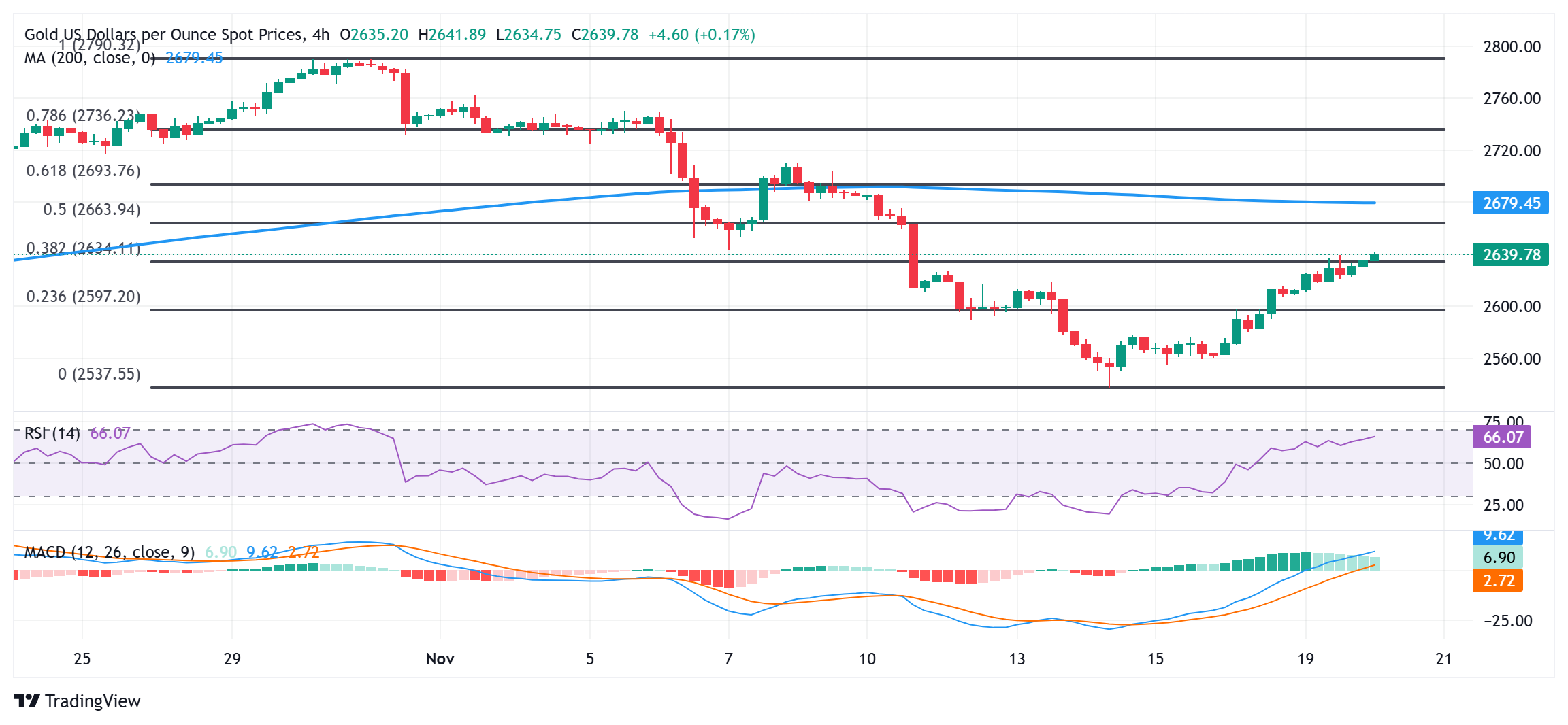
The recovery momentum from a two-month low touched last week lifts the Gold price beyond the 38.2% Fibonacci retracement level of the recent sharp retracement slide from the all-time peak. Adding to this, bullish oscillators on hourly charts support prospects for a further intraday appreciating move towards the $2,658-2,660 region en route to the $2,670-2,672 congestion zone. Some follow-through buying could allow the XAU/USD to aim back towards reclaiming the $2,700 round figure. That said, the lack of follow-through buying warrants caution for bullish traders.
On the flip side, the $2,622-2,620 area now seems to protect the immediate downside ahead of the $2,600 mark. A convincing break below the latter could make the Gold price vulnerable to accelerate the fall to the 100-day Simple Moving Average (SMA), around the $2,555 region, with some intermediate support near the $2,570 zone. This is followed by last week’s swing low, around the $2,537-2,536 area, which if broken decisively will be seen as a fresh trigger for bearish traders and set the stage for deeper losses.
Interest rates FAQs
Interest rates are charged by financial institutions on loans to borrowers and are paid as interest to savers and depositors. They are influenced by base lending rates, which are set by central banks in response to changes in the economy. Central banks normally have a mandate to ensure price stability, which in most cases means targeting a core inflation rate of around 2%. If inflation falls below target the central bank may cut base lending rates, with a view to stimulating lending and boosting the economy. If inflation rises substantially above 2% it normally results in the central bank raising base lending rates in an attempt to lower inflation.
Higher interest rates generally help strengthen a country’s currency as they make it a more attractive place for global investors to park their money.
Higher interest rates overall weigh on the price of Gold because they increase the opportunity cost of holding Gold instead of investing in an interest-bearing asset or placing cash in the bank. If interest rates are high that usually pushes up the price of the US Dollar (USD), and since Gold is priced in Dollars, this has the effect of lowering the price of Gold.
The Fed funds rate is the overnight rate at which US banks lend to each other. It is the oft-quoted headline rate set by the Federal Reserve at its FOMC meetings. It is set as a range, for example 4.75%-5.00%, though the upper limit (in that case 5.00%) is the quoted figure. Market expectations for future Fed funds rate are tracked by the CME FedWatch tool, which shapes how many financial markets behave in anticipation of future Federal Reserve monetary policy decisions.
Author

Haresh Menghani
FXStreet
Haresh Menghani is a detail-oriented professional with 10+ years of extensive experience in analysing the global financial markets.