Gold plunges below $4,000 as traders book profits and US Dollar strengthens
- XAU/USD tumbles 1.50% from record $4,058 as DXY gains.
- Ceasefire optimism between Israel and Hamas fuels profit-taking, while Chinese traders’ return adds volatility.
- Despite correction, extended US shutdown, dovish Fed Minutes keep long-term bull trend intact.

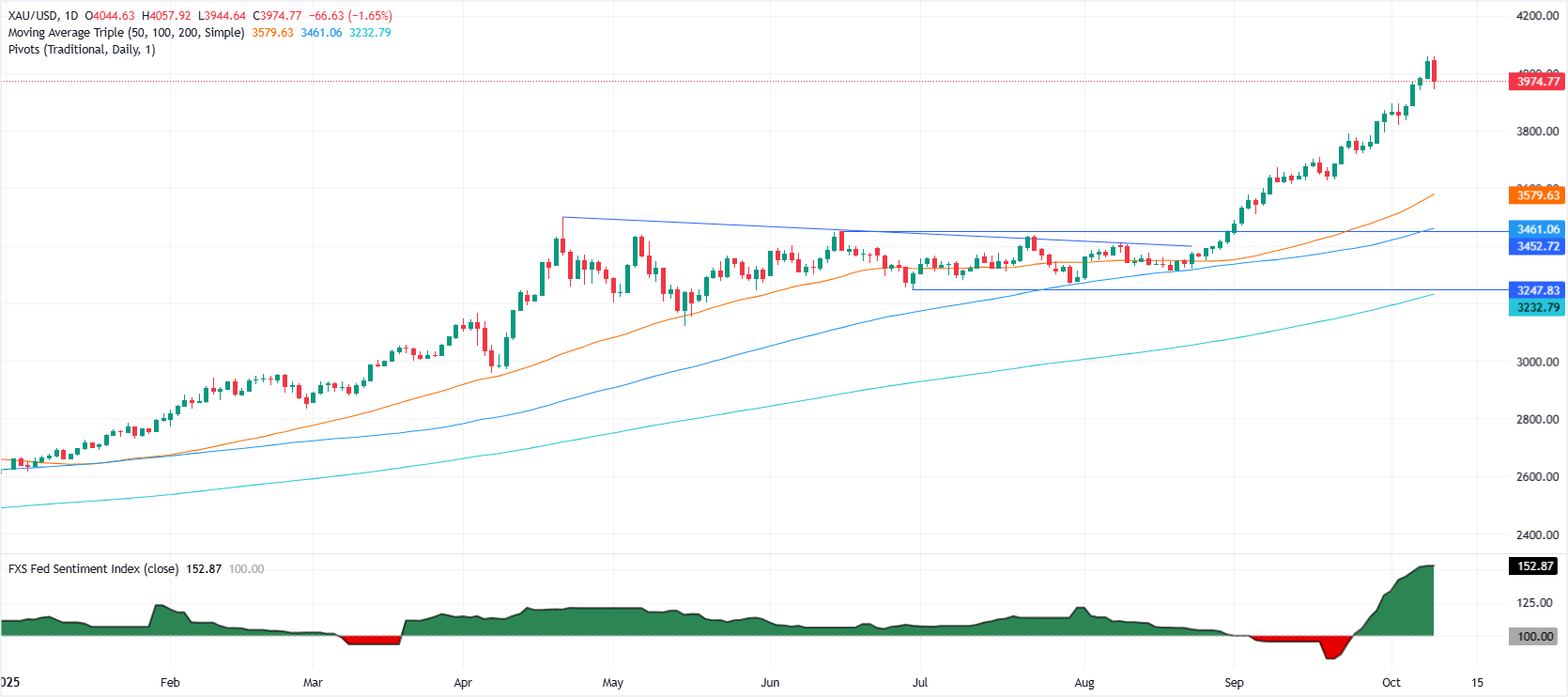
Gold price retreated during the North American session on Thursday after hitting a record high of $4,058, plunges below $4,000 as the Greenback posts solid gains.. XAU/USD trades at $3,978, down 1.5%.
Safe haven demand eases amid Israel–Hamas ceasefire hopes
The Gold market mood turned negative on Thursday. Bullion prices fell as traders booked profits, sending prices toward a daily low of $3,944 as China’s traders got back from holidays. Upbeat news regarding a permanent ceasefire between Israel and Hamas added to relief sentiment by market players.
Despite this, the ongoing Russia-Ukraine war extends despite efforts by the White House.
Nevertheless, Gold is set to continue rallying as the US government shutdown extended to its ninth day, while the latest Minutes by the Federal Reserve (Fed) showed that policymakers agreed to support a weakening labor market.
Fed Governor Michael Barr said that he does not think that there is a generalized spillover of tariffs onto services inflation. He added that uncertainty about inflation and the jobs market warrants a cautious approach to additional rate cuts.
Echoing his comments was the Minneapolis Fed's Neel Kashkari, who said that he “basically agrees” with everything that Barr said.
Daily digest market movers: Gold slumps amid rising US Treasury yields
- Bullion is pressured as the US Dollar strengthens sharply across the board. The US Dollar Index (DXY), which tracks the performance of the buck’s value against a basket of six currencies, is up 0.62% at 99.42.
- US Treasury yields rise as the 10-year Treasury note is up two basis points at 4.148%. US real yields — which correlate inversely to Gold prices — also climbed to 1.798%.
- Further comments by Fed Governor Michael Bar revealed that the current monetary policy is appropriate and rates are modestly restrictive. He sees the Fed’s inflation goal facing significant risks, adding that two more years would be a long time for consumers to wait for inflation to hit 2%. Regarding economic growth, he added that the economy remains resilient, with strong consumer spending suggesting that US Gross Domestic Product (GDP) remained strong in Q3 2025.
- Goldman Sachs revised its 2026 forecast for Gold prices from $4,300 to $4,900, citing strong flows into Gold ETFs and central bank demand.
- Money markets indicate that the Fed will cut interest rates by 25 basis points (bps) at the upcoming October 29 meeting. The odds stand at 94%, according to the Prime Market Terminal interest rate probability tool.
Technical outlook: Gold’s advance halted, sinks below $4,000
Gold’s rally remains intact despite the ongoing leg-down that drove XAU/USD below $4,000. Momentum shifted mildly bearish as the Relative Strength Index (RSI) fell from around 86.13 to 75.40, shy of crossing below the 70 overbought level, which usually triggers a sell signal.
If Gold climbs back above $4,000, expect a test of the all-time high of $4,059, followed by $4,100, and $4,150. Conversely, a daily close below $3,950 could open the door for a retracement toward the 20-day Simple Moving Average (SMA) at $3,800.
Gold FAQs
Gold has played a key role in human’s history as it has been widely used as a store of value and medium of exchange. Currently, apart from its shine and usage for jewelry, the precious metal is widely seen as a safe-haven asset, meaning that it is considered a good investment during turbulent times. Gold is also widely seen as a hedge against inflation and against depreciating currencies as it doesn’t rely on any specific issuer or government.
Central banks are the biggest Gold holders. In their aim to support their currencies in turbulent times, central banks tend to diversify their reserves and buy Gold to improve the perceived strength of the economy and the currency. High Gold reserves can be a source of trust for a country’s solvency. Central banks added 1,136 tonnes of Gold worth around $70 billion to their reserves in 2022, according to data from the World Gold Council. This is the highest yearly purchase since records began. Central banks from emerging economies such as China, India and Turkey are quickly increasing their Gold reserves.
Gold has an inverse correlation with the US Dollar and US Treasuries, which are both major reserve and safe-haven assets. When the Dollar depreciates, Gold tends to rise, enabling investors and central banks to diversify their assets in turbulent times. Gold is also inversely correlated with risk assets. A rally in the stock market tends to weaken Gold price, while sell-offs in riskier markets tend to favor the precious metal.
The price can move due to a wide range of factors. Geopolitical instability or fears of a deep recession can quickly make Gold price escalate due to its safe-haven status. As a yield-less asset, Gold tends to rise with lower interest rates, while higher cost of money usually weighs down on the yellow metal. Still, most moves depend on how the US Dollar (USD) behaves as the asset is priced in dollars (XAU/USD). A strong Dollar tends to keep the price of Gold controlled, whereas a weaker Dollar is likely to push Gold prices up.
Author

Christian Borjon Valencia
FXStreet
Markets analyst, news editor, and trading instructor with over 14 years of experience across FX, commodities, US equity indices, and global macro markets.