Gold tanks as China deal and Mideast diplomacy spark market euphoria
- XAU/USD falls over 1.5% as safe-haven demand wanes on global trade and geopolitical easing.
- US-China trade deal signed; more agreements expected before July 9, boosting sentiment.
- Iran signals diplomacy; Israel–Gaza war may end in two weeks, says Al Arabiya.
- Core PCE rose above forecasts; Fed’s Kashkari still expects two rate cuts in 2025.

Gold price tumbled over 1.50% on Friday amid an improvement in risk appetite, driven by several factors. The de-escalation of the Israel–Iran conflict, the trade agreement with China, and ongoing negotiations between the United States (US) and its peers to reach commercial deals were welcomed by investors, who had previously sought refuge in Bullion’s safe-haven demand.
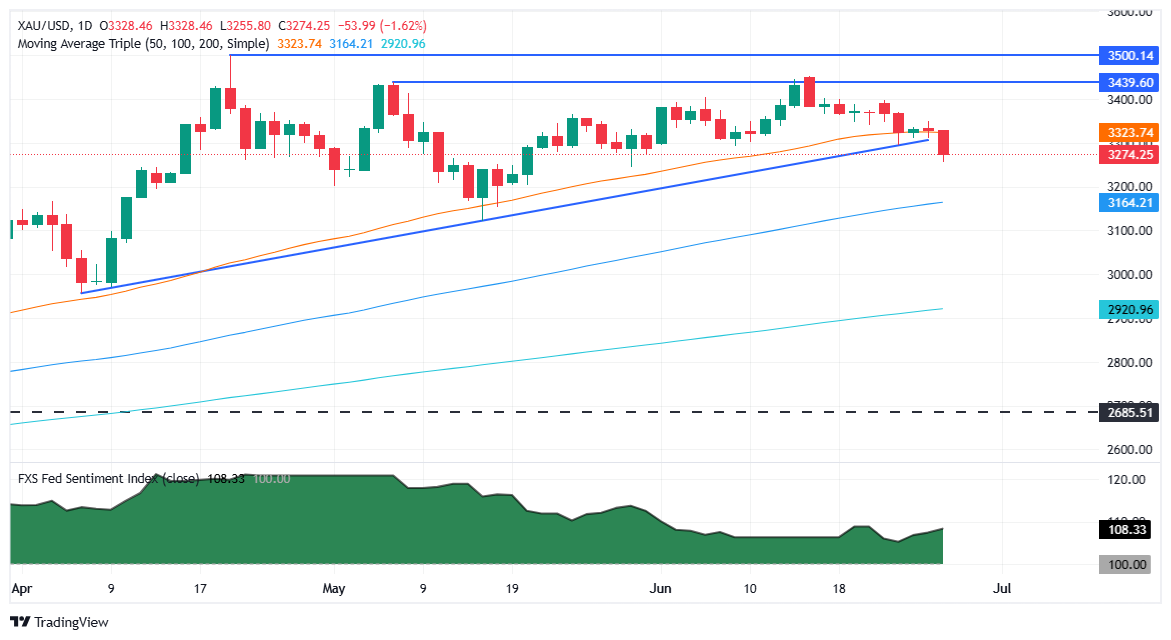
The XAU/USD trades at $3,274 after hitting a daily high of $3,328. On Thursday, the White House announced that the US and China have formally signed a trade agreement, effectively ending the ongoing “trade war.” US Commerce Secretary, Howard Lutnick, said that additional deals are looming as the July 9 deadline approaches.
Regarding geopolitics, Iran has shown signs of flexibility, leaning toward diplomacy, as its representative in the UN said that Tehran is open to forming a regional nuclear consortium in the event of an agreement with Washington.
Adding to the upbeat mood is the possibility of the end of the Israel–Gaza war within two weeks, revealed Al Arabiya.
In the US, the Federal Reserve's (Fed) preferred inflation gauge, the core Personal Consumption Expenditures (PCE) Price Index, came in line with estimates in May but failed to show any progress toward disinflation.
Earlier, the Minneapolis Fed's Neel Kashkari commented that he still sees two rate cuts in 2025.
Daily digest market movers: Gold price set for correction amid steady US Dollar and US yields
- Gold price is losing its luster due to market participants becoming increasingly optimistic about the global economy. News of the trade deal with China, as well as those with other countries, including South Korea, Vietnam and the EU, was welcomed by investors.
- Howard Lutnick, the US Commerce Secretary, added that China is “going to deliver rare earths to us,” and once they do that, “we’ll take down our countermeasures,” Lutnick told Bloomberg News in an interview.
- Core PCE in May rose by 2.7% YoY, a tenth above estimates and April’s data. Headline inflation for the same period increased by 2.3% YoY as expected.
- The University of Michigan (UoM) revealed that Consumer Sentiment in June improved moderately. The Index rose from 60.5 to 60.7, while inflation expectations were downwardly revised, with households expecting prices to rise from 5.1% to 5% over the next year. For the next five years, inflation is projected to be around 4%, down from 4.1%.
- The US 10-year Treasury note is flat, yielding 4.242%. The US Dollar Index (DXY), which tracks the performance of the buck’s value against a basket of six peers, is virtually unchanged at 97.28.
- Minneapolis Fed President Neel Kashkari said an inflation boost is likely coming, but actual inflation indicates renewed progress toward the 2% target. More time is needed to determine whether the effects of the trade war are delayed or if they will be smaller than initially thought.
- Money markets suggest that traders are pricing in 63.5 basis points of easing toward the end of the year, according to Prime Market Terminal data.
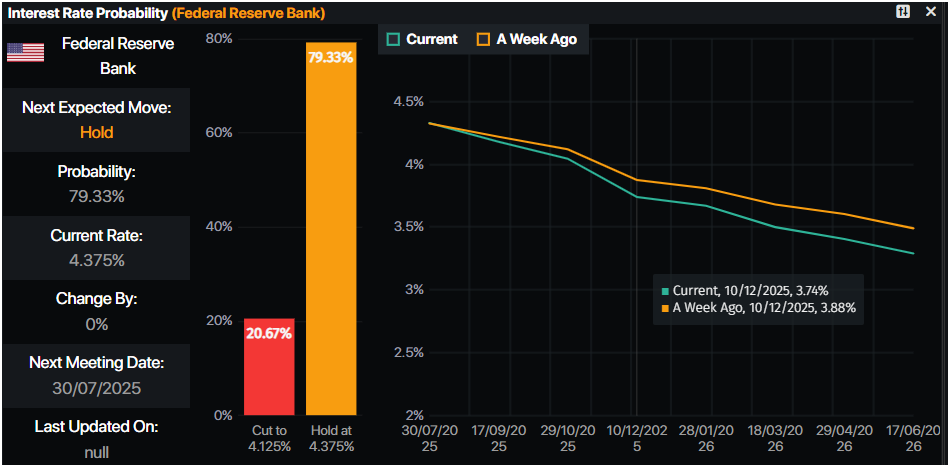
Source: Prime Market Terminal
XAU/USD technical outlook: Gold price set for a pullback to $3,200
Gold price uptrend remains in place, but in the short term, it could drop further after breaking below the 50-day Simple Moving Average (SMA) at $3,323. The Relative Strength Index (RSI) indicates that momentum has turned bearish despite the price action achieving higher highs and higher lows.
For a bullish continuation, XAU/USD must climb past $3,300. The following key resistance would be the 50-day SMA at $3,323, followed by the June 26 peak of $3,350. If surpassed, up next is $3,400. On the flip side, if XAU/USD tumbles below $3,300, the May 29 low of $3,245 and $3,200 are up for grabs.
Risk sentiment FAQs
In the world of financial jargon the two widely used terms “risk-on” and “risk off'' refer to the level of risk that investors are willing to stomach during the period referenced. In a “risk-on” market, investors are optimistic about the future and more willing to buy risky assets. In a “risk-off” market investors start to ‘play it safe’ because they are worried about the future, and therefore buy less risky assets that are more certain of bringing a return, even if it is relatively modest.
Typically, during periods of “risk-on”, stock markets will rise, most commodities – except Gold – will also gain in value, since they benefit from a positive growth outlook. The currencies of nations that are heavy commodity exporters strengthen because of increased demand, and Cryptocurrencies rise. In a “risk-off” market, Bonds go up – especially major government Bonds – Gold shines, and safe-haven currencies such as the Japanese Yen, Swiss Franc and US Dollar all benefit.
The Australian Dollar (AUD), the Canadian Dollar (CAD), the New Zealand Dollar (NZD) and minor FX like the Ruble (RUB) and the South African Rand (ZAR), all tend to rise in markets that are “risk-on”. This is because the economies of these currencies are heavily reliant on commodity exports for growth, and commodities tend to rise in price during risk-on periods. This is because investors foresee greater demand for raw materials in the future due to heightened economic activity.
The major currencies that tend to rise during periods of “risk-off” are the US Dollar (USD), the Japanese Yen (JPY) and the Swiss Franc (CHF). The US Dollar, because it is the world’s reserve currency, and because in times of crisis investors buy US government debt, which is seen as safe because the largest economy in the world is unlikely to default. The Yen, from increased demand for Japanese government bonds, because a high proportion are held by domestic investors who are unlikely to dump them – even in a crisis. The Swiss Franc, because strict Swiss banking laws offer investors enhanced capital protection.
Author

Christian Borjon Valencia
FXStreet
Markets analyst, news editor, and trading instructor with over 14 years of experience across FX, commodities, US equity indices, and global macro markets.