Gold pares gains as strong US data offsets Fed cut narrative
- Gold pressured by profit-taking as US Initial Jobless Claims and GDP surprise on the upside.
- Durable Goods Orders beat forecasts, reinforcing the resilience of the US economy.
- Fed officials Miran and Bowman lean dovish, while Schmid and Goolsbee warn inflation risks remain elevated.

Gold price trimmed earlier gains after reaching a daily high of $3,761 on Thursday, following the release of a US jobs report that showed signs of strength, contrary to the main reason for cutting rates last week. Also, traders are eyeing the release of inflation data on Friday. The XAU/USD pair trades at $3,733, down 0.05% at the time of writing.
US Initial Jobless Claims for the week ending September 20 dipped below estimates, with Continuing Claims following suit, showing an improvement in the labor force. Other data revealed the economy is strong as Gross Domestic Product (GDP) for Q2 of 2025 improved to 3.8% in its final release.
Durable Goods Orders also exceeded estimates and the previous print. All in all, traders booked profits, as shown by Bullion price action, which is still above the $3,700 figure.
Officials of the Federal Reserve (Fed) continued to cross the wires. Fed Governors Stephen Miran and Michelle Bowman remain on the dovish side as some of their comments suggest that they advocate for further cuts as the labor market is “more fragile.” Conversely, Kansas City Fed Jeffrey Schmid and Chicago Fed Austan Goolsbee were hawkish. Schmid stated that policy is “slightly restrictive,” which is the right place to be, while Goolsbee said what’s most worrying is the risk that inflation could rise persistently.
Traders’ eyes shift towards Friday’s economic docket. The Fed preferred inflation gauge, the Core Personal Consumption Expenditures (PCE) Price Index, is awaited, along with Consumer Sentiment by the University of Michigan (UoM) and Fed speeches.
Daily digest market movers: Gold holds firm as US yields jump
- Bullion prices drop slightly as the Greenback recovered, as shown by the US Dollar Index (DXY). DXY, which tracks the buck’s value against a basket of six currencies, is up 0.72% at 98.55.
- US Treasury yields are climbing, with the 10-year Treasury note up by three and a half bps at 4.187%. US real yields—calculated by subtracting inflation expectations from the nominal yield—, which correlate inversely to Gold prices, surge nearly four bps to 1.803%.
- US Initial Jobless Claims for the week ending September 20 dipped below estimates of 235K, coming at 218K, down from the previous week 232K print. Continuing Jobless Claims dipped from 1.928 million to 1.926 million.
- US GDP for the second quarter of 2025 grew 3.8% YoY, well above expectations and the second estimate of 3.3%, the fastest pace in two years, according to the US Bureau of Economic Analysis (BEA).
- Durable Goods Orders in August improved sharply by 2.9%, crushing July’s -2.7% contraction and surpassing estimates of -0.5%.
- After the data, expectations that the Federal Reserve will cut rates by 25 bps at the October 19 meeting decreased from 94% a day ago, to 85% as revealed by data from Prime Market Terminal.
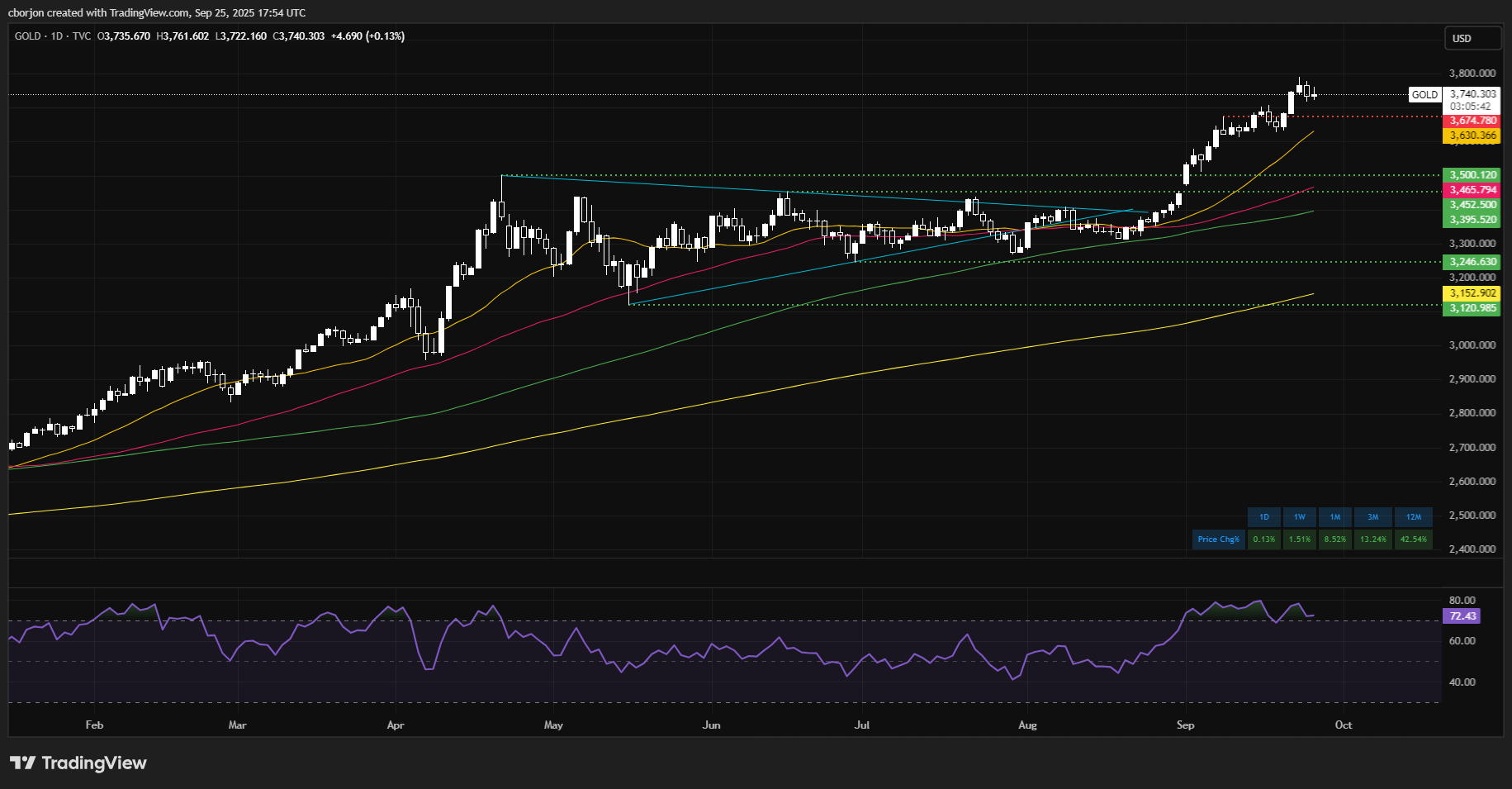
Technical outlook: Gold price stays below $3,750, bears eye $3,700
Despite retreating, Gold price remains bullish in the long term, but daily, a reversal is underway, threatening to keep prices below $3,750 towards the end of the week. A daily close below the latter would clear the path for sellers to test $3,700 in the near term, followed by $3,650.
On the upside, if XAU/USD surpasses $3,750, the next stop would be the all-time high at $3,791.
Gold FAQs
Gold has played a key role in human’s history as it has been widely used as a store of value and medium of exchange. Currently, apart from its shine and usage for jewelry, the precious metal is widely seen as a safe-haven asset, meaning that it is considered a good investment during turbulent times. Gold is also widely seen as a hedge against inflation and against depreciating currencies as it doesn’t rely on any specific issuer or government.
Central banks are the biggest Gold holders. In their aim to support their currencies in turbulent times, central banks tend to diversify their reserves and buy Gold to improve the perceived strength of the economy and the currency. High Gold reserves can be a source of trust for a country’s solvency. Central banks added 1,136 tonnes of Gold worth around $70 billion to their reserves in 2022, according to data from the World Gold Council. This is the highest yearly purchase since records began. Central banks from emerging economies such as China, India and Turkey are quickly increasing their Gold reserves.
Gold has an inverse correlation with the US Dollar and US Treasuries, which are both major reserve and safe-haven assets. When the Dollar depreciates, Gold tends to rise, enabling investors and central banks to diversify their assets in turbulent times. Gold is also inversely correlated with risk assets. A rally in the stock market tends to weaken Gold price, while sell-offs in riskier markets tend to favor the precious metal.
The price can move due to a wide range of factors. Geopolitical instability or fears of a deep recession can quickly make Gold price escalate due to its safe-haven status. As a yield-less asset, Gold tends to rise with lower interest rates, while higher cost of money usually weighs down on the yellow metal. Still, most moves depend on how the US Dollar (USD) behaves as the asset is priced in dollars (XAU/USD). A strong Dollar tends to keep the price of Gold controlled, whereas a weaker Dollar is likely to push Gold prices up.
Author

Christian Borjon Valencia
FXStreet
Markets analyst, news editor, and trading instructor with over 14 years of experience across FX, commodities, US equity indices, and global macro markets.
















