Gold nears $4,000 as shutdown fears, interest rate cuts ignite rally
- Gold surges due to prolonged US government shutdown and dovish Fed outlook boosting safe haven appeal.
- Fed officials stay cautious — Miran sees slower growth, while Kashkari warns tariff inflation risks remain unclear.
- Goldman Sachs lifts 2026 Gold target to $4,900, citing strong ETF inflows and continued PBoC reserve accumulation.

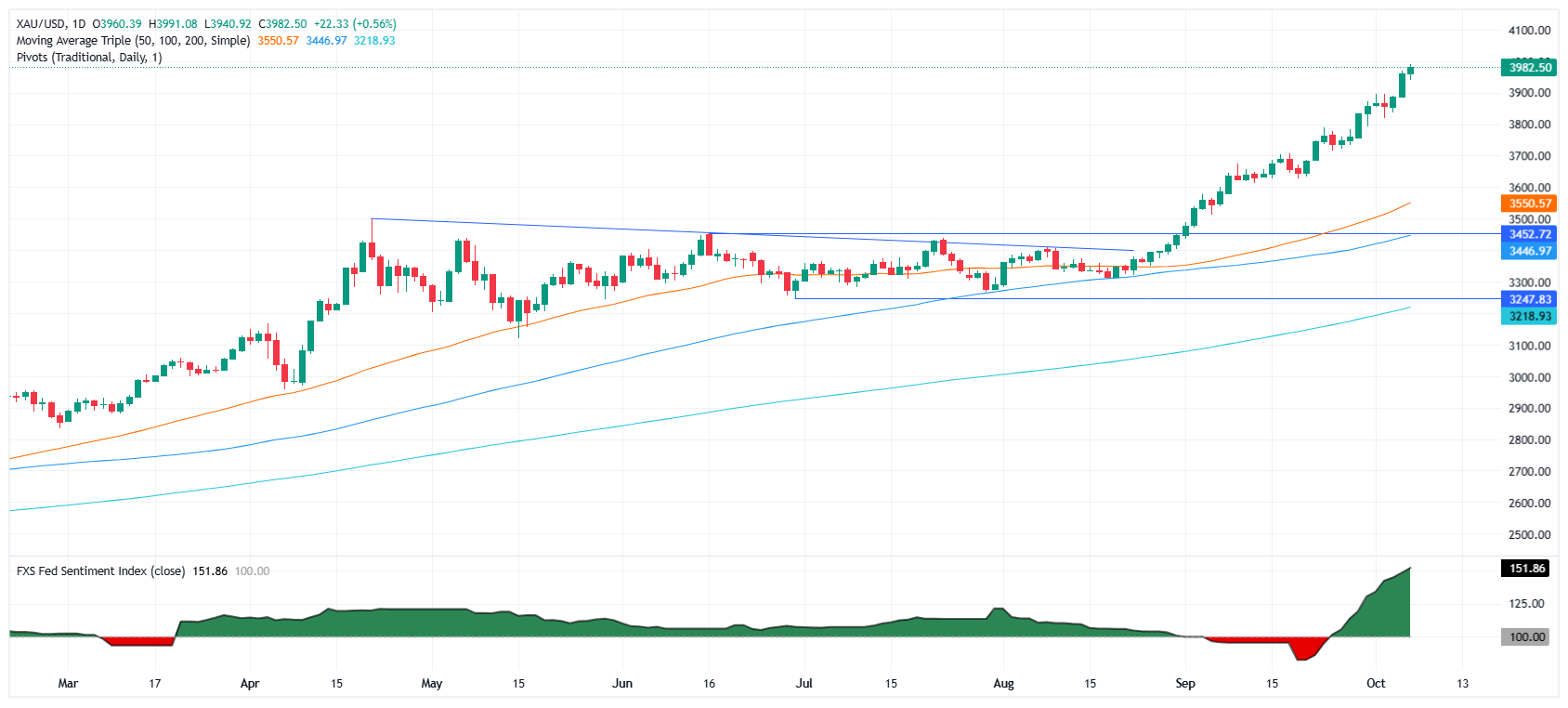
Gold price rallied during the North American session and reached a record high of $3,991, before settling closer to $3,982 for a 0.60% gain. Uncertainty about the US government shutdown and expectations of lower interest rates the Federal Reserve (Fed) keep the yellow metal bid.
Bullion hits fresh record highs on US fiscal gridlock, geopolitical uncertainty and central bank demand
The New York Fed revealed the Survey of Consumer Expectations (SCE) showed that inflation expectations ticked higher, while the labor market continued to deteriorate.
Aside from this, Fed officials crossed the wires. The Minneapolis Fed's Neel Kashkari was moderately hawkish, saying that it is too soon to know if inflation will be sticky from tariffs. Earlier, Fed Governor Stephen Miran noted that growth in the first half of this year was slower than expected and that policy should be forward looking, given the lags of policy impact.
Alongside the reasons mentioned above, Bullion is also underpinned by the Russia-Ukraine war and political uncertainty in France and Japan.
Goldman Sachs revised their 2026 forecast for Gold prices from $4,300 to $4,900, citing strong flows into Gold ETFs and central bank demand. The People’s Bank of China (PBoC) added Bullion to its reserves in September for the eleventh straight month.
Daily digest market movers: Gold edges up as US yields tumble
- Bullion prices rise in tandem with the US Dollar as the DXY, which tracks the buck’s value against a basket of six currencies, gains 0.46% to 98.57.
- US Treasury yields retreat as the 10-year Treasury note is down three basis points at 4.125%. US real yields — which correlate inversely to Gold prices —, are also down nearly three-and-a-half bps at 1.785%.
- The Minneapolis Fed's Kashkari revealed that data is showing some stagflation signals and that he is bullish on labor. He’s not convinced that a few rate cuts will translate to lower mortgage rates, but if they do drastically, he would expect the economy would a burst of high inflation.
- The New York Fed SCE showed that the median inflation expectations for one year increased from 3.2% to 3.4% and for a five-year period from 2.9% to 3%. For a three-year horizon, it remained steady at 3%.
- The same survey revealed that earnings growth expectations fell by 0.1% to 2.4%.
- Money markets indicate that the Fed will cut interest rates by 25 basis points (bps) at the upcoming October 29 meeting. The odds stand at 94%, according to the Prime Market Terminal interest rate probability tool.
Technical outlook: Gold price surges as bulls target $4,000
Gold price has extended its uptrend and seems poised to test the $4,000 mark in the near term. So far, the record high is $3,991. The Relative Strength Index (RSI) remains in overbought territory, but its slope remains tilted to the upside.
XAU/USD's next key resistance would be the all-time high of $3,991, followed by $4,000. On the flip side, Gold's first support would be $3,900, followed by the $3,850 level, ahead of the October 2 low of $3,819 and the $3,800 mark.
Gold FAQs
Gold has played a key role in human’s history as it has been widely used as a store of value and medium of exchange. Currently, apart from its shine and usage for jewelry, the precious metal is widely seen as a safe-haven asset, meaning that it is considered a good investment during turbulent times. Gold is also widely seen as a hedge against inflation and against depreciating currencies as it doesn’t rely on any specific issuer or government.
Central banks are the biggest Gold holders. In their aim to support their currencies in turbulent times, central banks tend to diversify their reserves and buy Gold to improve the perceived strength of the economy and the currency. High Gold reserves can be a source of trust for a country’s solvency. Central banks added 1,136 tonnes of Gold worth around $70 billion to their reserves in 2022, according to data from the World Gold Council. This is the highest yearly purchase since records began. Central banks from emerging economies such as China, India and Turkey are quickly increasing their Gold reserves.
Gold has an inverse correlation with the US Dollar and US Treasuries, which are both major reserve and safe-haven assets. When the Dollar depreciates, Gold tends to rise, enabling investors and central banks to diversify their assets in turbulent times. Gold is also inversely correlated with risk assets. A rally in the stock market tends to weaken Gold price, while sell-offs in riskier markets tend to favor the precious metal.
The price can move due to a wide range of factors. Geopolitical instability or fears of a deep recession can quickly make Gold price escalate due to its safe-haven status. As a yield-less asset, Gold tends to rise with lower interest rates, while higher cost of money usually weighs down on the yellow metal. Still, most moves depend on how the US Dollar (USD) behaves as the asset is priced in dollars (XAU/USD). A strong Dollar tends to keep the price of Gold controlled, whereas a weaker Dollar is likely to push Gold prices up.
Author

Christian Borjon Valencia
FXStreet
Markets analyst, news editor, and trading instructor with over 14 years of experience across FX, commodities, US equity indices, and global macro markets.